(Originally published in The News Herald on Thursday, March 8, 2001, as a "Bay Book" entry; a collection of snippets about the happenings, happenstance and personal experience that lend Bay and nearby counties their special character.)
Dr. "Bones" McCoy, whom you may recall was the crotchety Southern medical officer aboard the starship Enterprise way back in the day, had a fallback defense when asked to perform duties outside his realm of expertise.
"I'm a doctor, not a bricklayer!" he said, for instance, when ordered to repair a wound in the rocky skin of an alien using some kind of space age plaster.
But then, invariably, he did the work anyway.
I thought about Bones Sunday as I struggled with two-by-fours and four-by-fours and two-by-sixes and screws and bolts and a level and a drill and sundry other materials to build a backyard play-fort for my kids using a truckload of lumber and a kit we had purchased.
"I'm a writer, not a carpenter!" I said.
I had moaned something similar the day before when pressed to install an air conditioner through the wall of my son's bedroom; and a few months ago when faced with replacing a hardwired drop-in range with a freestanding one; and a few months before that... . Well, the list goes on for light years.
At the risk of mixing allusions, I also recalled a Bill Cosby standup routine in which he said truly smart men purposely mess up these tasks so that, the next time there's work to be done, their wives will not expect them to do it.
I suspect that's just wishful thinking, as it never quite works for me. Like Bones, all it takes is a look or a word from one of the crew - my kids or my wife - and I roll up my sleeves. And if I mess it up, they just expect me to fix it.
In fact, the only time the "Cosby defense" worked was the time our central air unit was on the fritz. I argued we ought to call a specialist - "I'm a writer, not an electrician!" - but my wife wouldn't hear of it. It's probably just a reset switch, she said.
So I turned off the power (I thought), opened the side of the unit, reached in for the reset switch and blinded myself with a burst of electricity that landed me a few feet back from the box.
McCoy's other famous remark sparkled through my brain:
"He's dead, Jim."
But that was just wishful thinking.
Showing posts with label Star Trek. Show all posts
Showing posts with label Star Trek. Show all posts
Friday, March 04, 2016


Friday, February 27, 2015
In Memoriam: Leonard Nimoy

Like so many others today, I am saddened by the
passing of Leonard Nimoy, the actor best known for his portrayal of Spock in
the classic television series Star Trek.
A friend of mine (who is the age of my son) asked
which original series episodes would be best for Spock-watching this weekend,
and I told him that just about any episode that was good for Spock was good for
the whole series. However, these are the ones that immediately came to mind:

• In a Season 1 episode, The Naked Time, Spock is infected by the same germ that has
affected the rest of the crew and begins to lose his inhibitions, releasing the
emotions he has pent up throughout his life. He breaks down and cries,
confessing to Kirk how he never even told his mother (a human woman living on a
world where emotions were considered “bad taste”) how much he loved her — our
first real glimpse behind his Vulcan facade.

• Later in the season, Galileo Seven gives us a “lifeboat episode,” with a small number of
crew under Spock’s command trying to repair their crashed shuttle while under
attack from giants on an uncharted, inhospitable planet. The crew soon turns on
Spock, whose lack of emotional reaction to the stresses makes him a target of
their fear and anger. However, it is Spock’s “hail Mary” at the end that saves
them all.

• Another outstanding first-season episode, This Side of Paradise, again allows Spock
a chance to lose his self-control, this time under the influence of alien
spores. The hour gives Nimoy a chance to embrace his most naturalistic acting
of the entire series as we see the first officer experiencing true bliss and
true love, finally able to express himself freely. He then puts the mask back
on, his “self-imposed purgatory” as he calls it, to help Kirk save his ship and
crew.

• Amok Time
kicked off the second year with Spock going into his mating season, which
required him to return home or die trying. His visible struggle to maintain
dignity, his sadness when he believes he has killed his captain, and the
brilliant smile that escapes from under his mask when the truth is revealed — these
are truly great moments by Nimoy that made Spock so much more real to fans.
Other good Spock moments can be found in Journey to Babel, which introduces Spock’s
mother and father; The Devil in the Dark,
in which Spock mind-melds with a dangerous blob creature and experiences its
physical and emotional pain; The City on
the Edge of Forever, in which Spock is tasked with building a computer
using “stone knives and bearskins” while Kirk falls into a doomed love; Mirror, Mirror, which shows us that even
the Spock of a parallel “evil” timeline is subject to the demands of logic; Specter of the Gun, which finds Spock
melding with the crew to save them from death in a manufactured OK Corral
scenario; and All Our Yesterdays,
which has Spock cast back in time on a frozen world and falling in love with
Mariette Hartley, who is wearing little more than a stone knife and bearskins.
 |
| "I Reach." |
I even have fondness for the two most-ridiculed
episodes of the series because of their very fine Nimoy moments, which have to
be seen to be believed. The Enterprise intercepts a bevy of space-hippies in The Way to Eden, and we learn how Spock “reaches”;
he is not Herbert. And the Season 3 premiere, Spock’s Brain, which finds Kirk and Co. tracking Spock’s stolen
brain across the galaxy with a remote-controlled Spock body along for the ride.
Nimoy, of course, was much more than Spock. To fans
of his work, he was a photographer, poet, playwright, author, producer,
director — and even singer. (Look up The
Ballad of Bilbo Baggins for a lark.) He was a social philosopher, truly
embracing the concepts of Infinite Diversity in Infinite Combinations that
surfaced on Star Trek.
And as such, he was, and always shall be, our
friend.
Thursday, April 24, 2014
Man of many roles returns
 |
| Tim as a Cylon, circa 1978 |
He lettered in football, basketball and baseball. But
while at the University of F lGainesville .
Over the next several years, he completed his studies, did a two-year Army
stint in Vietnam , worked a
variety of jobs — and chased his dream of being in movies and TV shows by
moving to Hollywood .
In 1976, he got his start as an extra in “Two Minute Warning.”
His IMDB.com listing doesn’t tell the whole story of
his experiences (many of which, due to the names involved and the activities
they got up to, you’ll have to ask him about yourself). But the highlights are
there: acting and/or stunts on two “Captain America ”
telefilms in 1979, “Hart to Hart,” “WKRP in Cincinnati ,” “The Love Boat,” “Bob Newhart” and
many more. He was in the finale of “Cheers,” and regularly played a Cylon on
the 1978-79 “Battle starGa lactica,” an MP on “Baa
Baa Blacksheep,” and a SWAT team member on “Hill St
“It’s been fun,” he said. “It’s anybody’s dream:
today, you’re a Cylon, tomorrow you’re a cowboy, next week a gangster in 1935.
As kids, we played all these kinds of things. Now you can be something
different every day.”
On the big screen, Tim appeared as one of Ricardo Mo ntMont alban,
in his early 60s when the movie was made, was all muscle.
“He worked out and worked out,” Tim said. Pointing
at a photo of him and Mont alban
in their movie costumes, he added, “That was all him. He was one solid guy.”
Culbertson also worked on “An Eye for an Eye,” “To
Live and Die in L.A. ,”
“The Man Who Loved Women,” “Cheech and Chong's Next Movie” and “Cannery Row.”
He was a Roman soldier in “History of the World Part 1” and claims Madeline Khan
was pointing at him when she hit her high note (“Yesss!”) while choosing
escorts.
“I’ve become friends with a variety of people with big
names over the years,” he said, mentioning Henry Winkler and Tom Hanks as two
of the “nicest, most genuine guys in the world.” He also praised Cindy Williams
and James Garner, but he was careful not to resort to name-dropping. He had
photos with nearly every one of these people while on sets.
As a background actor, much of his work went
uncredited, but you’ll recognize his face from role to role — at least,
whenever he’s not wearing a mask or body-doubling for other actors. For
instance: “I was the real father of (Chicken George) on ‘Roots,’” he revealed,
as he doubled for Chu ck Connors in a violent
scene Connors was reluctant to play.
Tim also appeared in numerous TV and print ads for products
like Salem
cigarettes, Schlitz beer and more. He joked with Tom Selleck that there would
have been no “Magnum, P.I.” if Salem
hadn’t let Selleck go and hired him.
Tim’s adventures have taken him across the globe,
with stories of fishing the Aleutian Island s, attempting a climb of Mount
E vTabletop Mo untainNew York State
 |
| Tim Culbertson, April 2014 |
Accompanied by his cat, Miss April, Tim is in the
area to look at real estate, both for a home and for investment. He’s also
looking up old friends and revisiting old haunts, remarking that the older he
gets, the more important those ties become.
“I’m always thinking about getting a couple of Cuba ns at Tally-Ho,”
he said, even as he finished a sandwich at the Captain’s Table. “I have nev er not stopped by —
got to get my Tally-Ho fix.”
He’s also looking for a way to contribute locally by
supporting area charities, as he has in years past with celebrity golf events:
“You try to give back, to find a way to make some money to help people who
don’t have the means. … I’m a Christian person, and I believe what I’ve been
doing — especially in the last ten years — is more or less God-directed,” he
said.
Peace.
---
Friday, July 05, 2013
Flashback Friday: Speaking with Sarek
(Once upon a time, I had a phone interview with Mark Lenard, the gentleman who played (among many other sci-fi roles) Sarek on the classic Star Trek series and films. He was soft-spoken and self-deprecating, and generous. He sent me three autographed photos (unasked) after the talk. This article appeared on Page 6B of The News Herald on Saturday, Feb. 28, 1995. Lenard died at age 72 on Nov. 22, 1996 of multiple myeloma.)
For years, he served the Vulcan race as ambassador to the United Federation of Planets — and served more patriarchal duties as father to Star Trek's beloved Mr. Spock.
Now Ambassador Sarek makes his first official visit to Panama City as Mark Lenard, the actor who first brought Sarek to life more than 25 years ago, headlines today's Trek-O-Rama science fiction convention at the Marina Civic Center.
"Star Trek has been a big part of my life, off and on, ever since," Lenard said in a telephone interview from his New York home. "I can never really get away from it, and I'm always going to conventions and talking about it."
More mundane TV watchers will recognize Lenard's distinctive voice from advertisements for Saab, Maxwell House Coffee, Scope, BP Oil, CNN Crossfire and others. He has appeared in dozens of movies and TV series including The Greatest Story Ever Told, Annie Hall, Gunsmoke, and Planet of the Apes.
Lenard also applied his voice to the reading of Sarek and Federation, two best-selling Trek novels, for recent book-on-tape productions.
"Plus, I teach a class and I'm directing and playing in a film version of an opera — people will be pleased to hear it's a non-singing role," Lenard said. "And I'm writing, so I'm very busy now."
One of his major activities is a touring production of The Boys in Autumn, which guest stars Walter Koenig, another Trek alumnus.
"We play Tom Sawyer and Huck Finn at middle age. Walter plays Tom and I play Huck," Lenard said. "It has great humor. They're two old curmudgeons, and it's quite moving. We've had good reception and we've been at it long enough to get very good at it."
Lenard said there were no plans to have him appear on the current incarnations of Star Trek, although he played Sarek and other alien characters in the original series, the cartoon spinoff, the movies and Next Generation.
The character of Sarek died in the latter series, in a scene in which he was suffering from a brain disease similar to Alzheimer's, in which his mind focuses on memories and unleashes the pent up emotions of a lifetime.
"I enjoyed it, although there was just the one scene," Lenard said. "But it was a little like King Lear, and I played it that way."
In his very first television work after moving to Hollywood, Lenard was cast as the Romulan commander in the classic Trek episode, Balance of Terror, a space adventure fashioned on a submarine warfare plotline. That work led to his casting as Sarek in the episode Journey to Babel, where his performance turned a one-shot character into a fan favorite.
Lenard has definite feelings on the running "which Trek was best" question.
"I recently saw one of the old shows and it's far superior to the others, much more fun," he said. "It was the one about Apollo, and it had a few wrinkles in it that were not the best. But it was a great character show. That's what they did the best."
Lenard has never been a real fan of science fiction, except when it shifted focus from hardware and special effects to character development and emotion. And he never watched Star Trek until he started being invited to science fiction conventions.
"I started watching the show out of self-preservation, because people were asking me all these questions about it," he said.
But Lenard said he was pleased with his Star Trek affiliation.
"It's part of our culture now, and our language," he said. "It's an honest show. It stands for good things. And the theme, 'Infinite Diversity in Infinite Combinations' is just as applicable today."
'Spock's father' energizes Trek-o-Rama
 |
| MarkLenard.com |
Now Ambassador Sarek makes his first official visit to Panama City as Mark Lenard, the actor who first brought Sarek to life more than 25 years ago, headlines today's Trek-O-Rama science fiction convention at the Marina Civic Center.
"Star Trek has been a big part of my life, off and on, ever since," Lenard said in a telephone interview from his New York home. "I can never really get away from it, and I'm always going to conventions and talking about it."
More mundane TV watchers will recognize Lenard's distinctive voice from advertisements for Saab, Maxwell House Coffee, Scope, BP Oil, CNN Crossfire and others. He has appeared in dozens of movies and TV series including The Greatest Story Ever Told, Annie Hall, Gunsmoke, and Planet of the Apes.
Lenard also applied his voice to the reading of Sarek and Federation, two best-selling Trek novels, for recent book-on-tape productions.
"Plus, I teach a class and I'm directing and playing in a film version of an opera — people will be pleased to hear it's a non-singing role," Lenard said. "And I'm writing, so I'm very busy now."
One of his major activities is a touring production of The Boys in Autumn, which guest stars Walter Koenig, another Trek alumnus.
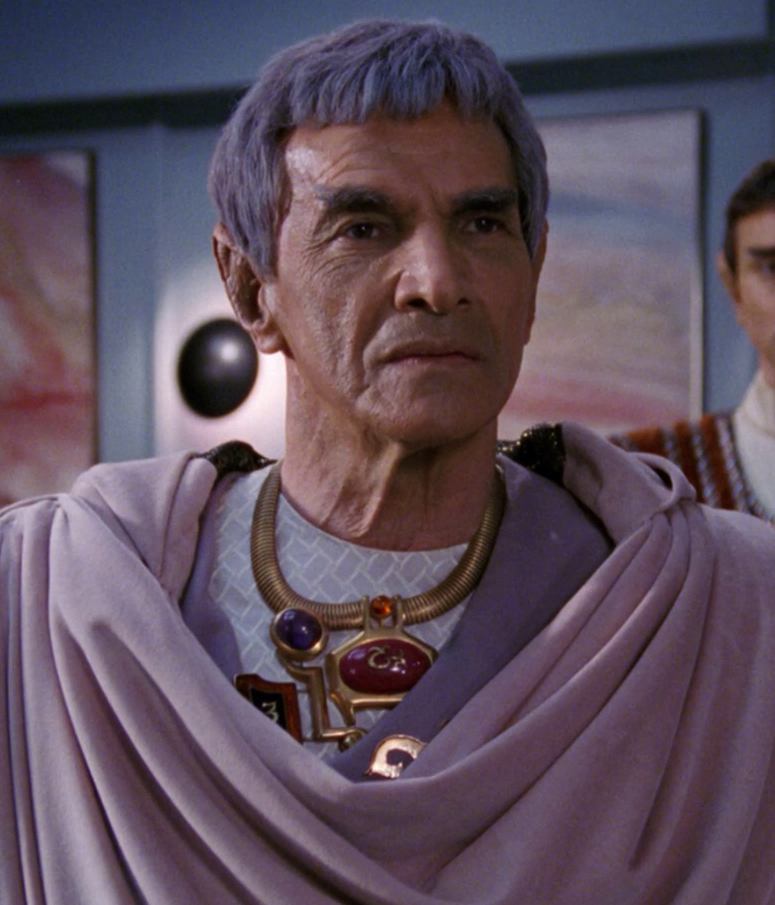 |
| Lenard as Sarek in 'Next Generation' |
Lenard said there were no plans to have him appear on the current incarnations of Star Trek, although he played Sarek and other alien characters in the original series, the cartoon spinoff, the movies and Next Generation.
The character of Sarek died in the latter series, in a scene in which he was suffering from a brain disease similar to Alzheimer's, in which his mind focuses on memories and unleashes the pent up emotions of a lifetime.
"I enjoyed it, although there was just the one scene," Lenard said. "But it was a little like King Lear, and I played it that way."
In his very first television work after moving to Hollywood, Lenard was cast as the Romulan commander in the classic Trek episode, Balance of Terror, a space adventure fashioned on a submarine warfare plotline. That work led to his casting as Sarek in the episode Journey to Babel, where his performance turned a one-shot character into a fan favorite.
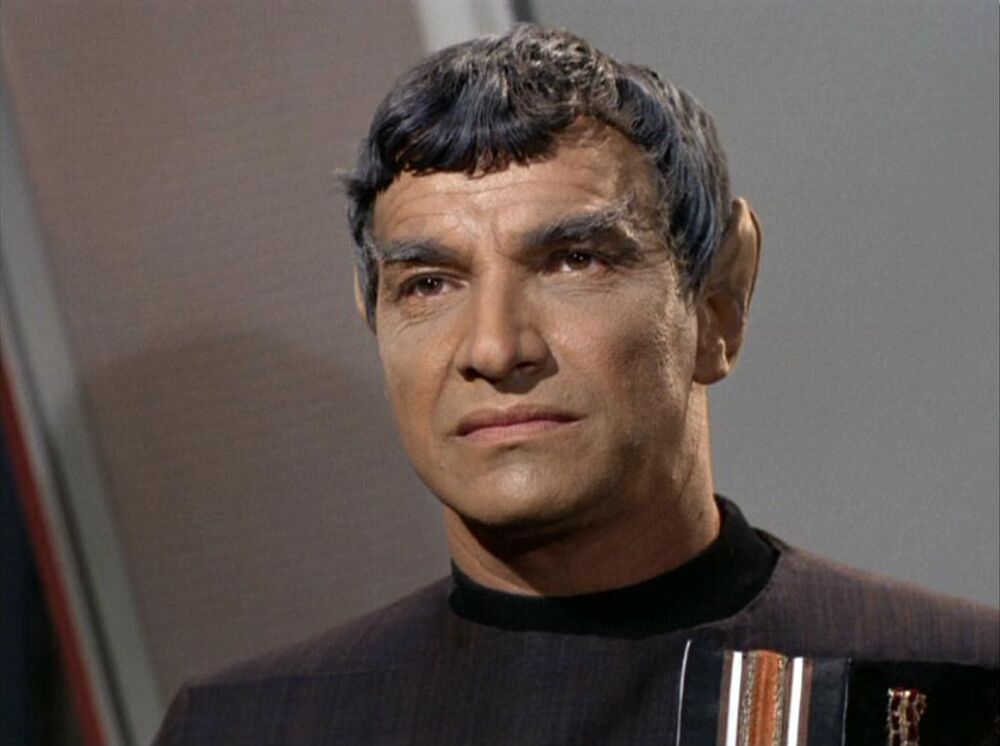 |
| Lenard as Sarek in 'Journey to Babel' |
"I recently saw one of the old shows and it's far superior to the others, much more fun," he said. "It was the one about Apollo, and it had a few wrinkles in it that were not the best. But it was a great character show. That's what they did the best."
Lenard has never been a real fan of science fiction, except when it shifted focus from hardware and special effects to character development and emotion. And he never watched Star Trek until he started being invited to science fiction conventions.
"I started watching the show out of self-preservation, because people were asking me all these questions about it," he said.
But Lenard said he was pleased with his Star Trek affiliation.
"It's part of our culture now, and our language," he said. "It's an honest show. It stands for good things. And the theme, 'Infinite Diversity in Infinite Combinations' is just as applicable today."
Friday, June 21, 2013
Flashback Friday: Conversation with 'Tasha Yar'
(Once upon a time, I did a telephone interview with Denise Crosby, best known to geeks as Tasha Yar, the ill-fated security chief in the first season of Star Trek: The Next Generation. She was coming to Panama City for one of the small conventions we had here in the 1990s, but she had a health issue and had to cancel. The following article, which ran with an info box with all the convention details, appeared on the Entertainment pages in the back of the B section of The News Herald on Saturday, Feb. 10, 1996.)
In science fiction, dead is not dead. Just ask Denise Crosby, who originated the role of Security Chief Tasha Yar on Star Trek: The Next Generation.
When Crosby wanted out of the popular show, Executive Producer Gene Roddenberry decided to do something that had never been done to a Star Trek officer before.
(Sure, the guys in the red shirts always got zapped. Security has alweays been a dangerous job on Trek. But a headlining star?)
"It would be absolutely shocking and dramatic," Crosby said during a telephone interview from her California home last week. "And we agreed upon that."
Roddenberry assured her that "Dead is dead. There's no coming back." But the creator of the Star Trek franchise -- at that time still the master of his characters' fates -- was proven wrong.
"It's amazing. By doing that, I sort of rose to a cult status," Crosby said. "I was the great enigma of the show in that I chose to leave."
Crosby said she was fortunate to have known and worked with Roddenberry, whose imaginative creation has fallen into other hands since his death. And while she respects the people involved in recent Trek efforts, she feels the legacy has lost something without its creator's guidance.
"This was Gene's. It was more than just somebody sitting in an office and designing a TV show," she said. "This was a man's point of view, a philosophy. He has something to say, and that's what people are responding to. It's a very definitive philosophy about science fiction, about the future and mankind."
After leaving Trek, Crosby more than kept busy. She costarred in the Stephen King movie Pet Sematery, starred with Fisher Stevens in Fox TV's Key West as Mayor Chancy Caldwell, and began a continuing role on ABC's Lois and Clark.
She also appeared in several more movies and TV shows, including 48 Hours, Desert Hearts, The Red Shoes Diary, and The Flash. She recently returned to the stage in the award-winning Last Summer at Bluefish Cove, and reteamed with director Mary Lambert on a Fox TV pilot called Love is Strange, in which she plays a ghost.
But as busy as her post-Trek life became, the specter of Tasha Yar continued to haunt her.
Two years after Yar's "death," the new Trek producer, Rick Berman, called her with a proposition: a time travel episode would revive Yar only to send her to another dramatic and heroic death.
"For me, Yesterday's Enterprise was so much fun to do," she said. "It was my first time to see everyone again. I could see where the tension was, where things had developed, people had grown into their parts. It also gave me a chance to work with Whoopie (Goldberg, who had taken the recurring part of the ageless bartender Guinan shortly after Yar's untimely departure)."
The show left Yar vanishing into a vortex, destined to die along with the crew of a time-lost Enterprise in battle with Romulans. But, as Crosby describes it, the ending created a new opening for her return:
"My idea was that, because of Yesterday's Enterprise, Tasha went back into history. What if she was pregnant? The Romulans captured her, kept her alive and raised the child to study it or have it as a hostage? What are the ramifications of a human child growing up with the enemy?"
So she boldly called the producers, asked for a story meeting and pitched the idea like any TV writer would.
"A couple of months later, they went with it, but they wanted the child to be half-Romulan. I thought I would get through the show without the makeup, the prosthetics," Crosby said.
Thus was born the Romulan Sela -- and the second action figure modeled after Crosby's likeness. All of which put a unique spin on her personal view of her career.
"When I was first in drama school, reading everything, watching every movie, like a sponge absorbing everything, I never thought I'd have an action figure (modeled after me)," she said. "I don't think Meryl Streep has an action figure."
'Trek's' Tasha Yar to appear at Bay Point convention
 |
| From TrekDoc.com |
When Crosby wanted out of the popular show, Executive Producer Gene Roddenberry decided to do something that had never been done to a Star Trek officer before.
(Sure, the guys in the red shirts always got zapped. Security has alweays been a dangerous job on Trek. But a headlining star?)
"It would be absolutely shocking and dramatic," Crosby said during a telephone interview from her California home last week. "And we agreed upon that."
Roddenberry assured her that "Dead is dead. There's no coming back." But the creator of the Star Trek franchise -- at that time still the master of his characters' fates -- was proven wrong.
"It's amazing. By doing that, I sort of rose to a cult status," Crosby said. "I was the great enigma of the show in that I chose to leave."
Crosby said she was fortunate to have known and worked with Roddenberry, whose imaginative creation has fallen into other hands since his death. And while she respects the people involved in recent Trek efforts, she feels the legacy has lost something without its creator's guidance.
"This was Gene's. It was more than just somebody sitting in an office and designing a TV show," she said. "This was a man's point of view, a philosophy. He has something to say, and that's what people are responding to. It's a very definitive philosophy about science fiction, about the future and mankind."
After leaving Trek, Crosby more than kept busy. She costarred in the Stephen King movie Pet Sematery, starred with Fisher Stevens in Fox TV's Key West as Mayor Chancy Caldwell, and began a continuing role on ABC's Lois and Clark.
She also appeared in several more movies and TV shows, including 48 Hours, Desert Hearts, The Red Shoes Diary, and The Flash. She recently returned to the stage in the award-winning Last Summer at Bluefish Cove, and reteamed with director Mary Lambert on a Fox TV pilot called Love is Strange, in which she plays a ghost.
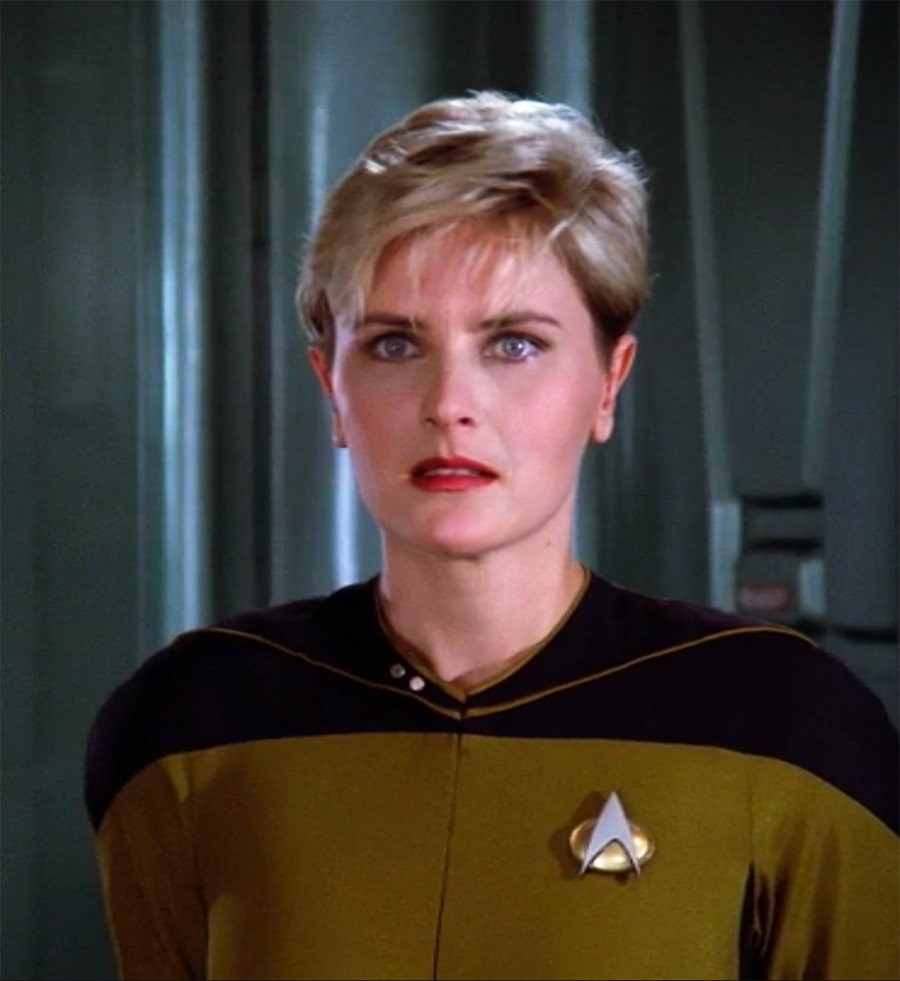 |
| From MemoryAlpha.com |
Two years after Yar's "death," the new Trek producer, Rick Berman, called her with a proposition: a time travel episode would revive Yar only to send her to another dramatic and heroic death.
"For me, Yesterday's Enterprise was so much fun to do," she said. "It was my first time to see everyone again. I could see where the tension was, where things had developed, people had grown into their parts. It also gave me a chance to work with Whoopie (Goldberg, who had taken the recurring part of the ageless bartender Guinan shortly after Yar's untimely departure)."
The show left Yar vanishing into a vortex, destined to die along with the crew of a time-lost Enterprise in battle with Romulans. But, as Crosby describes it, the ending created a new opening for her return:
"My idea was that, because of Yesterday's Enterprise, Tasha went back into history. What if she was pregnant? The Romulans captured her, kept her alive and raised the child to study it or have it as a hostage? What are the ramifications of a human child growing up with the enemy?"
So she boldly called the producers, asked for a story meeting and pitched the idea like any TV writer would.
"A couple of months later, they went with it, but they wanted the child to be half-Romulan. I thought I would get through the show without the makeup, the prosthetics," Crosby said.
Thus was born the Romulan Sela -- and the second action figure modeled after Crosby's likeness. All of which put a unique spin on her personal view of her career.
"When I was first in drama school, reading everything, watching every movie, like a sponge absorbing everything, I never thought I'd have an action figure (modeled after me)," she said. "I don't think Meryl Streep has an action figure."
Friday, May 03, 2013
Flashback Friday: Robin Curtis beams down
(Once upon a time, I interviewed actress Robin Curtis prior to her visit for a small sci-fi convention in Panama City. The actress was best known to me as the second "Lt. Saavik," having taken the role over in Star Trek movies 3 and 4. She was fun to talk to, very open and uninhibited, the polar opposite of her half-Vulcan character. This article is dated Friday, Feb. 24, 1995, meaning it went to press on Feb. 23.)
'Trek' star to appear at local Trek-O-Rama

Her face may not be familiar at first — minus the characteristic pointed ears and arching eyebrows — and her effervescent personality would embarrass her repressed Vulcan counterpart.
But Bay County Star Trek fans will be pleased by the person beneath the makeup as they get the chance to mind-meld with Robin Curtis — "Saavik" from the third and fourth Trek films — at the Trek-O-Rama convention.
"I enjoy (conventions) so much, but I haven't done one in a while, so I'm a little rusty," Curtis said in a telephone interview from her California home Tuesday evening.
Self-described as "effusive, expressive and full-of-life," it wasn't easy for someone like Curtis to play a coldly logical Vulcan.
"I spill all over everybody, excitement leaks from every pore," Curtis said. "(The fans) realize how difficult that must have been for me."
Curtis took over the role of Saavik after Kirstie Alley (of Cheers) had played the part in Star Trek II. Curtis said her status as a replacement was never an issue among the cast or the fans.
"It's interesting how, in life, the obvious problems are the ones that never materialize," she said. "The fans appreciate me for me."
Her role was pared down in the fourth Trek to give more screen time to the ensemble of original players. She said that was fine with her because that group of actors deserved the attention.
"My association with Star Trek has been nothing but beneficial, really. To think I'm still generating income from a job 11 years ago is astonishing," she said.
According to Curtis, her body of work could only be considered "a career" if it were put together with "some paste and Duco cement." Star Trek conventions — she appeared at 17 of them last year — have helped pay the rent.
"I've kind of let fans in on the fact that actors spend most of their time unemployed or looking for work," she said. "And they have let me in on what I have become a small part of."
The positive message behind Trek — that the future is bright and full of adventure — took Curtis a while to comprehend. She had never been a real Trek fan before landing the Saavik role, but has since immersed herself in the lore of future history.
"Who knows why the hell these things come to us? I'm just pleased to be part of something I consider to be a good thing," Curtis said. "I like what I've learned and how these people think. I hate to stereotype, but on the whole, I find the fans to be interesting, thoughtful, fun-loving people."
Curtis compares favorably her experiences on the movie sets with those on the set of Star Trek: The Next Generation, in which she guest-starred as a Romulan spy.
"It's viscerally very much the same," she said. "Star Trek is very stylized. The pace is slower and more thoughtful than most TV. There's that upright, military stance, straight as a beam right up your butt."
Curtis catches some good-natured ribbing for her stint hosting an infomercial for the Braun Handblender, but she doesn't apologize for blatant hucksterism. After all, in some ways, that's what conventions cater to.
"As long as it doesn't go up an orifice, we'll sell it," she said. "Actually, I wish I had a nickel for every one they sold (through the infomercial). Sales quadrupled and they renewed my contract for another year."
Curtis also has made a few commercials recently, but she hopes infomercials don't become her bread and butter.
"I'm hoping I haven't found my niche. That's not the goal, here, but I do thank God I'm capable of doing these kinds of things and maintaining a modicum of integrity," she said. "Work begets work."
During the interview, her new agent interrupted to tell her Dove Books wants her to do another science fiction book-on-tape reading for them — a job that no doubt came her way because of her Star Trek recognition value.
"It never stops. It never ceases to amaze me," she said. "Star Trek is like this monster machine that just won't stop."
'Trek' star to appear at local Trek-O-Rama

Her face may not be familiar at first — minus the characteristic pointed ears and arching eyebrows — and her effervescent personality would embarrass her repressed Vulcan counterpart.
But Bay County Star Trek fans will be pleased by the person beneath the makeup as they get the chance to mind-meld with Robin Curtis — "Saavik" from the third and fourth Trek films — at the Trek-O-Rama convention.
"I enjoy (conventions) so much, but I haven't done one in a while, so I'm a little rusty," Curtis said in a telephone interview from her California home Tuesday evening.
Self-described as "effusive, expressive and full-of-life," it wasn't easy for someone like Curtis to play a coldly logical Vulcan.
"I spill all over everybody, excitement leaks from every pore," Curtis said. "(The fans) realize how difficult that must have been for me."
Curtis took over the role of Saavik after Kirstie Alley (of Cheers) had played the part in Star Trek II. Curtis said her status as a replacement was never an issue among the cast or the fans.
"It's interesting how, in life, the obvious problems are the ones that never materialize," she said. "The fans appreciate me for me."
Her role was pared down in the fourth Trek to give more screen time to the ensemble of original players. She said that was fine with her because that group of actors deserved the attention.
"My association with Star Trek has been nothing but beneficial, really. To think I'm still generating income from a job 11 years ago is astonishing," she said.
According to Curtis, her body of work could only be considered "a career" if it were put together with "some paste and Duco cement." Star Trek conventions — she appeared at 17 of them last year — have helped pay the rent.
"I've kind of let fans in on the fact that actors spend most of their time unemployed or looking for work," she said. "And they have let me in on what I have become a small part of."
The positive message behind Trek — that the future is bright and full of adventure — took Curtis a while to comprehend. She had never been a real Trek fan before landing the Saavik role, but has since immersed herself in the lore of future history.
"Who knows why the hell these things come to us? I'm just pleased to be part of something I consider to be a good thing," Curtis said. "I like what I've learned and how these people think. I hate to stereotype, but on the whole, I find the fans to be interesting, thoughtful, fun-loving people."
Curtis compares favorably her experiences on the movie sets with those on the set of Star Trek: The Next Generation, in which she guest-starred as a Romulan spy.
"It's viscerally very much the same," she said. "Star Trek is very stylized. The pace is slower and more thoughtful than most TV. There's that upright, military stance, straight as a beam right up your butt."
Curtis catches some good-natured ribbing for her stint hosting an infomercial for the Braun Handblender, but she doesn't apologize for blatant hucksterism. After all, in some ways, that's what conventions cater to.
"As long as it doesn't go up an orifice, we'll sell it," she said. "Actually, I wish I had a nickel for every one they sold (through the infomercial). Sales quadrupled and they renewed my contract for another year."
Curtis also has made a few commercials recently, but she hopes infomercials don't become her bread and butter.
"I'm hoping I haven't found my niche. That's not the goal, here, but I do thank God I'm capable of doing these kinds of things and maintaining a modicum of integrity," she said. "Work begets work."
During the interview, her new agent interrupted to tell her Dove Books wants her to do another science fiction book-on-tape reading for them — a job that no doubt came her way because of her Star Trek recognition value.
"It never stops. It never ceases to amaze me," she said. "Star Trek is like this monster machine that just won't stop."
Friday, April 12, 2013
Flashback Friday: The Ladybird of the Galaxy
(The following is a segment from a memoir writing project I'm playing with. Hope you like it. Share your own recollections of 1970s Sci-Fi TV shows in the comments. — And yes, I know Trek was a 1960s era show, but Roddenberry did quite a few 1970s TV pilots, all of which Majel appeared in.)
My work with The News Herald in Panama City, Florida, has allowed me opportunities to speak with many of the actors that brought sci-fi TV to life over the years. In February 1994, and appropo of our subject, I interviewed an interplanetary dignitary when Majel Barrett-Roddenberry — actress and wife of the late Gene Roddenberry, the creator of Star Trek — beamed into town for a small sci-fi convention.
Barrett was perhaps best known to fans of the Trek television and movie series. Not only was she married to Gene (called by his fans "The Great Bird of the Galaxy"), but she was personally involved with every incarnation of the show as an actress and she appeared in each of his subsequent attempts to launch TV series.
She told me that, even though they had hoped (with Trek) to create something new and different for television, “We never dreamed it would be such a cult. You don’t just get up in the morning and say, ‘Today I’m going to make a legend.’ We just had a job, and we hoped people would like what we were doing.”
Barrett was cast as the starship Enterprise’s female first officer, “Number One” in the original pilot, which starred Jeffrey Hunter as Capt. Christopher Pike. The role was written for her, and she was the first actor cast, she said. Unfortunately, the network thought the pilot was “too cerebral for those slobs in TV-Land,” she said. (It was a curse that would haunt all of Roddenberry’s future TV pilots.)
“They liked the idea and wanted to see another pilot, but they wanted some changes. First, they wanted Gene to get rid of the woman second in command, because they said no one would believe a woman in that position. And second, get rid of the pointy-eared Spock character because he was too devilish and would upset women viewers,” she said.
“As much as he knew it was going to break my heart, Gene desperately wanted to keep the Spock character. He thought he could keep some things he wanted if he gave in to some of their requests,” she said. “So he decided to marry the woman and keep Spock on the show. Besides, Leonard (Nimoy, who played Spock) wouldn’t have had it the other way around.”
NBC also deflated Gene’s concept of gender equality, Barrett said. He had originally wanted the crew complement to be half male and half female. Instead, the female complement was reduced to about 10 percent. “But that was okay, because Gene figured 30 good women could handle a crew of 300,” she said.
With a bleached-blond hairstyle, the naturally brunette Barrett rejoined the cast as Nurse Christine Chapel during the entire run of the series, which starred William Shatner as Capt. James T. Kirk.
“I really wanted to be a part of Star Trek, and when this one script (“What Are Little Girls Made Of?” which introduced the Chapel character) came in, I knew it was my opportunity,” she said.
She cut her hair and bleached it blonde, then waited in Gene’s office for him to come in. He passed by her twice, even spoke to her once, before finally recognizing her. She told him, “If I can fool you, I can fool the network.”
Barrett’s voice was also used for the voice of the ship’s computer. She later contributed her voice to the animated Trek series which ran on Saturday mornings in the early 1970s. She appeared as Chapel in two of the Trek films, including her favorite of the series, Star Trek IV: The Voyage Home.
In the 1980s, after Gene launched the syndicated television series, Star Trek: The Next Generation, Barrett took on the character Llwaxana Troi, the hyper-sensual mother of one of the command staff. She also continued to provide the voice of the ship’s computer, and she played Lwaxana again in the third Trek series, Deep Space Nine, in the 1990s.
“Gene came in one day and said, ‘I have a great part for you. You won’t have to act.’ He described Llwaxana as ‘the Auntie Mame of the Galaxy,’” she said. “The way the first script was written, she was very shallow, but by the third and fourth appearance, she started to blossom. I’ve been very fortunate that the writing has been superb.”
Barrett died Dec. 18, 2008, as a result of leukemia. (Her birthday was Feb. 23, a date that has some importance to me. It happened in the year 1932.) Her cremains are expected to be launched into space in 2014 alongside her husband's.
 |
| From Wikipedia.org |
Barrett was perhaps best known to fans of the Trek television and movie series. Not only was she married to Gene (called by his fans "The Great Bird of the Galaxy"), but she was personally involved with every incarnation of the show as an actress and she appeared in each of his subsequent attempts to launch TV series.
She told me that, even though they had hoped (with Trek) to create something new and different for television, “We never dreamed it would be such a cult. You don’t just get up in the morning and say, ‘Today I’m going to make a legend.’ We just had a job, and we hoped people would like what we were doing.”
 |
| From Wikipedia.org |
Barrett was cast as the starship Enterprise’s female first officer, “Number One” in the original pilot, which starred Jeffrey Hunter as Capt. Christopher Pike. The role was written for her, and she was the first actor cast, she said. Unfortunately, the network thought the pilot was “too cerebral for those slobs in TV-Land,” she said. (It was a curse that would haunt all of Roddenberry’s future TV pilots.)
“They liked the idea and wanted to see another pilot, but they wanted some changes. First, they wanted Gene to get rid of the woman second in command, because they said no one would believe a woman in that position. And second, get rid of the pointy-eared Spock character because he was too devilish and would upset women viewers,” she said.
“As much as he knew it was going to break my heart, Gene desperately wanted to keep the Spock character. He thought he could keep some things he wanted if he gave in to some of their requests,” she said. “So he decided to marry the woman and keep Spock on the show. Besides, Leonard (Nimoy, who played Spock) wouldn’t have had it the other way around.”
NBC also deflated Gene’s concept of gender equality, Barrett said. He had originally wanted the crew complement to be half male and half female. Instead, the female complement was reduced to about 10 percent. “But that was okay, because Gene figured 30 good women could handle a crew of 300,” she said.
With a bleached-blond hairstyle, the naturally brunette Barrett rejoined the cast as Nurse Christine Chapel during the entire run of the series, which starred William Shatner as Capt. James T. Kirk.
“I really wanted to be a part of Star Trek, and when this one script (“What Are Little Girls Made Of?” which introduced the Chapel character) came in, I knew it was my opportunity,” she said.
She cut her hair and bleached it blonde, then waited in Gene’s office for him to come in. He passed by her twice, even spoke to her once, before finally recognizing her. She told him, “If I can fool you, I can fool the network.”
Barrett’s voice was also used for the voice of the ship’s computer. She later contributed her voice to the animated Trek series which ran on Saturday mornings in the early 1970s. She appeared as Chapel in two of the Trek films, including her favorite of the series, Star Trek IV: The Voyage Home.
In the 1980s, after Gene launched the syndicated television series, Star Trek: The Next Generation, Barrett took on the character Llwaxana Troi, the hyper-sensual mother of one of the command staff. She also continued to provide the voice of the ship’s computer, and she played Lwaxana again in the third Trek series, Deep Space Nine, in the 1990s.
“Gene came in one day and said, ‘I have a great part for you. You won’t have to act.’ He described Llwaxana as ‘the Auntie Mame of the Galaxy,’” she said. “The way the first script was written, she was very shallow, but by the third and fourth appearance, she started to blossom. I’ve been very fortunate that the writing has been superb.”
Barrett died Dec. 18, 2008, as a result of leukemia. (Her birthday was Feb. 23, a date that has some importance to me. It happened in the year 1932.) Her cremains are expected to be launched into space in 2014 alongside her husband's.
Subscribe to:
Posts (Atom)