Showing posts with label Flashback Friday. Show all posts

Sunday, June 19, 2016

Flashback Father's Day: The Drama of Life

(This article originally was published by The News Herald in Panama City on Father's Day, June 18, 2006.)


The drama of life
By David Angier

Most parents cringe at the drama their teenagers bring into their lives, but Tony Simmons applauds it.

Even when his son, Nathan, is engaging in drunken brawls, kissing random women and acting crazy,

Tony simply smiles and watches - at times from front-row center.

In the years before Nathan, now 17, discovered acting, the drama he brought into the Simmons' household was nothing to smile about. But next weekend, father will join son on stage for a Shakespeare in the Park production of "Othello," in an activity that has drawn them closer together.

Admittedly, Tony Simmons' part is a small one - he has a few lines that he says he's struggled to learn - while Nathan takes center stage as the too-trusting and honorable Cassio, the unwitting tool of Iago's complex scheme of treachery and murder. Director Chuck Clay said he picked "Othello" - the tale of a war-weary general who returns home after defeating his enemies abroad, only to find his greatest enemy in his own home - because it seemed relevant to the times.

"Of all of Shakespeare's plays, 'Othello' is universal," Clay said. "It's something that's going on in our lives today. It has events and themes that we identify with, that we read about every day in the papers."

Act I, Scene I

Tall, lanky Nathan Simmons steps on the 25-by-12-foot stage at Gulf Coast Community College's theater lab and stops being Nathan Simmons. He's still dressed in jeans and black Chuck Taylors. His eyes are still nearly obscured by shaggy blond hair, but his mannerisms alter noticeably. He stands taller and speaks with a force that is absent away from the spotlight.

He's Cassio.

"Reputation, reputation, reputation," Cassio exclaims. "O, I have lost my reputation! I have lost the immortal part of myself, and what remains is bestial."

The only time Nathan Simmons comes out is when he misses a line. He stumbles over his words, smiles, rephrases and exits. Off stage he jumps up and down in frustration, then darts to a chair to study the line.

Nathan Simmons entered his first theater class during his freshman year at Bay High School. Before then, he describes himself as "pretty anti-social." Nathan's entrance into the theater magnet program coincided with doctors finally determining, after years of misdiagnoses, that he had a seizure problem.

Doctors initially thought he had an attention deficit condition and put him on medication that aggravated his seizures. Doctors finally realized the problem when Nathan was in eighth grade, but the damage to his reputation was done. Nathan was an outsider.

"I didn't have a lot of friends," he said. "But theater is a big family, and as I got into it I grew closer to all those people."

In four years of theater, Nathan has performed in more than 20 plays. He's won awards, acclaim and found a goal for the rest of his life.

"When mom and dad see me on stage, they're really proud of me, and that makes me feel good," Nathan said. "Before I started high school, I had no idea what I wanted to do. Now I have a goal to shoot for. I have a plan. I would like to major in theater and go to New York and perform there. If I can't do that, I'd settle for teaching theater."

He said he enjoys sharing his latest project with his father.

"We connect a lot more," Nathan said. "Before I joined the theater program I kept to myself a lot. Since then, I've become a nicer person, a happier person. Dad and I, we get along really well. He enjoys watching me on stage. Having him do this show is great because he doesn't have to sit in the audience this time; he can see it from the inside."

Nathan said it's nice the roles have changed in this aspect of their lives. "He's come up to me a couple of times and asked me, 'What exactly am I supposed to be doing here?'" Nathan said. "I've helped him in memorizing lines, and he's said that this is a lot more difficult than it looks. Dad's been more than willing to learn, and it's nice that he's let me be the teacher for once."

Act I, Scene II

Tony Simmons, online editor for The News Herald, is having a hard time "loosening up." He has to remember where to face, what to do and, above all else, what to say - while making it all seem completely natural. At the same time, he's got to project.

Shakespeare in the Park is a physically demanding endeavor. The actors don't have walls to bounce sound out to the audience, and it's up to the actors to make their voices carry. Simmons doesn't have a problem turning to his son for advice.

"He's having to teach me how to loosen up," Tony Simmons said. "This is an alien thing to me; these other people are just letting go. There's no sense of self, or self-consciousness, I guess, and that's something I have to learn."

His only prior acting experience was his senior play in high school 24 years ago. He agreed to do "Othello" — "because they asked me to. They assured me it was a small role. I thought this is something that Nathan and I can do together."

Tony Simmons isn't the type of father who rolls his eyes or shakes his head when he thinks about his son pursuing a career in acting - a difficult profession to succeed at. He's seen too many positive changes in his son's life occur in four years of theater to be pessimistic about the future.

"He's got a lot of promise, and I'd just like to see him take it as far as he can go," Simmons said, noting that Nathan has talent as a playwright. For now, Tony Simmons is learning to loosen his control of his son's life as well.

"I have to be almost less involved than I used to be," he said. "Nathan's found a way to make his own way."

Friday, April 29, 2016

Flashback Friday: Doc Savage and 'The River Extraction'

(Originally published Sunday, May 6, 2001, in The News Herald)

Cover Art by James Bama
As a youngster, one of my greatest literary heroes was Clark Savage Jr., better known as "Doc Savage: The Man of Bronze." A millionaire, surgeon and inventor, Doc traveled the planet righting wrongs with the aid of his World War I buddies, Monk, Ham, Johnnie, Renny and Long Tom (and sometimes his cousin Patricia Savage).

Written by Lester Dent under the pen name "Kenneth Robeson," Doc's adventures were set in the 1930s and featured in pulp magazines of the day. I became familiar with him in the 1970s when Bantam reprinted the serialized stories in the form of paperback novels, Marvel Comics published illustrated tales and Warner Bros. produced a campy movie starring Ron Ely.

Without doubt, Doc was the template on which other superheroes and adventurers were built. Clark Kent owes more to Clark Savage than a first name. (A "biography" of Doc released in the 1980s linked him by blood with the English nobleman called Tarzan, Sherlock Holmes and Lamont Cranston - "The Shadow.")

Ron Ely as "Doc"
Doc's base was on the 86th floor of the Empire State Building, but he also had a secret "Fortress of Solitude" in the Arctic where he exercised his mind and body to the pinnacle of human perfection. Invariably Doc's physical exertions and hand-to-hand battles resulted in his safari clothing being reduced to tatters. (The number of shirts he went through was used to comic effect in the film.)

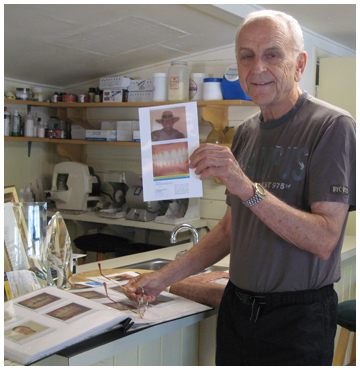
That image came to mind this week when I heard the tale of Ebro dentist John Savage ripping off his clothing as he dived into the Choctawhatchee River to pull a patient out of a sinking car. (Call it an emergency dental extraction.)

"It was strictly an immediate reaction," Savage said later. "They asked me if the water was cold and I had to say I never even knew if it was cold or not. There was just too much tension and too much tragedy about to happen.

John Savage, DDS
"I tried to get my socks off, but there wasn't time to get them off."

The car had raced out of control and bounded between trees and over a sand bank where Savage's riverside office (and Fortress of Solitude) sits; the driver initially had trouble getting out of the car and then struggled to swim while wearing steel-toe work boots.

"I'd try to help anybody in that condition," Savage said. "I didn't have time to think about it."

Once again, "Doc Savage" was the hero of the moment. Now he's back at his day job - fighting for tooth, justice and the American way.

Peace.

Friday, April 22, 2016

Flashback Friday: Digressions in infinite complications

(The following was first published in The News Herald on Sunday, April 29, 2001.)

She needed a spoon for her cereal, but none were clean, so she washed all of the dishes, wiped down the counter tops, swept the floor, mopped, noticed dirt on the baseboards and instead of washing them pulled them off the wall and sanded the paint off of them, refinished them, reattached them to the wall, which she suddenly realized needed a new coat of paint in a different color so she went to Wal-Mart, where she bought paint and brushes, and came back home to paint the dining room (and living room and bathroom) walls — never having paused for breakfast.

Did anybody see where that rabbit ran off to?

She wanted to re-seed bare spots in the lawn, so she bought seed, bags of top soil and cow compost, flowering bedding plants, decorative trimming bricks, and went to find a hoe in the shed, but the shed was in disarray so she pulled everything out of it and stacked boxes and junk for a trip to the dump, and stacked other items for Goodwill, then organized the shed and realized that the hoe was not in the shed at all but rather on the side of the house where our spring garden is usually planted but where pine straw was still heavy on the ground, needing to be raked, so she raked the straw into trashcans that also would be carried to the dump — never having got around to seeding the lawn.

Could someone help us catch these wild geese?

She wanted to relax before bedtime with the latest Left Behind book, but the dog had gotten hair on the bed, so she stripped the comforter and sheets and started a load of wash and folded clothes that were in the drier and went to put them away, but the drawers were full of winter clothes so she sorted the winter clothes — setting many aside for donation — and put the remainder in a tote that wouldn't fit into the closet until the closet was sorted — setting several items aside, again, for donation — and by this time the comforter and sheets had been washed and dried so she made the bed and went to sleep — never having cracked open the book.

But I digress.

Getting to the point (if there is one): The walls would not be repainted now if I had run the dishwasher the night before, as I had promised; the shed would not be cleaned if I had put away the hoe; the winter clothes and closets might not be sorted yet, if I had not played with the dog on the bed.

What would she do without me?

Friday, March 04, 2016

Flashback Friday: 'Trek' defense doesn'twork, no Bones about it

(Originally published in The News Herald on Thursday, March 8, 2001, as a "Bay Book" entry; a collection of snippets about the happenings, happenstance and personal experience that lend Bay and nearby counties their special character.)

Dr. "Bones" McCoy, whom you may recall was the crotchety Southern medical officer aboard the starship Enterprise way back in the day, had a fallback defense when asked to perform duties outside his realm of expertise.

"I'm a doctor, not a bricklayer!" he said, for instance, when ordered to repair a wound in the rocky skin of an alien using some kind of space age plaster.

But then, invariably, he did the work anyway.

I thought about Bones Sunday as I struggled with two-by-fours and four-by-fours and two-by-sixes and screws and bolts and a level and a drill and sundry other materials to build a backyard play-fort for my kids using a truckload of lumber and a kit we had purchased.

"I'm a writer, not a carpenter!" I said.

I had moaned something similar the day before when pressed to install an air conditioner through the wall of my son's bedroom; and a few months ago when faced with replacing a hardwired drop-in range with a freestanding one; and a few months before that... . Well, the list goes on for light years.

At the risk of mixing allusions, I also recalled a Bill Cosby standup routine in which he said truly smart men purposely mess up these tasks so that, the next time there's work to be done, their wives will not expect them to do it.

I suspect that's just wishful thinking, as it never quite works for me. Like Bones, all it takes is a look or a word from one of the crew - my kids or my wife - and I roll up my sleeves. And if I mess it up, they just expect me to fix it.

In fact, the only time the "Cosby defense" worked was the time our central air unit was on the fritz. I argued we ought to call a specialist - "I'm a writer, not an electrician!" - but my wife wouldn't hear of it. It's probably just a reset switch, she said.

So I turned off the power (I thought), opened the side of the unit, reached in for the reset switch and blinded myself with a burst of electricity that landed me a few feet back from the box.

McCoy's other famous remark sparkled through my brain:

"He's dead, Jim."

But that was just wishful thinking.

Friday, October 31, 2014

Memories of haunted Halloweens gone by

1991 vintage Flash mask
PANAMA CITY — When my son was 3, I took him to a kid-friendly haunted maze at a Kmart store’s garden center. His sister was a newborn down the street at Sacred Heart Hospital in Pensacola, and our first photographs of them together show him in his Flash costume.

She turns 23 today, our little Halloween treat. But a visit to the Panama City Jaycees Haunted House under construction earlier this month set my mind on a minor event of that momentous day in 1991, and from there the Halloween memories began to tumble.

Apparently, the red-and-yellow plastic coveralls with the lightning logo conferred upon her brother the super-speed powers of the comic book hero whose adventures he had viewed on television. At least, one would think so, to see him running everywhere he went.

The mask and costume also rendered him fearless. Near the end of the haunted maze, a man in some kind of scarecrow/clown outfit squatted down and made spooky noises at the boy, who drew back his right arm and promptly punched the man in the nose of his mask.

I apologized, the man laughed, and Flash propped his fists on his hips in a heroic pose, having vanquished evil.

Jessi and Nathan
The Flash’s greatest adventure was on my mind when I walked the unfinished maze above Panama City Marine Institute, which has sheltered the Jaycees Haunted House for 11 years. (You can view a video tour through the haunted house at PanamaCity.com, and see the schedule on pages 10-11 for times and details on the event.)

Will Hancock, who has supervised the Haunted House project for the Jaycees for several years, told me last week that the event is “very alive” and doing robust business.

“I am pleased with all the hard work and dedication put in so far,” Will said. “The ‘13 Ghosts’ room and the ‘Oculus’ room have been the most consistent (frights) so far, but that can change tonight. We are adding more sound and lighting as we speak.”

The scares, while safe for adults and teens, are not appropriate for little children. I just hope no one gets punched in the nose.

No frightful creatures jumped out at me during my tour — which was lucky, since I had no hero handy to leap to my defense. But suddenly, 1991 seemed like only yesterday. When I wondered where the years had gone, I could feel them piled up like a bottleneck, heavy and thick with sweet memory.

Jessi playing with makeup.
... Sitting with the kids at a fire in a friend’s Cove area front yard, reading “The Raven” and handing out candy.

.... Wrapping the kids like toilet paper mummies during a contest at another friend’s Halloween party at Pine Log.

... Walking the sidewalks of North Shore neighborhoods to gather massive hauls of candy.

... Playing “pin the fangs on the monster” at one of Jessi’s earliest birthday parties in Century.

... Dressing in costumes to grab supper at Golden Corral on yet another Halloween.

So many autumn evenings, pumpkins carved, yards decorated, homemade costumes, movie nights with the house full of her friends, and outfits I can’t even begin to recall.

In that moment, picturing the boy in the Flash uniform holding a newborn little girl in a hospital room, I wondered if ghosts of the past truly haunt houses, or if they only haunt old men whose children have grown up.


Peace

---

Friday, July 04, 2014

...The more they stay the same

PANAMA CITY BEACH — As of the end of June, I have now been at this job (or at least, employed in various jobs at this newsroom) for 21 years. The same week, my first child turned 26. This is the only job he remembers me ever having.

I thought about that a bit, picturing the me of 21 years ago rolling into town. I had more hair, fewer wrinkles, less debt, and lived in a state of blissful ignorance about the longevity of my heart, much less the trajectory of this thing that (in retrospect) I have to call a “career.”

But that train of thought, once it left the station, started me looking back at how things have changed around here in the past couple of decades. (That’s right: Now that I’m an old man, you may have to endure the occasional “back in my day” trips down the rabbit hole.)

In 1993, we still used a walkie-talkie style radio to keep in touch with reporters in the field. Production included wax paste-up of columns before pages were photographed for conversion to negatives that were used to — You know what? Never mind.

Photographers used film, and the photo lab always smelled of chemicals. Graphic artists used colored acetate sheets to create color effects, requiring multiple negative sheets — er, never mind.

And yet, most photos and art were printed in black-and-white. When I started posting our old photos to the website some years ago, like the one of Sir Loin, people complained that I was turning color photos to black-and-white to make them seem more “vintage.” Nope. That’s how they were originally printed.

Local schools had newspapers. Students came to this office to do physical layout work.
I carried a beeper, and when it went off, I had to locate a pay phone or public phone to check in. Only rich people had car phones or those “cell phones” with the big battery backpacks.

In 1994, I covered a Gulf Coast (then-Community) College meeting in which Professor Joe Howell described the highlights of the so-called “Internet” database system and the advantages access would give to faculty and students in the future.

“In less than a minute, he had at his fingertips computer files in Iowa, Sweden and Asia — including professional journals, research information, job listings, electronic mailboxes and computer bulletin boards,” the report said. “There was even a file on ‘UFO and Alien Information’ — although he quickly skipped past it.”

There was no indication that morning of how such a simple file transfer system would evolve and change the world — much less the news business. By 1995, there was a debate over whether we needed Internet access in the newsroom; that year, I signed up for my personal email and was among the first reporters to list an email at the bottom of his stories.

In 2006, I became the newsroom’s first Online Editor. In 2011, when I moved over to PanamaCity.com, a fellow named Brady Calhoun became the online editor; he first showed up in this newsroom in 1995 as a student intern from Rutherford High School that I was assigned to supervise.

He had more hair, fewer wrinkles, and lived in a state of blissful ignorance about the trajectory of his newspaper career.

The more things change… You know the rest.

Peace.
---
(This is my Undercurrents column for The News Herald and PanamaCity.com for July 4.)

Friday, July 19, 2013

Flashback Friday: Success in 60 Minutes

(Once upon a time, specifically Aug. 8, 1994, The News Herald published this profile of longtime Bay County resident John Hamlin, who traveled the world as a producer for CBS 60 Minutes. We had a nice interview at a downtown restaurant, and afterward John asked me to delay running the article for a while because of personal reasons; an editor ran it anyway, about a week earlier than John had asked. He called to thank me for publishing it early, as shortly after that his mother had died, and if the story had been held any longer, she wouldn't have seen it. She was rightfully very proud of him, and he was glad she had seen the article and knew her friends and family would see it too. He joined CMT in 2007, where he serves as Senior Vice President for Music Events and Talent.)

Success in 60 Minutes

Former Bay resident credits luck, timing and more in becoming producer for TV's top news magazine

John Hamlin, CMTPress.com
John Hamlin grew up in Bay County and visits his family here twice a year.

That is, when he's not chasing Mexican guerrillas in the high jungles, chatting with Mick Jagger about the 1994 Rolling Stones tour, or setting up a prison interview with Mike Tyson for his boss, Ed Bradley of CBS-TV's 60 Minutes.

Hamlin, 33, talked about his on-the-job adventures during a recent trip home. His parents are retired U.S. Air Force Col. Ralph E. and Mary Bruce Hamlin of Callaway.

Hamlin is one of five producers on Bradley's news team, each of whom is challenged to create five quality stories each season. Last year, he got interviews for Bradley with an ex-undercover agent for the DEA, a retired U.S. army colonel who became Commander-in-Chief of the Estonia military, "parachute" lawyers who specialize in disaster lawsuits, and a Mexican rebel leader.

This year, he's putting together stories on international arms deals, the effects of Agent Orange in Vietnam and a "secret" story he can't discuss yet.

Hamlin considers the Mexico piece on Subcomandante Marcos his personal "coup," having made two excursions into the jungle to secure Bradley the interview. After arriving at the appointed meeting place — about four hours' drive into the jungle — the crew was told Marcos could not do the interview.

That night, as Bradley slept in the jeep and the crew slept around a camp fire, armed guerrillas in ski masks and bandoleras surrounded them. They were rousted out and hustled into an abandoned school building. Minutes later, Marcos appeared, finally ready to talk.

"His English isn't the best, and he said, 'Good night. I am Subcommandante Marcos.' We offered him something to drink and he said, 'You have Boodweiser?'"

Hamlin said the interview that resulted will be re-run in mid-August, just in time for the Mexican elections.

LUCKY BREAKS?

Hamlin's family first came to Bay County when his father was stationed at Tyndall Air Force Base during John's sixth-grade year. They returned to settle in Callaway when his father retired. He attended Rutherford High School and Gulf Coast Community College, where he was a DJ on WKGC.

"I was a really terrible disc jockey, but it was fun, and I figured out I could interview people," Hamlin said. "I would talk to bands when they came into town and run the interviews during my show."

One of his real talents was shooting stills of rock bands, Hamlin said. A photo of his appeared on a Journey album cover and he had a small article published in Rolling Stone. "But I was a better photographer than writer," he said.

After getting his degree in journalism from the University of South Florida, Hamlin began looking for jobs in TV news all over the Southeast.

"Charlie Wooten at KGC told me Channel 7 had better equipment and Channel 13 had better people. I chose the people, but the equipment (was bad). We literally used Band-Aids to keep things together," Hamlin said. "Of course, it isn't like that now."

He shot, wrote and edited two reports a day for three years, motivated by two factors: "beat Channel 7 and do good work so I could move on to a network."

"My only dilemma now is figuring out a way to get 60 Minutes to let me have a Panama City Beach bureau. Panama City is a great place to work and live, but I couldn't be an anchor; I looked young, I didn't have good delivery. So I couldn't make a good living on the air."

A stint at ESPN followed, including a job as Bureau Chief of the Los Angeles office, during which he won an Emmy for feature production. Then CBS Sports hired him to produce feature segments and studio shows for the French Olympics in 1990. During the hiatus between Olympics, he convinced his superiors to let him work on Bradley's Street Stories.

"I had helped design the coverage of boxing on ESPN, so I had great boxing contacts and I knew Tyson," Hamlin said. "I convinced him and his lawyer to let us to a full hour on Street Stories."

Street Stories ended shortly thereafter and Hamlin returned to the sports division. With 18 months still to go before Olympics work geared back up, he produced packages for NFL Today, which won him another Emmy.

When he discovered Bradley had an opening on his 60 Minutes staff, Hamlin applied. Certain he would not be hired, he rehearsed his gracious thanks for even being considered. Instead, Bradley called and asked him when he could start. He was working a week later.

"Clearly, the jumps from here to ESPN to CBS Sports to 60 Minutes are huge jumps, and luck and timing played a part," Hamlin said. "Luck and timing might get you the job, but won't keep you the job."

BEHIND THE SCENES

Because Hamlin was hired halfway through the production season, Bradley told him to start working on shows for the following year. Many producers will set up profiles of movie stars to have stories "in the can" whenever the stars release a new movie or come back into the news.

Unlike a movie producer, whose job is to secure funding for the production, a news producer acts as a reporter. He or she makes the contacts, does the research, writes the questions and works in the post-production phase. Bradley's job in the equation is to ask the questions on-air, rewrite some of the narration and questions, and use his charisma to capture the audience.

"The hardest part of the job is coming up with stories," Hamlin said. "That's why I hated being an assignment manager. They say you're only as good as your last story, but I think you're only as good as your next one."

Hamlin said the staff members of 60 Minutes are highly competitive with one another, but also very supportive. That doesn't mean they cover for each other, though.

"There's not much baby-sitting with new people. They didn't become the top show on television by hand-holding. There's a level of quality that's required, and a lot of self-inflicted pressure," Hamlin said. "I don't think anyone denies we all want the show to succeed, and that means being proud of the work other people do. But make no mistake, everyone wants to get the great stories."

Despite the current glut of news-magazine shows on TV, Hamlin said 60 Minutes remains the legend of the genre.

"There's no secret why it's the Number One show on TV. These people are master storytellers," Hamlin said. "The strength of what we do is in the writing and the storytelling, not fancy special effects."

For now, Hamlin and his wife, the former Angela Wiggins of Panama City, are enjoying a few days of relaxation. Hamlin said one of his favorite things to do when in town is, "sitting on the back deck at Schooners drinking a beer. Does it get any better than that? It reminds me why I keep coming back here."

Friday, July 12, 2013

Flashback Friday: Reviewing the 'Chronos' comic series

(I really miss this comic book. I'm an easy mark for time travel stories, and when they're done right I can't let go of them. I want to revisit them time after time (see what I did there?). I'd love to see Walker Gabriel show up in the current DC "New 52" universe. Anyway, here's my review of the series, Chronos, from the May 13, 1998 edition of The News Herald. This appeared in our "Generation NeXt" section, which often had comic book content.)

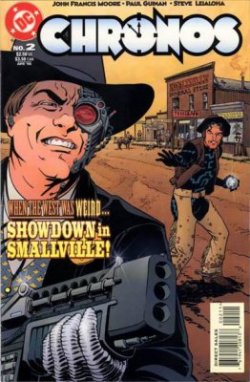
From BigRedHair.com
Catching up with 'Chronos'

Time is like light, according to Walker Gabriel.

"It's both a wave and a particle," he explains. "It can be diffused and reflected. The suit I'm wearing generates an energy field that bends time around me."

Walker is the not-too-bad bad guy — who just might turn out to be a hero after all — at the center of DC Comics' new monthly series, Chronos, about the rehabilitation of a time-traveling ne'er-do-well.

Writer John Francis Moore and penciller/co-creator Paul Guinan, joined by inker Steve Leialoha, have woven a tapestry of detailed characters, adventure and pseudo-science supported by artwork and pacing that bring disparate times and places to life with astonishing realism.

The first issue of Chronos was a dense mix of new and old DC characters and concepts. The second was less bewildering — Walker's misadventures trapped in 1873 in Smallville, Kansas, where he meets the Clark and Kent families and runs afoul of a Linear Man, one of the guardians of DC continuity, posing as a U.S. marshal.

(Think Back to the Future III meets The Terminator.)

By issue three — and the introduction of a devilish immortal who seems to have met Walker before — the weave of the storyline's tapestry begins to coalesce.

Walker's travels hold the promise of plenty of guest stars from DC history — from the weird West of Jonah Hex to the far future of the Legionnaires. Still, guest stars galore don't matter if there's not a strong character at the core — which, I think, Walker will come to be.

Perhaps the most appealing aspect of the story is his journey, not his destination. Walker is on a voyage of self-discovery, learning about how his past and future actions have (or, depending on the era, will have) affected people — and discovering the hero within the jaded young scientist.

The first glimmer of this greater man he will (did?) become is seen in issue one, when an older Walker materializes in time to save his younger self from a time-traveling enemy; his first real step toward heroism follows in issue two, when he plans to steal money from the family that gave him a home and a job — but his conscience won't let him.

Monthly from DC Comics
Highly recommended

-------

(Another note: The series lasted only 11 regular issues, plus a "1 million" issue as part of a DC crossover. It ended with Walker erasing himself from history (actually creating an alternative timeline) in order to save his mother's life. It had so much potential. >>Just check out this page, where Walker meets Martha and Jonathan Kent on a dark country road one night just before they see a rocket crashland <<)

>>Also, I recently compared an image from Doctor Who to a cover of Chronos in this blog.<<


Friday, July 05, 2013

Flashback Friday: Speaking with Sarek

(Once upon a time, I had a phone interview with Mark Lenard, the gentleman who played (among many other sci-fi roles) Sarek on the classic Star Trek series and films. He was soft-spoken and self-deprecating, and generous. He sent me three autographed photos (unasked) after the talk. This article appeared on Page 6B of The News Herald on Saturday, Feb. 28, 1995. Lenard died at age 72 on Nov. 22, 1996 of multiple myeloma.)

'Spock's father' energizes Trek-o-Rama

MarkLenard.com
For years, he served the Vulcan race as ambassador to the United Federation of Planets — and served more patriarchal duties as father to Star Trek's beloved Mr. Spock.

Now Ambassador Sarek makes his first official visit to Panama City as Mark Lenard, the actor who first brought Sarek to life more than 25 years ago, headlines today's Trek-O-Rama science fiction convention at the Marina Civic Center.

"Star Trek has been a big part of my life, off and on, ever since," Lenard said in a telephone interview from his New York home. "I can never really get away from it, and I'm always going to conventions and talking about it."

More mundane TV watchers will recognize Lenard's distinctive voice from advertisements for Saab, Maxwell House Coffee, Scope, BP Oil, CNN Crossfire and others. He has appeared in dozens of movies and TV series including The Greatest Story Ever Told, Annie Hall, Gunsmoke, and Planet of the Apes.

Lenard also applied his voice to the reading of Sarek and Federation, two best-selling Trek novels, for recent book-on-tape productions.

"Plus, I teach a class and I'm directing and playing in a film version of an opera — people will be pleased to hear it's a non-singing role," Lenard said. "And I'm writing, so I'm very busy now."

One of his major activities is a touring production of The Boys in Autumn, which guest stars Walter Koenig, another Trek alumnus.

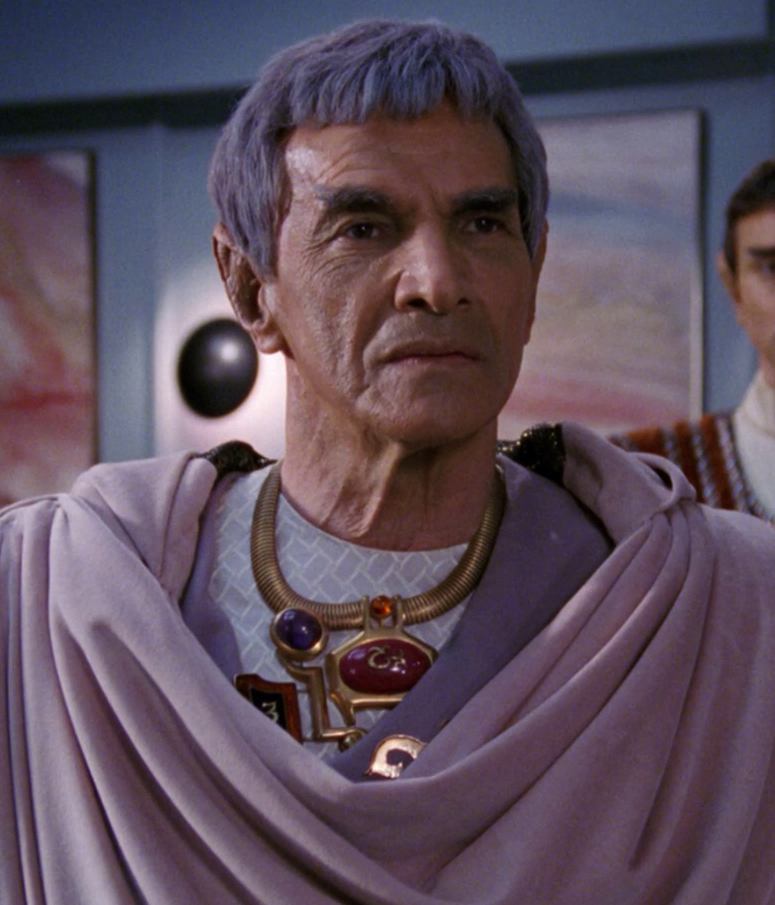
Lenard as Sarek in 'Next Generation'
"We play Tom Sawyer and Huck Finn at middle age. Walter plays Tom and I play Huck," Lenard said. "It has great humor. They're two old curmudgeons, and it's quite moving. We've had good reception and we've been at it long enough to get very good at it."

Lenard said there were no plans to have him appear on the current incarnations of Star Trek, although he played Sarek and other alien characters in the original series, the cartoon spinoff, the movies and Next Generation.

The character of Sarek died in the latter series, in a scene in which he was suffering from a brain disease similar to Alzheimer's, in which his mind focuses on memories and unleashes the pent up emotions of a lifetime.

"I enjoyed it, although there was just the one scene," Lenard said. "But it was a little like King Lear, and I played it that way."

In his very first television work after moving to Hollywood, Lenard was cast as the Romulan commander in the classic Trek episode, Balance of Terror, a space adventure fashioned on a submarine warfare plotline. That work led to his casting as Sarek in the episode Journey to Babel, where his performance turned a one-shot character into a fan favorite.

Lenard as Sarek in 'Journey to Babel'
Lenard has definite feelings on the running "which Trek was best" question.

"I recently saw one of the old shows and it's far superior to the others, much more fun," he said. "It was the one about Apollo, and it had a few wrinkles in it that were not the best. But it was a great character show. That's what they did the best."

Lenard has never been a real fan of science fiction, except when it shifted focus from hardware and special effects to character development and emotion. And he never watched Star Trek until he started being invited to science fiction conventions.

"I started watching the show out of self-preservation, because people were asking me all these questions about it," he said.

But Lenard said he was pleased with his Star Trek affiliation.

"It's part of our culture now, and our language," he said. "It's an honest show. It stands for good things. And the theme, 'Infinite Diversity in Infinite Combinations' is just as applicable today."

Friday, June 28, 2013

Flashback Friday: Gigi Edgley Gives Back

(Once upon a time I got to sit down with actress Gigi Edgley in a semi-quiet corner of the Bay Point Mariott (now Wyndham) conference center. The former star of Farscape was in town as part of a sci-fi convention. She was lovely and charming and sweet, and genuinely enjoyed being there and meeting fans. (Unlike a couple of others who were there to make money by autographing stuff.) I got photos of her chatting with my friends Jayson Kretzer and Mattie Jankowski in the artists' room. (Though I couldn't locate those shots for this post.) Anyway, this interview ran in the News Herald's weekly Entertainer tab on June 12, 2008, the weekend following the event.)

Gigi Edgley Gives Back

Photo by Andrew Wardlow/The News Herald
Gigi Edgley thinks she may be on the verge of creating her own multimedia entertainment empire -- if she doesn't lose track of herself in the process.

"It's just been stunning, the adventures of the last sort of two or three months," she said. "I woke up this morning like, 'Where am I now?'"

The Australian actress, best known for her role as "Chiana" on the long-running Sci Fi Channel series Farscape, was in Panama City Beach recently. She was a featured guest at the "Wrath of Con" science fiction convention held at Marriott's Bay Point Resort.

Fans have kept Farscape alive since it went off the air in 2002. Their support helped revive it for a mini-series in 2005, and it is now advertised to return to SciFi.com later this year in the form of 10 all-new webisodes produced by the Jim Henson Co. (2013 edit: This web series never came to be.)

"I wanted to give something back," Edgley said, explaining why she attends these "cons" all over the world.

Edgley as 'Chiana'
Throughout the three-day Wrath of Con, Edgley mingled with fans in the vendor room, talked with artists, signed autographs, traded friendly barbs with fellow guests, and hit the dance floor during after-hours parties. One afternoon, she sat still for an interview in the lobby of the convention center, laughed easily, and showed off samples of her work.

She's now based in Los Angeles, but in recent weeks she has opened a film (Newcastle) at the Tribeca festival in New York; visited Biloxi, Miss., and Seattle, Wash., for more sci-fi conventions; shot a new movie in Louisiana; and made a stopover to see her family Down Under.

In the meantime, she has also been working on an album (the EP So it Seems is now available), written a comic book (Blue Shift) and a graphic novel (Nobody Knows), and filmed vignettes based on the comic -- using her EP as background music for the short films.

This kind of frantic juggling is second nature to Edgley: Her list of skills includes dance, singing, martial arts, trapeze and fire twirling.

"It's been amazing," she said. "It's been really good to learn how to put my writer's cap on and following my passion into directing and producing and creating projects that, really, I'm very passionate about.  It's been very exciting."

(The rest of the interview is here, in this video:)


Friday, June 21, 2013

Flashback Friday: Conversation with 'Tasha Yar'

(Once upon a time, I did a telephone interview with Denise Crosby, best known to geeks as Tasha Yar, the ill-fated security chief in the first season of Star Trek: The Next Generation. She was coming to Panama City for one of the small conventions we had here in the 1990s, but she had a health issue and had to cancel. The following article, which ran with an info box with all the convention details, appeared on the Entertainment pages in the back of the B section of The News Herald on Saturday, Feb. 10, 1996.)

'Trek's' Tasha Yar to appear at Bay Point convention

From TrekDoc.com
In science fiction, dead is not dead. Just ask Denise Crosby, who originated the role of Security Chief Tasha Yar on Star Trek: The Next Generation.

When Crosby wanted out of the popular show, Executive Producer Gene Roddenberry decided to do something that had never been done to a Star Trek officer before.

(Sure, the guys in the red shirts always got zapped. Security has alweays been a dangerous job on Trek. But a headlining star?)

"It would be absolutely shocking and dramatic," Crosby said during a telephone interview from her California home last week. "And we agreed upon that."

Roddenberry assured her that "Dead is dead. There's no coming back." But the creator of the Star Trek franchise -- at that time still the master of his characters' fates -- was proven wrong.

"It's amazing. By doing that, I sort of rose to a cult status," Crosby said. "I was the great enigma of the show in that I chose to leave."

Crosby said she was fortunate to have known and worked with Roddenberry, whose imaginative creation has fallen into other hands since his death. And while she respects the people involved in recent Trek efforts, she feels the legacy has lost something without its creator's guidance.

"This was Gene's. It was more than just somebody sitting in an office and designing a TV show," she said. "This was a man's point of view, a philosophy. He has something to say, and that's what people are responding to. It's a very definitive philosophy about science fiction, about the future and mankind."

After leaving Trek, Crosby more than kept busy. She costarred in the Stephen King movie Pet Sematery, starred with Fisher Stevens in Fox TV's Key West as Mayor Chancy Caldwell, and began a continuing role on ABC's Lois and Clark.

She also appeared in several more movies and TV shows, including 48 Hours, Desert Hearts, The Red Shoes Diary, and The Flash. She recently returned to the stage in the award-winning Last Summer at Bluefish Cove, and reteamed with director Mary Lambert on a Fox TV pilot called Love is Strange, in which she plays a ghost.

From MemoryAlpha.com
But as busy as her post-Trek life became, the specter of Tasha Yar continued to haunt her.

Two years after Yar's "death," the new Trek producer, Rick Berman, called her with a proposition: a time travel episode would revive Yar only to send her to another dramatic and heroic death.

"For me, Yesterday's Enterprise was so much fun to do," she said. "It was my first time to see everyone again. I could see where the tension was, where things had developed, people had grown into their parts. It also gave me a chance to work with Whoopie (Goldberg, who had taken the recurring part of the ageless bartender Guinan shortly after Yar's untimely departure)."

The show left Yar vanishing into a vortex, destined to die along with the crew of a time-lost Enterprise in battle with Romulans. But, as Crosby describes it, the ending created a new opening for her return:

"My idea was that, because of Yesterday's Enterprise, Tasha went back into history. What if she was pregnant? The Romulans captured her, kept her alive and raised the child to study it or have it as a hostage? What are the ramifications of a human child growing up with the enemy?"

So she boldly called the producers, asked for a story meeting and pitched the idea like any TV writer would.
"A couple of months later, they went with it, but they wanted the child to be half-Romulan. I thought I would get through the show without the makeup, the prosthetics," Crosby said.

Thus was born the Romulan Sela -- and the second action figure modeled after Crosby's likeness. All of which put a unique spin on her personal view of her career.

"When I was first in drama school, reading everything, watching every movie, like a sponge absorbing everything, I never thought I'd have an action figure (modeled after me)," she said. "I don't think Meryl Streep has an action figure."


Friday, June 14, 2013

Flashback Friday: An early review of 'Starman' comic

(On May 21, 1996, the News Herald printed the following review of James Robinson's revival of the Starman character at DC Comics. It was as much a love letter to that series as a statement in reaction to what comics had become in the 1990s. I remain a fan. (Please ignore the use of the 'x' in 'comix,' which was how we spelled things in the 'Generation NeXt' section back then.))

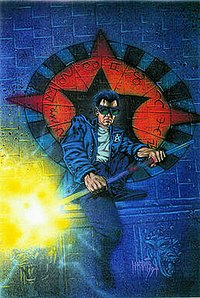
Jack Knight, From Wikipedia
The heroes of old are, with a few notable exceptions, gone from the pages of four-color comix. That bright world has lost its innocence — and much of its creative energy — to teams of muscle-bound vigilantes toting semi-automatic plasma bazookas, and to impossibly endowed females flirting with loss of circulation if their rubber corsets were any tighter.

 Then came Starman.

As created by writer James Robinson and artist Tony Harris, Starman is Jack Knight — a small figure of a man, a tattooed late-20-something, obsessed with all things rare and antique. He'd rather scour rural flea markets for View Master reels and Depression glass than dress in Spandex and duke it out with the villains.

His idea of a costume is night-vision goggles and a leather jacket.

But as the younger son of a 1940s superhero, Jack has become the epitome of the chicken-or-egg question that haunts history: Do great events conspire to create heroes, or do great men and women arise to make history?

In Jack's case, events sought him out and he rose to the challenge. His big brother, David, was first to don Dad's mantle, only to be killed by a sniper's bullet in the first pages of the first issue.

(Jack has since had two surreal visits with his deceased brother — the first as they fought in a grave yard over the right to the Starman name, and the second as David sought to warn Jack of future events.)

With his father injured, his brother dead and his own antique shop razed by the children of an old foe, Jack uses his dad's "star rod" to rout the bad guys and restore order to Opal City.

Through Jack and his supporting cast, Robinson has crafted a book with the multiple layers of history, personality, foreshadowing and drama usually found only in works print-only fiction. His characters are distinct and react with realism — as seen in the frustration and distance between father and son that slowly dissolves into a growing respect and admiration for their individual strengths.

The periodic "Times Past" stories allow guest artists to explore events in the history of Opal and its citizens, giving us a glimpse of the Golden Age of heroes; or a tale of the nigh-immortal. sometimes-villainous Shade and his friendship with Oscar Wilde.

Meanwhile, artist Harris has crafted a vision of retro-deco cities, of characters delineated by quirky swirls and outlines, of shadows and black bordered pages.  No larger-than-life people dominate his panels — save for the lumbering Solomon Grundy. Though stylistically rendered, these are anatomically realistic human beings with an expressive range far removed from the grimacing brain-bashers in other comix.

Like our own shared version of reality, this can be a dark world. People die. Bad guys revel in the pain of others. Some cops are less-than-true to their code. Evil is powerful.

But now there's a beacon in the night.

"Starman has always been around," Robinson said in his introduction to the series, "a light in the darkness, in his own little corner of the DC universe."

Friday, June 07, 2013

Flashback Friday: 'Hitchhiker' journeys to syndication

From Wikipedia
(Once upon a time, I did a telephone interview with Lewis Chesler, creator of "The Hitchhiker," as the show moved from HBO to syndication (and got edited to a PG version in the process). This story was published in The News Herald on Dec. 6, 1995.)

The darkness is within us all, waiting for the right temptation — the particular provocation — that will allow us to damn ourselves.

The idea that evil is internal — not an external force — is the driving concept behind The Hitchhiker, a cable anthology series that is now available to local channels through the magic of syndication.

According to series creator/executive producer Lewis Chesler, the true nature of evil is best revealed through "conflicts within ourselves."

"With The Hitchhiker, we wanted to bring a level of psychological suspense that had not been present in mainstream television to that point," Chesler said. "The projection of that anxiety, psycho-erotic in a way, made for real engaging stories."

A dramatic, half-hour suspense series reminiscent of Rod Serling's The Twilight Zone, The Hitchhiker thumbed his way to 85 episodes, becoming the longest-running original dramatic series in cable TV history.

Hitchhiker first debuted in 1984 as Home Box Office's first dramatic series. Since then, it has won eight ACE Awards, delivered record-setting ratings for a cable series and paved the way for numerous imitators.

"In the '50s, science fiction was very popular, and people used it as an allegory of fears about communism and so on, manifesting `The Other' as people from outer space," Chesler said.

"I think today we also have anxieties and fears about what is within us, that subverts us," he said. "And as we approach the millennium, more people are realizing that we are more complex than we knew — that life is more ambiguous and paradoxical than we knew."

Using an anthology format to present "morality plays," each episode is introduced by the enigmatic Hitchhiker, played by Page Fletcher. When he appears, strange things follow: tales of greed, jealousy and the supernatural, that end in ironic twists of fate.

"He's a witness, not an avenging angel. He never interacts and he has an omniscience," Chesler said. "We chose the figure of a hitchhiker for two reasons: He represents the allure of freedom, the ability to transgress and break the boundaries, but he also represents danger and the unknown. He has that duality within him in that his behavior is not clear-cut — it's elusive."

The use of top movie and television talents is one of the reasons Hitchhiker has endured while hundreds of other cable-made series have faded to black. A number of major film directors, actors and writers were involved in the series.

Chesler is now working on Strangers, an HBO series he calls "the sequel" to The Hitchhiker. The pilot, shot two years ago in Paris, was directed by Wayne Wang (The Joy Luck Club), and features Linda Fiorentino, Tim Hutton and Joan Chen. The series will debut in January of 1996.

"The stories are about the American encounter with the mysterious `other.' They're like half-hour Last Tangoes in Paris, about Americans who go abroad and are on uncertain ground," Chesler said. "They're kind of dark, erotic, psychologically dense, very European."

Friday, May 31, 2013

Flashback Friday: Logging on to 'Internet'

(In 1994, I blew readers' minds with the idea of easy access to a global information filing system by which anyone at a community college might be able to access info all over the planet in only a few minutes. I know, it's difficult to believe now, but about 20 years ago this whole "Internet" thing sounded like sci-fi. Here's the story from The News Herald's Dec. 14, 1994 edition.)


GCCC will offer students access to the information superhighway


From July 25, 1994
Gulf Coast Community College is not just "surfing the Internet," it's ready to hang-ten, according to one of the school's on-line professors.

For years, computers on campus have been integrated into a closed network. But recently they have joined the Florida Information Resource Network, creating a gateway onto the international Internet.

During a recent meeting of the District Board of Trustees, Professor Joe Howell described the highlights of the system and the advantages Internet access will give to faculty and students in the future. Howell demonstrated how easy it is for someone sitting at a terminal in Bay County to access information sources around the world.

 In less than a minute, he had at his fingertips computer files in Iowa, Sweden and Asia — including professional journals, research information, job listings, electronic mailboxes and computer bulletin boards.

There was even a file on "UFO and Alien Information" — although he quickly skipped past it.

Howell accessed the U.S. Department of Education database and found an excerpt from his own doctoral dissertation on file. He looked at job listings in the Chronicle of Higher Education by reading the expensive journal on-line.

"In the not-too-distant future, we want Gulf Coast Community College to be a server site on the Internet," Howell said. "If someone wants an academic calendar, a catalog, they can get it through the computer system."

The cost would be very small with the appropriate software in place, he said.

Now, 30 terminals on campus have access to the Internet. In the future, open terminals may be installed in public areas such as the college library, so students could use the available wealth of information throughout the world.

"The challenges are doing it faster and better and using it in the instructional process," Howell said.

Meteorology students, for instance, could reach into public-access NASA files for satellite photographs less than four minutes old. They could gather information on a city's weather patterns and create forecasts in class.

"We can do that today," Howell said. "This is not science fiction."

Another challenge may be blocking student access to objective or offensive materials that can be found through the Internet. But Howell said no matter what safeguards are put in place, "some enterprising young person" will no doubt find ways to bypass them.

The ramifications of having so much electronic information at one's fingertips could make facilities like libraries — which are expensive to build, equip and staff — anachronisms, college President Bob McSpadden said.

"What role will a facility with 80,000 hardback books play in the future? A museum?" he said.

The project was made possible by a $12,000 grant from the George G. Tapper Foundation.

Howell said he had always wondered just what was meant by the term "information superhighway." The Internet, he said, puts anyone in the information fast-lane.

McSpadden said he thought trustees "would be astounded by the information" now available to the college. He was right.

"It has created a world of excitement," McSpadden said. "And its capabilities will carry us well into the future."

Friday, May 24, 2013

Flashback Friday: Melissa Etheridge

(Once upon a time I did a telephone interview with Melissa Etheridge in advance of her Pensacola concert, which was opening for Sting in Feb. 1994. This is dated Feb. 19, 1994, though I believe it ran earlier than that.)
Melissa Etheridge affirms: `Yes I Am'
MelissaEtheridge.com
Melissa Etheridge is at it again, so smile when you read the title of her latest album release, Yes I Am.

Is she becoming more politically active while disclaiming any agenda? Is she echoing her own ``coming out'' statement regarding her sexual orientation? Is she still writing gender-neutral lyrics to raw rock'n'roll music?

Ask her and she would have to say, Yes I Am.

Etheridge, 32, earned a Grammy for Best Female Rock Performance in 1993 for the single Ain't It Heavy from her 1992 album, Never Enough. Her throaty delivery, backed by deep emotion and searing guitar, would make tracks from Yes I Am Grammy contenders as well, if they were being awarded to female rockers this year.

 ``Needless to say, it's frustrating. I feel there's a real movement of female rock music, and (the lack of nominations in the category) is an oversight,'' Etheridge said. ``It points out to me a lack of rock radio play, which these nominations are based on.''

Etheridge points to the rise of the punk rock ``riot grrls'' as one of female rock's new movements. She said she ``likes the extremes'' represented by the militant feminism and blatant anti-male stance taken by the groups, which often hold no-men-allowed concerts and as a rule exclude men from front row seating.

``When the extremes move, they push the middle and I don't look like such a `bad feminist' anymore,'' she said.

Etheridge's current gig is opening for Sting on the Southeastern leg of his 1994 American tour. They will perform at the Pensacola Civic Center on Feb. 19. On the day before rehearsals began on the West Coast, she spoke via telephone about music, religion, and sexual expression.

So much has been written recently regarding Etheridge's sexual preference and her friendship with country singer k.d. lang, that one might expect the songs on her latest release to reflect her newfound openness. Not necessarily so.

Her new disc opens with the driving guitars of I'm the Only One, a song that could be interpreted for either straight or lesbian singers: she is losing her lover to another woman — is the lover male or female? In Etheridge's case, the answer would be the latter, but the song could be just as meaningful coming from the throat of straight female performers.

Wikipedia.org
``I made a decision a while ago that I would write the songs truthfully but still try not to exclude anyone. The passions and desires and feelings cross all boundaries. That is the same for everyone,'' she said. ``A man can listen to my songs and say `I know that feeling.' A straight woman can listen and say `I have felt that way.' I don't want to limit myself or that experience,'' she said.

Etheridge — who once said she was the product of a stale, white-bread midwestern environment — shares a home in Hollywood with a passle of pets and her companion, filmmaker Julie Cypher, who shot Etheridge's earliest music video. Although Etheridge said her music was open to personal interpretations, ``self-examination'' is her catch phrase. Any political, social or sexual message comes out of ``peeling back the layers,'' opening her feelings and thoughts for ``total revelation'' to the audience.

``I believe there is a way to create from and write from a totally honest part of yourself and speak directly from that,'' Etheridge said. ``But sort of like eye witnesses to a crime, everyone will see something different in it.''

Etheridge had a religious upbringing and performed both in Catholic and Protestant churches during her youth. She said she's ``not a religious person per se,'' but the influence of those years appears in her music, particularly in the new song, Talking to my Angel.

``On each of my albums there is at least one song that refers to angels,'' she said. ``I grew up in many different churches, and was struck by their icons and symbols and religious knowledge, and realized the power they have in our society. So the terms `angels,' `devils,' `God,' are incorporated into much of my writing. I'm talking about spiritual forces, a muse, inspiration, the spirit and memory of loved ones I've lost. They take on a new form that I call `angels.' ''

There is also a hint of darkness in Etheridge's songs, the plaintive voice of the outcast seeking approval and love, yet reveling in her differences. Having been embraced both by straight and homosexual audiences, and having gained public recognition through her award, she can afford to do both.

``In my personal exploration, I've found that there really is a `dark side' to all of us. You find it in our religions, books, even movies. People try to exorcise it, but there comes a point when you can't get rid of it,'' she said. ``So much fear and intolerance comes from that darkness. We're afraid of so much that we don't understand.

``I try to overcome my past inheritance of ignoring that side of me, so I draw it out, write about it, talk about it — shed come light on it. That's my philosophy, how to find some inner peace.''

(The rest of the story: I drove with my wife to Pensacola to see the concert; Etheridge's manager said I would have two tickets waiting at will-call. Instead, there was a pass to photograph the first two songs of Sting's performance, but no tickets. The show was sold out. We turned and walked away. Monday, the manager called to thank me for the article, and was apologetic when I told her about the ticket problem.)

Friday, May 17, 2013

Flashback Friday: Garibaldi on the Firing Line

(Once upon a time, I did a telephone interview with Jerry Doyle, who was at that time playing Security Chief Michael Garibaldi on the sydicated sci-fi series Babylon 5. The following originally published in the Sept. 8, 1995 edition of the News Herald.)


Jerry Doyle shares many of the character traits — and flaws — of Security Chief Michael Garibaldi, the role he portrays on the syndicated sci-fi drama Babylon 5.

Both men have high standards, are outspoken and audacious, and both have a murky past. Both men sometimes take a side door to reach their targets, and neither man is above a little scheming if it produces the right results.

"I think a lot of acting is just life experiences, reality brought into a situation and interpreted," Doyle said.

Born and raised in Brooklyn, Doyle received a Bachelor of Science degree in Aeronautics from Embry Riddle Aeronautical University in Daytona. His first job was marketing and selling corporate jets in New Jersey, but he never really wanted to leave college.

"I was having too much fun," he said. "It was a surprise when it happened. My wife and I have fond memories of the (Fort) Lauderdale area, and a dream of when we can get this great big ol' sprawling place on the water and just go sailing."

Doyle left a nine-year Wall Street career in 1990 to try his luck in Hollywood. He had endured the October market crash, company problems, daily pressure and what he termed an ambush from 60 Minutes. The place just wasn't fun any more.

"When 60 Minutes walks into your office, you know the day isn't going to go the way you expected," he said.

To get an acting job in L.A., Doyle needed a performance resume. But he had never acted before and "stocks, bonds and hostile takeovers" just wouldn't look good to casting directors. So he fudged a bit on his resume, creating a fictitious credit with the Harlem Dance Theatre.

"I didn't bend the rules — they snapped. I put a lie in there so blatant that I thought people would get the joke. If anybody had ever 'seen' them, there was a real good possibility that I wasn't touring with that group," Doyle said.

"In 4-1/2 years, nobody's ever questioned it," he said. "It's still on there, as my tribute to absurdity."

That side-door route landed him roles on The Bold and the Beautiful, Homefront, Reasonable Doubt, and Duckman.

Then came Babylon 5.

A COP'S LIFE

Garibaldi is a man with flaws. A recovering alcoholic who's lost more jobs than he can recall; who's lost at love more often than not; who's burned all his bridges and has nowhere to turn if things go wrong on B-5.

"We're all trying to overcome our demons," Doyle said. "We may conquer technology, cure diseases, but we're always working on ourselves. It's what the audience hopefully can relate to."

As Garibaldi, Doyle has turned a supporting role into the show's most popular character. A recent three-issue story in the B-5 comics adaptation focused entirely on Garibaldi, as did two recent novels. Doyle has also gained an international fan following, thanks to the show's popularity overseas.

In an integral first-season episode, Garibaldi has a vision of a future battle in which he and the station commander are trying to hold off unseen attackers while civilians evacuate B-5. Garibaldi volunteers to cover the retreat, yelling that this is the moment for which he was born.

"Yeah, a lot of people have said that they know what happens to me in the future," Doyle said. "But they're talking about a spin-off series (if B-5 lasts through its projected five-year mission). I was given the option of wrapping up my storyline or going on to the new show. I'm not going to tell you what I decided."

The role of space cop comes easily to Doyle, whose father was a career police officer in New York (his mother worked at home). His father provided a good life for the family, and put off his own joys for later in life. But he died at 41, having never done the things he dreamed of doing.

"I didn't want that to happen to me," Doyle said.

And yet, foremost in Doyle's thoughts are his family and the future he can provide for them. He said L.A. isn't the kind of place to raise kids, so he wants to "grab as much as I can as fast as I can, punch out and go where the air's nice."

He would like nothing better than to be able to "wear shorts, drink beer and take people fishing," activities he said defines the Florida vacation/retirement lifestyle.

But until then, he won't be waiting for projects to come his way. He's co-written two scripts, is developing a feature film, a TV movie-of-the-week and an old-fashioned Christmas special.

"I would love to be involved in a product that lives on ... something that's timeless, like a Casablanca," he said. "And I'd like to do a pirate movie. I think that would be way cool."
-----
(NOTE: The interview was accompanied by this sidebar that included more comments from Doyle:)
-----
Babylon 5 Info Guide

The Babylon Project was our last, best hope for peace. It was the dawn of the Third Age of Mankind, the year the Great War came upon us all. The year is 2259. The name of the place is Babylon 5.

Two years before Paramount launched its space station-based Trek spinoff, television veteran J. Michael Straczinsky had tried to sell a network on his vision of just such a series:

--The space station Babylon 5 would be a hotbed of mystery, suspense and intrigue, where humans and aliens would scheme and struggle and join together in unexpected alliances.

--As forces behind the scenes plotted to seize control of the Earth government, a dark presence from a forgotten time would rise to challenge the champions of all things good and just.

--And in the third year of the series, a war of intergalactic proportions would erupt, and humankind would face its darkest hour.

No network nibbled, but Warner Brothers gave the concept a greenlight for first-run syndication.

In the ensuing years, B-5 has opened new frontiers in TV sci-fi. That pivotal third year is now upon us, when the galaxy's "last, best hope for peace" becomes its "last, best hope for victory."

In the meantime, B-5 has garnered an Emmy award for visual effects and Emmy nominations for make-up, hair and cinematography. It was nominated for a Hugo award from the World Science Fiction Association and received The Space Frontier Foundation Award for Best Vision of the Future from the National Association of Space Scientists, Astronauts and Engineers.

Though syndicated in the U.S., B-5 is carried on TV networks in other countries. In Great Britain, for instance, the show has developed a cult following similar to the Star Trek phenomenon.

"It's huge, like the No. 2 or No. 3 show in England, Ireland, France and Italy," said Jerry Doyle, who plays B-5 Security Chief Michael Garibaldi. "I'm going to Bristol in August and Dublin in September (for fan conventions)."

But unlike most television series, Straczynski saw B-5 as a complete story with a definite ending five years after the premiere. Each episode would be like a chapter of a book, each season would be a volume in the continuing story.

The show has also done something few series have accomplished: B-5 lost its hero and most integral character at the close of the first season.

Commander Jeffrey Sinclair (Michael O'Hare) appeared only as a face on a recorded message in season two, although a first-season episode revealed him to be "The One" who, in the future (or the distant past), will lead the forces of light against the Shadows.

The future Sinclair, in fact, was responsible for the mysterious disappearance of B-5's predecessor, Babylon 4 — snatching it out of the past via a time travel device for use as a base of operations against the dark enemy.

"I don't know what they're going to do with that character. We just try to play the beats as they're written out," Doyle said. "There's a strong possibility that (Sinclair) will resurface this season -- but whether it will be to start a new storyline, to finish a storyline, or as another recorded message, I really don't know."

To put it mildly, the show is complex and multi-layered. Characters change over time, literally evolving into new forms and revealing new facets of their personalities. Subplots that seemed minor grow into major plot points.

Psy-Corps telepaths jockey for political control; Home Guard bigots beat up aliens and want Earth out of space; the assassination of the Earth president is covered up; the mysterious Shadows aid a race war as another alien power grooms the new B-5 commander (Bruce Boxleitner) to battle the Shadows; and, behind the scenes, Sinclair gathers a secret army of "Rangers."

The Great War is upon us. And all eyes turn to Babylon 5.

Friday, May 10, 2013

Flashback Friday: Jurasik's Spark

(Once upon a time, I interviewed actor Peter Jurasik about his role on Babylon 5 as the alien ambassador from Centaruri Prime, Londo Molari. He was at times jovial and introspective, but mostly it was apparent he enjoyed his work and the people with whom he worked. This was published Oct. 18, 1996, as B-5 was ending its third season of syndication and Jurasik was already working on Season 4.)

Get past the gravity-defying hair and the thick Bela Lugosi accent, and the essence of Londo Molari, Centauri Prime's ambassador to space station Babylon 5, is really quite human.

On a recent October morning, actor Peter Jurasik — who breathes life into Londo for fans of B-5 — talked with The News Herald from his California home, commenting on the autumnal weather, the evolution of his TV character and an upcoming book release.

As the interview began, Jurasik was interrupted by a phone call from fellow B-5 cast member Bill Mumy (formerly Will Robinson of Lost in Space). Mumy wanted to play a round of racquetball, but Jurasik had tickets to the Dodgers-Braves game.

The exchange brings home the fact that these guys are just regular folks. And yet, for the entertainment of thousands of fans world-wide, they're seen as enemies on a galactic scale, their actions determining the fate of worlds.

Babylon 5 follows the activities aboard a massive space station in the 23rd century, located in deep space where a quarter-million aliens and humans mingle to work out their differences. But earth's government is reeling from civil war, corruption at the highest levels, and the return of an ancient Shadow race that seeks conquest among the stars.

Londo, long considered a washed-up politician in a backwater assignment, has emerged as a major player in the conflict — and on the wrong side.

Jurasik says the role was a perfect fit for his needs as a character actor.

"Initially, when I went in to read for the part, we had a short chat and I asked (B-5 creator Joe Straczinski what he'd like for these people to sound like. He said, 'These guys are from outer space. They can sound any way you want them to.' Which is great for a character actor. Character actors will inevitably put on a wig or an accent or a costume, and I've done all of that."

Jurasik has appeared in numerous TV incarnations over the past 20 years, including a memorable turn as sleazy "Sid the Snitch" on Hill Street Blues. He's also appeared on Dear John, L.A. Law, MASH, Taxi and Dave's World.

Picking up the theme of change, Jurasik says circumstances have either "conspired or inspired" Londo to great personal changes. His drive to restore the lost glory of his homeworld led him to bargain with a shadowy alien race for greater power and influence.

"I hate to go '90s on you, but his priorities have changed. Four years ago, when we first met Londo, he was pretty buffoonish, pretty much a drunk. But there was an underlying bitterness, almost an anger, black and biley. He's always been very concerned about his people. So the change, for me, tracks very well."

If that sounds like the kind of evolution that real people experience, then B-5 has accomplished something few other sci-fi shows attempt: to allow characters to grow. Similar shows generally present self-contained stories that always leave the characters pretty much at status quo. Miss an episode or two and you'll still recognize the characters. Not B-5.

"With Babylon, you will get some satisfaction by watching one episode. We have great special effects, exciting storylines. But the real hook is the big story arc. I think that's what has really grabbed the imagination of English fans, the Dickensian tradition. It's something that's just not emphasized on American television."

Meanwhile, Jurasik has recently completed his first sci-fi novel, Diplomatic Act, (from Simon & Schuster//Baen Books, spring 1997) which takes a sardonic look at Hollywood and contains more than a few veiled references to the set of B-5.

"What do I know more about than that? It's about an actor working on a science fiction show playing a diplomat, who is abducted by aliens because he reminds them of somebody. They are from this `watcher' society, and are intrigued by TV."

Regular B-5 viewers (and alien watchers) will know that Londo has had a vision of his death — and a time travel episode last season reinforced this vision. But Jurasik hints that the future is malleable.

"It's not really a cop-out, but it's the out all the actors use, at least on our show. Joe Straczynski is really The Great Maker, and he indicates to us that these dreams and prophecies are just that — it doesn't necessarily mean they will come true."

Now beginning its fourth season, B-5 was plotted as a five-year storyline. But Jurasik, dangling a bit of intrigue, said his character may not even survive to the series finale.

"I have always taken the line that I think audiences like to have happy endings. I don't know that Joe will subscribe to that, at least in Londo's case. I mean, he's made some heavy mistakes and will have to pay for those. He's in a fight for his people in the fourth season, and he'll have to come to terms with the `deal with the devil' he made. Those things will have to be straightened out."

Friday, May 03, 2013

Flashback Friday: Robin Curtis beams down

(Once upon a time, I interviewed actress Robin Curtis prior to her visit for a small sci-fi convention in Panama City. The actress was best known to me as the second "Lt. Saavik," having taken the role over in Star Trek movies 3 and 4. She was fun to talk to, very open and uninhibited, the polar opposite of her half-Vulcan character. This article is dated Friday, Feb. 24, 1995, meaning it went to press on Feb. 23.)

'Trek' star to appear at local Trek-O-Rama

Her face may not be familiar at first — minus the characteristic pointed ears and arching eyebrows — and her effervescent personality would embarrass her repressed Vulcan counterpart.

But Bay County Star Trek fans will be pleased by the person beneath the makeup as they get the chance to mind-meld with Robin Curtis — "Saavik" from the third and fourth Trek films — at the Trek-O-Rama convention.

"I enjoy (conventions) so much, but I haven't done one in a while, so I'm a little rusty," Curtis said in a telephone interview from her California home Tuesday evening.

Self-described as "effusive, expressive and full-of-life," it wasn't easy for someone like Curtis to play a coldly logical Vulcan.

"I spill all over everybody, excitement leaks from every pore," Curtis said. "(The fans) realize how difficult that must have been for me."

Curtis took over the role of Saavik after Kirstie Alley (of Cheers) had played the part in Star Trek II. Curtis said her status as a replacement was never an issue among the cast or the fans.

"It's interesting how, in life, the obvious problems are the ones that never materialize," she said. "The fans appreciate me for me."

Her role was pared down in the fourth Trek to give more screen time to the ensemble of original players. She said that was fine with her because that group of actors deserved the attention.

"My association with Star Trek has been nothing but beneficial, really. To think I'm still generating income from a job 11 years ago is astonishing," she said.

According to Curtis, her body of work could only be considered "a career" if it were put together with "some paste and Duco cement." Star Trek conventions — she appeared at 17 of them last year — have helped pay the rent.

"I've kind of let fans in on the fact that actors spend most of their time unemployed or looking for work," she said. "And they have let me in on what I have become a small part of."

The positive message behind Trek — that the future is bright and full of adventure — took Curtis a while to comprehend. She had never been a real Trek fan before landing the Saavik role, but has since immersed herself in the lore of future history.

"Who knows why the hell these things come to us? I'm just pleased to be part of something I consider to be a good thing," Curtis said. "I like what I've learned and how these people think. I hate to stereotype, but on the whole, I find the fans to be interesting, thoughtful, fun-loving people."

Curtis compares favorably her experiences on the movie sets with those on the set of Star Trek: The Next Generation, in which she guest-starred as a Romulan spy.

"It's viscerally very much the same," she said. "Star Trek is very stylized. The pace is slower and more thoughtful than most TV. There's that upright, military stance, straight as a beam right up your butt."

Curtis catches some good-natured ribbing for her stint hosting an infomercial for the Braun Handblender, but she doesn't apologize for blatant hucksterism. After all, in some ways, that's what conventions cater to.

"As long as it doesn't go up an orifice, we'll sell it," she said. "Actually, I wish I had a nickel for every one they sold (through the infomercial). Sales quadrupled and they renewed my contract for another year."

Curtis also has made a few commercials recently, but she hopes infomercials don't become her bread and butter.

"I'm hoping I haven't found my niche. That's not the goal, here, but I do thank God I'm capable of doing these kinds of things and maintaining a modicum of integrity," she said. "Work begets work."

During the interview, her new agent interrupted to tell her Dove Books wants her to do another science fiction book-on-tape reading for them — a job that no doubt came her way because of her Star Trek recognition value.

"It never stops. It never ceases to amaze me," she said. "Star Trek is like this monster machine that just won't stop."