Showing posts with label books I have read. Show all posts

Friday, April 29, 2016

Flashback Friday: Doc Savage and 'The River Extraction'

(Originally published Sunday, May 6, 2001, in The News Herald)

Cover Art by James Bama
As a youngster, one of my greatest literary heroes was Clark Savage Jr., better known as "Doc Savage: The Man of Bronze." A millionaire, surgeon and inventor, Doc traveled the planet righting wrongs with the aid of his World War I buddies, Monk, Ham, Johnnie, Renny and Long Tom (and sometimes his cousin Patricia Savage).

Written by Lester Dent under the pen name "Kenneth Robeson," Doc's adventures were set in the 1930s and featured in pulp magazines of the day. I became familiar with him in the 1970s when Bantam reprinted the serialized stories in the form of paperback novels, Marvel Comics published illustrated tales and Warner Bros. produced a campy movie starring Ron Ely.

Without doubt, Doc was the template on which other superheroes and adventurers were built. Clark Kent owes more to Clark Savage than a first name. (A "biography" of Doc released in the 1980s linked him by blood with the English nobleman called Tarzan, Sherlock Holmes and Lamont Cranston - "The Shadow.")

Ron Ely as "Doc"
Doc's base was on the 86th floor of the Empire State Building, but he also had a secret "Fortress of Solitude" in the Arctic where he exercised his mind and body to the pinnacle of human perfection. Invariably Doc's physical exertions and hand-to-hand battles resulted in his safari clothing being reduced to tatters. (The number of shirts he went through was used to comic effect in the film.)

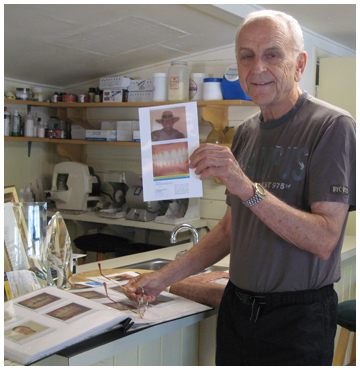
That image came to mind this week when I heard the tale of Ebro dentist John Savage ripping off his clothing as he dived into the Choctawhatchee River to pull a patient out of a sinking car. (Call it an emergency dental extraction.)

"It was strictly an immediate reaction," Savage said later. "They asked me if the water was cold and I had to say I never even knew if it was cold or not. There was just too much tension and too much tragedy about to happen.

John Savage, DDS
"I tried to get my socks off, but there wasn't time to get them off."

The car had raced out of control and bounded between trees and over a sand bank where Savage's riverside office (and Fortress of Solitude) sits; the driver initially had trouble getting out of the car and then struggled to swim while wearing steel-toe work boots.

"I'd try to help anybody in that condition," Savage said. "I didn't have time to think about it."

Once again, "Doc Savage" was the hero of the moment. Now he's back at his day job - fighting for tooth, justice and the American way.

Peace.

Tuesday, October 13, 2015

Behind the Writing: PART 1: Characters or Situations?

The following is the first in a three-part series about the craft of writing, specifically characters and situations, why we write stories, and how to refill the creative well. These conversations took place in early October 2015 with author Mark Boss and myself.

Mark Boss at PC Creative Con 2K15
Mark: We were talking the other day about characters. You read Stephen King’s “On Writing,” and he says he always starts with a situation; I started thinking, how predominant is that? How many authors start with a situation versus starting with a character? When you told me about your Alabama trip, it seemed like the seed of it, the germ was the character first. What triggered that idea, and then did you build the situation around that character?

Tony: I think that story came out of inundating — immersing myself in a bunch of unrelated ideas. I’m in Birmingham, and there’s a lot of stuff about the Confederacy, it’s an iron town — that whole blacksmithy, iron works, steam era feel to it. And I’m reading a lot of steampunk. All of those things fed into the mulcher, and then, driving home, seeing those old Southern city names —

Mark: Specifically, Jemison and Thorsby. Were they in that order?

Tony: Yes.

Mark: Because you might not have thought of it (if they were in the reverse order).

Tony: Right. That came from character first, from a mixture of the names and a time period I had floating around in my head. So in a way, the situation was kind of already there. I was primed to find a story that was steeped in the Old South.

Mark: Which is quite a departure, because I’d say most steampunk, maybe 90 percent of it, is Victorian England. At best, they cross the Channel to France. So Steampunk-USA is a departure.

Tony: With my Caliban stories, it definitely came out of character first. I was 14 years old and wanted to write Doctor Strange. Before I knew it, I wasn’t writing about the wizard, I was writing about the kid he trained and the development of his potential as a magic-user. Over the years, both of those characters kind of developed in the back of my head. — So, how about you, Mark? Character or situation?

Mark:  Looking at the last few books, I realize I’m going more ‘situation.’ My thing was a “what-if.” What if all these bad things happened at the same time? I love zombie things, and zombies were very big at the time. And yet I thought, okay, what if we ramped it up? Because one apocalypse is not enough for me. That’s just too slow. I want to see us get devastated. So you throw in aliens — the classic thing of alien invasion — and then you throw in a robot uprising, and then we’re starting to get it boiling. We’ve brought it up to temperature. Then I started thinking, everyone is going to be caught in this, but we don’t want to follow the people who just sit in their basement and wait for it to stop. We want to follow people out there actually doing things. The books jump around a fair amount to different characters. Even so, I tried to focus on the excitement: Let’s go look for the most important things happening or the most fun things happening. That was more a situation thing, but I had never thought hard about it until recently.

In the next post, we’ll address the question: Why do we make up stories?

Check out Mark's blog "Chimp With Pencil"<<
Mark's website<<
and his Amazon author page<<

Friday, August 28, 2015

Superheroes Aliens Robots Zombies - First trilogy now on sale!

Cover art by Rob Woodrum
My friend Mark Boss has finally released the first three books of his new series, SUPERHEROES ALIENS ROBOTS ZOMBIES. If you like any one of those four subjects, you will devour these books. I have read them (during the editing/writing phase) and loved them. Each book comes with bonus materials, as well.

The story follows a boatload of vibrant characters, from Special Agent Kyle Kane, who first battles the zombies in a small town and eventually plays a major roll countering an alien invasion; Vigilant, the high-tech vigilante; Schroeder and Alvin, the sniper and his smartgun; Protor and his robot brethren; Hook, the singularity in human form, and his robot spider soldiers; and so many more!

<< The story starts with this volume, which is ONLY 99 CENTS for Kindle devices. (Disclaimer: Mark has included part of my THIS MORTAL FLESH novel as bonus material in this volume.)


Cover by Jayson Kretzer
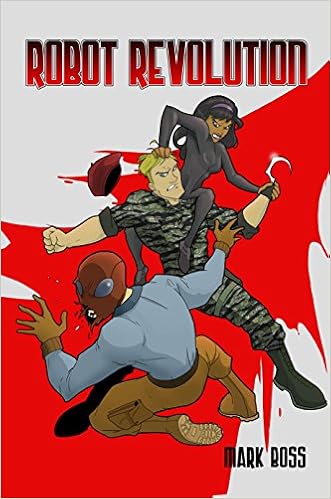
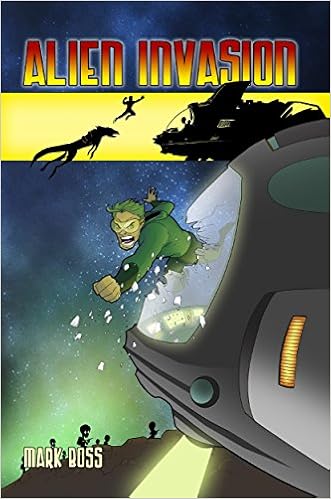
<< It continues with ROBOT REVOLUTION (which includes a short story about the character SCHROEDER), and comes to its interplanetary conclusion with ALIEN INVASION (which includes a behind-the-scenes essay about the origins of Mark's ideas, characters, and more).

Cover by Jayson Kretzer


You can find out more about Mark at these links:
>>His author website
>>His Twitter page
>>His blog site
>>His Goodreads page

Mark Boss at CreativeCon 2K15
Mark is a fellow member of the Coffeehouse Syndicate (a group of friends that get together once a week for lunch and conversation about movies, comics, TV, creativity and how we're going to take over the world), as well as The Cheshires writing group in Panama City. We also shared a table recently at Creative Con, where we shilled each other's work. I'm telling you all this for two reasons: 1) Transparency, and 2) I know what I'm talking about. Mark puts real thought and love into his work, which is fast-moving, hard-hitting, full of surprises and big ideas, as well as the smaller moments that make the action worthwhile.

Thursday, January 22, 2015

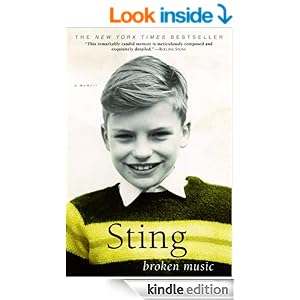
Book Review: 'Broken Music' by Sting

Though the pages are numbered/ I can't see where they lead/ For the end is a mystery/ No-one can read/ In the book of my life. 
-Sting, 'The Book of My Life' (Sacred Love)

"The Early Life and Misadventures of Gordon Sumner (Abridged)" would have sufficed for a title, but it would have been far too literal for the author of the engaging autobiography, Broken Music (352 pages; $26 Hardcover).

In this sometimes shocking self-portrait, the post-punk musician and poet known to the world as Sting first meets readers in the rainforests of South America in the 1990s, and takes them along on an hallucinatory semi-religious experience induced by ingesting a native plant — through time and memory — back into the life that molded him into a front man for The Police.

"It is a story very few people know," Sting writes in his introductory notes. "I had no interest in writing a traditional autobiographical recitation of everything that's ever happened to me. Instead I found myself drawn to exploring specific moments, certain people and relationships, and particular events which still resonate powerfully for me as I try to understand the child I was, and the man I became."

Often as eye-opening in its normalcy as it is in the offhand way it deals with what should have been outlandish, the narrative is always engrossing.

Here are unflinching examinations of young Gordon's family members, their hard lives, and the circumstances of his upbringing. In the process, those who know Sting's music and lyrics will find themselves recognizing the origins of his "summoner's tales" — the shipbuilders, the "Saint Agnes," the fortress round his heart.

It's little wonder that, reading Broken Music, I was repeatedly reminded of specific lines and images from Sting's albums — especially The Book of My Life, a track from his 2003 album, Sacred Love.

"Having been a songwriter most of my life, condensing my ideas and emotions into short rhyming couplets and setting them to music, I had never really considered writing a book," Sting writes in the book flap.

The title comes from a remembered moment when young Gordon, searching for an emotional outlet after realizing that his mother is having an affair, bangs on an old piano at his grandmother's house; the woman comes in and asks if he can't play something other than that "broken music."

And so he begins trying to use music to put things back together.

---
(This review originally appeared in The News Herald on Jan. 30, 2005.)

Thursday, November 20, 2014

TBT: Something From The Nightside

(This originally ran in The News Herald on Sunday, Nov. 28, 2004) 

WHAT WE'RE READING: The Nightside novels

In Something from the Nightside, private detective John Taylor returned to the dark, magical heart of London where he was born to find a teenage girl who had been eaten by a house that was not really a house.

The 2003 Ace book introduced Taylor, his preternatural gift for finding things, and the strange segment of the city where it's always 3 a.m., the moon is always full and things are never what they seem.

In the second book (late 2003) of Simon R. Green's projected six-part Nightside series, Agents of Light and Darkness, Taylor found himself fighting angels from both Above and Below after he was hired by a rogue priest to recover the Unholy Grail — the cup from which Judas drank at the Last Supper. Seems both sides thought it would give them the edge they needed to win their eternal war; needless to say, Taylor didn't like the odds of the Nightside surviving Judgment Day.

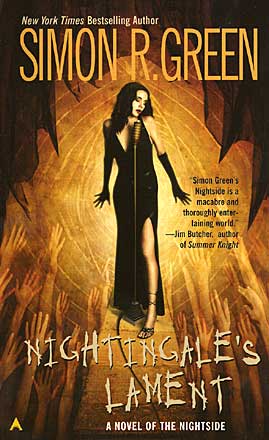
Now the third book, The Nightingale's Lament (2004), finds Taylor trying to figure out why fans are dying at their own hands after listening to the songs of the Nightside's latest singing sensation, Rossingnol — and what unearthly power her spiderlike managers hold over her.

(In March 2005, Ace is scheduled to release the fourth book, Hex and the City.)

Green is perhaps best known for his science fiction and fantasy series — the Deathstalker books chief among them. But the Nightside novels promise to supplant these, both in depth and scope.

Taylor runs the razor's edge, trusting neither the light nor the darkness — and trusted by neither side. He's an anti-hero for the ages, one who can reference both Obi-Wan Kenobi and Merlin the Magician, for instance. One who is as at ease jousting with knights as with biker chicks hopped up on demonic steroids.

The books are quick reads, mixing pulp detective yarns with Lovecraft all wrapped in wicked British humor. They also tend to follow a pattern that sets their protagonist and his few surviving friends against overwhelming odds — to which they respond with a shrug, a pull on a cigarette, and begin rolling up their sleeves.

You know this is liable to hurt later, but it's better to just get to it.

Now, that's the guy I want at my back when the traffic gets hungry and the spiders come out of the rotted woodwork and the angels turn people to salt at the fast-food joint and the nightingale's song makes death seem like a good idea. Someone to watch over you — to whack you upside the head and kick you in the behind and cast a protective spell and find the hidden path out of this mess.

Someone from the Nightside.

Thursday, May 15, 2014

Boss debuts new thriller, ‘One Bullet’

Cover Art
PANAMA CITY — The only criminal other criminals trust with their money is the bagman, and bagman Joe Barrow never lost a delivery until a mysterious killer left him for dead and escaped with the cash.

Now Joe and his girlfriend, Carly, must find the money before the Cartel, the cops, or his own Syndicate finds them. Carly owns his heart, and Joe will do anything to protect her. He should run, but he’s determined to expose whoever betrayed him and deliver the cash.

One bullet at a time.

That’s the situation in “One Bullet,” the new crime thriller from Panama City author Mark Boss. Set in Panama City, Rosemary Beach and other locations across the Emerald Coast, “One Bullet” tracks its characters from one extreme situation to another in a driving narrative full of violence and dark humor.

In many cases, Mark said, it’s only when people face that kind of situation that you see them for who they really are. That’s why he delighted in throwing obstacles, injuries and betrayals at Joe Barrow as “One Bullet” progressed.

“Early detective characters were cowboys in a city. There’s always a girl — there’s not a plot without a girl — there’s always a bad guy, a McGuffin (or plot device), a bag of cash or a case of jewels,” he said. “It’s a collision of people that are doomed in the same way characters in Greek and Norse myths are doomed, falling forward into the plot. They can’t help themselves.”

Mark’s previous books include the thrillers “Hired Guns” and “The Cultist,” and the urban fantasies “Dead Girl” and “Dead Girl 2: Fader Boy.” He’s a member of the Panama City Writers Association and The Cheshires writing group. His website is MarkBoss.net, and he blogs at ChimpWithPencil.com. >>This is his Amazon profile<<

Mark began writing pulp-style thrillers for a website called “Beat to a Pulp,” and an early version of “One Bullet” was produced for this site. However, he credits PCWA member Wayne Garrett with questioning a portion of the story that got him thinking of it in deeper terms.

“He got the hamster wheel turning,” Mark said, which led to research into things like money laundering and hacking. As is usual for novelists, most of the research is never seen in the book but serves to inform the writer’s approach.

Mark makes his living as an editor-for-hire, freelancing for novelists, tech companies, non-fiction authors, academics and more. His short fiction has been published in “Between There” Volume 2, “Meow,” “50-to-1,” “Blazing Adventures,” “The Dead Mule School of Southern Literature,” and the Emerald Coast Review.

“Editing pays the bills, and writing keeps me off of rooftops and out of sanitariums,” he said. “Anybody going into writing for the money is crazy or at least misinformed.”

Mark’s family came to Panama City in 1969, when he was a wee tyke. He considers himself a native. His first written works were comic books he illustrated in spiral notebooks, though he started reading epic novels like “The Hobbit” at an early age.

“Comics were friendly. They were short in pages, but epic in storytelling,” he said on his Amazon.com biographical note. “The point is that when I wrote/drew the last page, I had told a story.”

He soon began emulating Edgar Rice Burroughs and other authors he admired. He wrote his first (self-described “horrible”) novel during college in the mid-1980s, under the influence of Douglas Adams.

“When I was young, I went through a phase of reading Dashiell Hammett and Raymond Chandler,” he said. “The people in those books were so real to me — people who made terrible mistakes, but that’s real. The things that drove them were relatable to me.”

Post-modern storytelling, full of anti-heroes or a collection of debased characters, is not something that appeals to Mark, who said he needs someone in a story that he can pull for.

“They may be knuckleheads or killers, but at least they’re attempting to do the right thing,” he said. “The heart of every great story is good versus evil, the moral conflict. A story mines that, or it’s just a newscast.”

Mark said he’s fascinated by characters who make all the wrong decisions for all the right reasons, like those who throw caution to the wind for the sake of love: “That trumps everything. Love trumps reason, danger, all of it.”

Peace.

---
(This was my Undercurrents column for PanamaCity.com and The News Herald.)

Friday, November 15, 2013

Something Like a Dream I Had...

PANAMA CITY — The stage goes dark and a spotlight picks out the lone figure bending under the weight of her despair. She begins, quietly at first but with growing intensity, to sing about a dream of a life worth living.

Susan Boyle famously leaped from obscurity to international renown in 2009 for her rendition of the song “I Dreamed a Dream” from “Les Miserables.” It’s a song of desolation and hopelessness, sung as the character Fantine loses her job and drifts into prostitution, illness and death.

In the Gulf Coast State College production of the musical, opening Friday to a sold-out theater, the role and the song is performed by GCSC student Leeah Taunton.

“Fantine is a tragic character,” Taunton said. “She’s iconic for the women in poverty back then and the things they had to go through. She dreams of a life that she has always wanted and longed for, but unfortunately she doesn’t get that.”


As Clinton McCormick explains, that’s because people couldn’t change their stations in life in the days before the French Revolution. McCormick, as Jean Valjean, stands taller than just about anyone else on the stage — and it’s a suitable visual metaphor.

“Jean Valjean is the ultimate underdog,” McCormick said. “He got sent to prison just for stealing food to feed his family. … He’s given this chance by God to make something better out of himself. Back in this time period, this never happened. If you were poor, you stayed poor.”

McCormick said playing Valjean was the chance of a lifetime because he’s a symbol of hope and endurance, the struggle to make a better world one soul at a time: “It shows the goodness a man has in his heart. You hope to be this man in your own personal life. It inspires me to be a better person.”

(Which makes his struggle also, if you consider it, a fitting metaphor for the community college experience as well.)

Valjean’s nemesis is the police officer Javert, whom we first meet as the overseer of a group of convicts. Javert gives Valjean his parole papers and sends him off into the world, warning Valjean that he will always be a criminal in the eyes of the law and society.

“He’s often villainized, but he’s not a bad guy,” said Stephen DeVillers, who portrays Javert. “He is a good guy, he’s just strict to the letter of the law.”

DeVillers has played the lead in a number of productions at Gulf Coast, but he said “Les Mis” is like no other show he’s done: “It’s the biggest show we’ll ever see, probably, here — probably the biggest show I’ll ever do. It’s just been awesome doing this show.”

Taunton echoed his experience, saying her favorite thing about the production is the complexity and challenge: “It’s the most difficult show I’ve ever been in. The challenge every day — it’s very rewarding.”

Not everyone lives the dream they dreamed. Not all can change their station. But that doesn’t make the challenge less rewarding. It’s the journey, after all, and not the destination.

Peace.

(My Undercurrents column this week for PanamaCity.com and The News Herald.)

Thursday, October 03, 2013

Speaking to strangers...

River Jordan speaks at Palms Conference Center
PANAMA CITY BEACH — Laughter initially filled the Palms Conference Center on Wednesday afternoon as author River Jordan took the stage to tell her stories. Soon enough, however, the deeper truth of those stories began to sink in as River led the luncheon audience to understand how the lives of strangers are intertwined.

“Sometimes the life chooses you,” she said. “You don’t choose the life.”

River, the author of “Praying for Strangers,” is a Panama City native now based in Nashville. She spoke at the fundraiser to benefit the Panama City Rescue Mission’s Bethel Village program for women and children, which is working to purchase new mattresses for the shelter, with the help of The Sleep Center in Panama City.

“So many of us think of prayer as a bedtime activity, as we prepare for sleep,” said Cathy Byrd, director of the Women and Family Ministries for the Mission. “So this is a nice tie-in with our campaign. River shows us we can pray anywhere, anytime, for anyone.”

(For more details on the fundraising effort, visit PCRMission.org.)

Fran, River and Leah (mom)
River, who wore a necklace marked “Dream” on Wednesday, is a natural storyteller. She says she was “discovered” as a writer by a sixth grade teacher. She considers herself a novelist — she’s currently working on a new novel about “bourbon, bullets and broads” — and never intended to write a nonfiction book.

Clearly, as she says, she also never wants to be “trapped in the box” that people might want to imagine for her.

I first met River when she was executive director of the Gulf Coast Children’s Advocacy Center in Panama City. In her spare time, she was working on a novel that became her debut, “The Gin Girl.” Since then, she has published another three novels and two non-fiction books, including “Praying for Strangers.”

River started praying for strangers in 2009, as her sons were deployed to the Middle East and she realized she was selfishly praying for their safety. Instead, she vowed to pray for the strangers she met each day. She never meant to tell any of them that she prayed for them, and she never expected to know how her prayers might be received.

“It was never about anything except God’s love and blessings and perfect peace,” she said. “That they be loved, they be warm, that they be fed, or whatever (their need) may be.”

Me and River
But then she felt led to tell a woman in a bus stop that she had prayed for her, and the story that poured out of the woman inspired River to begin writing down what she learned through the year. Others shared stories with her, and she discovered that praying for people she didn’t even know was blessing her own life in unexpected ways.

“I don’t ‘look’ at the people in that moment,” she said. “I ‘behold’ them. I don’t judge them. I see them.”

And isn’t that, essentially, the prayer of everyone?

Peace.
---
This is my Undercurrents column for PanamaCity.com and The News Herald this week.

Friday, July 12, 2013

Flashback Friday: Reviewing the 'Chronos' comic series

(I really miss this comic book. I'm an easy mark for time travel stories, and when they're done right I can't let go of them. I want to revisit them time after time (see what I did there?). I'd love to see Walker Gabriel show up in the current DC "New 52" universe. Anyway, here's my review of the series, Chronos, from the May 13, 1998 edition of The News Herald. This appeared in our "Generation NeXt" section, which often had comic book content.)

From BigRedHair.com
Catching up with 'Chronos'

Time is like light, according to Walker Gabriel.

"It's both a wave and a particle," he explains. "It can be diffused and reflected. The suit I'm wearing generates an energy field that bends time around me."

Walker is the not-too-bad bad guy — who just might turn out to be a hero after all — at the center of DC Comics' new monthly series, Chronos, about the rehabilitation of a time-traveling ne'er-do-well.

Writer John Francis Moore and penciller/co-creator Paul Guinan, joined by inker Steve Leialoha, have woven a tapestry of detailed characters, adventure and pseudo-science supported by artwork and pacing that bring disparate times and places to life with astonishing realism.

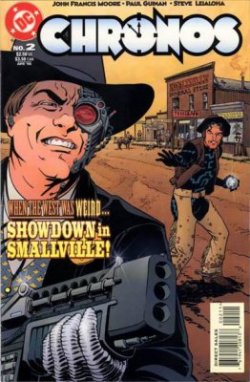
The first issue of Chronos was a dense mix of new and old DC characters and concepts. The second was less bewildering — Walker's misadventures trapped in 1873 in Smallville, Kansas, where he meets the Clark and Kent families and runs afoul of a Linear Man, one of the guardians of DC continuity, posing as a U.S. marshal.

(Think Back to the Future III meets The Terminator.)

By issue three — and the introduction of a devilish immortal who seems to have met Walker before — the weave of the storyline's tapestry begins to coalesce.

Walker's travels hold the promise of plenty of guest stars from DC history — from the weird West of Jonah Hex to the far future of the Legionnaires. Still, guest stars galore don't matter if there's not a strong character at the core — which, I think, Walker will come to be.

Perhaps the most appealing aspect of the story is his journey, not his destination. Walker is on a voyage of self-discovery, learning about how his past and future actions have (or, depending on the era, will have) affected people — and discovering the hero within the jaded young scientist.

The first glimmer of this greater man he will (did?) become is seen in issue one, when an older Walker materializes in time to save his younger self from a time-traveling enemy; his first real step toward heroism follows in issue two, when he plans to steal money from the family that gave him a home and a job — but his conscience won't let him.

Monthly from DC Comics
Highly recommended

-------

(Another note: The series lasted only 11 regular issues, plus a "1 million" issue as part of a DC crossover. It ended with Walker erasing himself from history (actually creating an alternative timeline) in order to save his mother's life. It had so much potential. >>Just check out this page, where Walker meets Martha and Jonathan Kent on a dark country road one night just before they see a rocket crashland <<)

>>Also, I recently compared an image from Doctor Who to a cover of Chronos in this blog.<<


Wednesday, June 26, 2013

The moon and the sleep of death

Boston.com
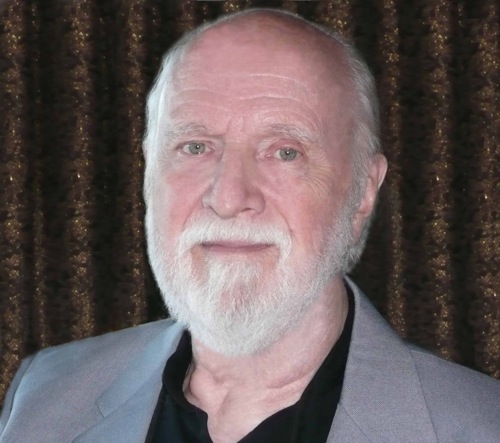
PANAMA CITY — A supermoon ruled the night on Sunday, the day Richard Matheson died, ensuring that I will always equate the two, bright and larger than life, a beacon passing through the darkness.

Matheson, who died at age 87, was one of the great fantasists of the 20th century. I had no idea he was gone until early Tuesday, and spent some time that day reflecting on his body of work and his approach to writing and living.

His novels and short stories became the films “The Incredible Shrinking Man,” “I am Legend” (also adapted as “The Last Man on Earth” and “The Omega Man”), “Duel,” “The Legend of Hell House,” “Somewhere In Time,” and “What Dreams May Come,” among many others. His work for television included scripting several classic episodes of “The Twilight Zone,” “Star Trek,” “The Outer Limits,” adapting Ray Bradbury’s “The Martian Chronicles” as a mini-series, and many more.

AintItCool.com
He created the character of Karl Kolchak in the original teleplay, “The Night Stalker,” and ensured a generation’s bad dreams.

In a 2004 interview (which you can link to in the online version of this column at PanamaCity.com), Matheson called his novel “What Dreams May Come” his most effective because it had relieved many readers of their fear of death — “the finest tribute any writer could receive.” I have not read his book, “Hunted Past Reason,” but in that same interview he twice references an opening quotation:

“To die is nothing. To live is everything.”

Unlike Bradbury, whose name I immediately equated with the greatest in fantasy and sci-fi from an early age, Matheson was a slow burn toward recognition; I was late to connect his name to all the various thrills and chills the man’s work had elicited in me. I don’t recall how or when I realized he had created so many of the films, TV shows and stories I’ve enjoyed.

And I return to the moon, its light a reflection of the sun’s, a symbol of subtlety — as Matheson worked his influence.

Sunday, I followed my daughter out of the house to view the moonrise. It passed among clouds and loomed behind tall pines as the lonely call of a whippoorwill (in legend regarded as a harbinger of death) carried across the hill. For all its size, the orb was not as impressive in my mind as that of Saturday, which had the advantage of context both beautiful and surreal.

That evening, a low tide left an expanded shoreline along St. Andrew Bay. My friend David was on a paddle board on the calm water under the eyes of a small gathering of party guests. My wife held my hand on the shore, and we watched a brilliant sunset light cumulous clouds pink and orange, reflecting on the dark bay.

A couple passed along the tide line, walking their quiet dogs on leashes. Just a few minutes earlier, we’d all been serenaded by guests practicing their bagpipes under moss-draped trees — the night literally blessed by carols and hymns — and joked about the howling of dogs.

And then, the moon: Bright and cold, white as bone, rising slowly over the city to our east and easing out above the bay. It was a night for dogs to howl, for whippoorwills to call, for fish to look up and humans to wonder, like Matheson and like Shakespeare before him, in that sleep of death, what dreams may come?


Peace

(This is my Undercurrents column for PanamaCity.com and The News Herald for Friday's edition, June 25, 2013.)

Friday, June 14, 2013

Flashback Friday: An early review of 'Starman' comic

(On May 21, 1996, the News Herald printed the following review of James Robinson's revival of the Starman character at DC Comics. It was as much a love letter to that series as a statement in reaction to what comics had become in the 1990s. I remain a fan. (Please ignore the use of the 'x' in 'comix,' which was how we spelled things in the 'Generation NeXt' section back then.))

Jack Knight, From Wikipedia
The heroes of old are, with a few notable exceptions, gone from the pages of four-color comix. That bright world has lost its innocence — and much of its creative energy — to teams of muscle-bound vigilantes toting semi-automatic plasma bazookas, and to impossibly endowed females flirting with loss of circulation if their rubber corsets were any tighter.

 Then came Starman.

As created by writer James Robinson and artist Tony Harris, Starman is Jack Knight — a small figure of a man, a tattooed late-20-something, obsessed with all things rare and antique. He'd rather scour rural flea markets for View Master reels and Depression glass than dress in Spandex and duke it out with the villains.

His idea of a costume is night-vision goggles and a leather jacket.

But as the younger son of a 1940s superhero, Jack has become the epitome of the chicken-or-egg question that haunts history: Do great events conspire to create heroes, or do great men and women arise to make history?

In Jack's case, events sought him out and he rose to the challenge. His big brother, David, was first to don Dad's mantle, only to be killed by a sniper's bullet in the first pages of the first issue.

(Jack has since had two surreal visits with his deceased brother — the first as they fought in a grave yard over the right to the Starman name, and the second as David sought to warn Jack of future events.)

With his father injured, his brother dead and his own antique shop razed by the children of an old foe, Jack uses his dad's "star rod" to rout the bad guys and restore order to Opal City.

Through Jack and his supporting cast, Robinson has crafted a book with the multiple layers of history, personality, foreshadowing and drama usually found only in works print-only fiction. His characters are distinct and react with realism — as seen in the frustration and distance between father and son that slowly dissolves into a growing respect and admiration for their individual strengths.

The periodic "Times Past" stories allow guest artists to explore events in the history of Opal and its citizens, giving us a glimpse of the Golden Age of heroes; or a tale of the nigh-immortal. sometimes-villainous Shade and his friendship with Oscar Wilde.

Meanwhile, artist Harris has crafted a vision of retro-deco cities, of characters delineated by quirky swirls and outlines, of shadows and black bordered pages.  No larger-than-life people dominate his panels — save for the lumbering Solomon Grundy. Though stylistically rendered, these are anatomically realistic human beings with an expressive range far removed from the grimacing brain-bashers in other comix.

Like our own shared version of reality, this can be a dark world. People die. Bad guys revel in the pain of others. Some cops are less-than-true to their code. Evil is powerful.

But now there's a beacon in the night.

"Starman has always been around," Robinson said in his introduction to the series, "a light in the darkness, in his own little corner of the DC universe."

Tuesday, May 21, 2013

Fan Trailer: Kingdom Come


I have a friend and former coworker, Brian Parsley, who is pretty great at making superhero costumes. Great enough that he does that full-time now. He appears in this as "Magog."

From Wikipedia
It's based on a groundbreaking graphic novel (originally a four-part prestige format series) from 1996 that explored a near-future in the DC Comics world that saw Superman coming out of retirement to try to reign in the out-of-control super-powered folks and fight a cabal of bad guys. There's much more to it than that — there kind of would need to be for it to remain a fan-favorite storyline nearly 20 years later — and if you want to read it, just hit this link.

Tuesday, April 16, 2013

Two Writers: A Video

Thanks to Lou Columbus for shooting and editing this chat between me and Michael Lister. It's a bit long, but if you have the time, we both read from our work in the second half; Michael reads from his newly released novel, The Big Beyond, and I read from a work-in-progress, Giants in the Earth.


Thanks again, Lou!

Friday, April 05, 2013

Beyond the Big Beyond

I'm going to be sharing a book event with Michael Lister on Sunday, 2-4 p.m. at the Bay County Public Library. We'll be discussing our latest projects and doing some reading, and there will be books to sign and sell if you're interested in that sort of thing. Here's a column I did about Michael's new novel:


Soldier reups for second noir adventure

PANAMA CITY — Private eye Jimmy “Soldier” Riley seems dead set on discovering what lies beyond that final farewell in local author Michael Lister’s latest novel.

“The Big Beyond” is a sequel to Lister’s “The Big Goodbye,” which introduced Riley, a hardnosed detective living and working in 1940s Panama City. Rich in historical details, the story is gritty and tragic, as good noir tends to be.

“Beyond” picks up immediately after the events of “Goodbye,” with Riley recovering from injuries both physical and emotional. It hits the ground running, too, as Riley is almost immediately kidnapped and horribly tortured. It seems the trouble he stirred up in his previous outing had much deeper roots than he suspected.

Riley hovers near death, but can’t let go while he still has a score to settle and more than a few injustices to square — all while searching wartime Panama City for a dangerous serial killer who combines art and murder.

“I love Panama City, and I’ve enjoyed writing about the way it was in the 1940s far more than I ever would’ve imagined,” Lister said. “So much was going on here at the time, and it’s just such an interesting and cool era. And this time I got to explore what was happening to Japanese-Americans and what was going on in the art scene at the time. I foresee coming back to Soldier and his friends over and over again.”

A Wewahitchka native, Lister has had 12 novels, three short-story collections and three nonfiction books published. The John Jordan mysteries, also known as Lister’s “Blood Series,” are the author’s most popular and most acclaimed works, with kudos from “Publisher’s Weekly” and “Ellery Queen Magazine,” among others.

“The Big Beyond” will be followed by a third Soldier Riley adventure to complete an initial trilogy; Lister said Riley has other stories still to tell. He’s currently offering a Soldier short story prequel in ebook format and is hard at work on the third book in the series.

“I’ve always loved both film noir and the classic hardboiled detective genre,” Lister said. “ ‘The Big Beyond’ has given me another opportunity to explore and pay homage to them both.”

CityArts Cooperative will step back in time for a ’40s Night release party celebrating the era and the release of the new novel at 6 p.m. today. The public is invited to come in costume or as you are, and enjoy live 1940s music, a costume contest, book signing and reading, film noir, dancing and much more.

Then, from 2-4 p.m. Sunday, Lister will discuss “The Big Beyond,” writing, North Florida and many other topics with this writer in a dual interview format: We will interview each other about recent and upcoming projects, read from our latest work and sign books.


’40s NIGHT PARTY

    When: 6-10 p.m. Friday, April 5
    Where: CityArts Cooperative, 318 Luverne Ave., Panama City
    What: Step back in time and experience Panama City in the 1940s with friends and fans of Jimmy “Soldier” Riley, the private eye protagonist of the new novel from Michael Lister, “The Big Beyond.” Come in costume or as you are. Featuring live ’40s music, games, prizes, book signing and reading, and film noir.


BEYOND ‘THE BIG BEYOND’

    When: 2-4 p.m., Sunday, April 7
    Where: Bay County Public Library, 898 W. 11th St., Panama City
    What: Presentation by Michael Lister with Tony Simmons, discussing writing approaches and more; with books available for signing and purchase


Hope to see you there.
Peace.

Thursday, March 14, 2013

What's What Lately

It has been a busy time in the life of the Simmons family. A new home still being moved into/fixed up/maintained, a new job for Debra, school for Jess and work/band responsibilities for Nathan, trying to fit a new church home into that, and still trying to make room for creative endeavors and friends and maybe meeting my obligations with a group of local writers (i.e., reading and commenting on their work as conscientiously as they are on mine).

I've taken to having lunch at least once a week at St. Andrews Coffee House, often with friends like Lou Columbus, Mark Boss, and/or Jayson Kretzer. Yesterday, shared a table and sandwiches with Lou and Michael Lister, and we talked about Michael's new novel, "The Big Beyond," which has one of the best first sentences I've seen; I'm looking forward to reading the rest of it.

Meanwhile, I also have several books, magazines, and/or comics I'm reading at the same time. Right now, besides trying to make my subscription to WIRED worthwhile by actually reading some of it, I'm partway through these: "The Long Man" by Steve Englehart (sequel to his excellent "The Point Man"), "Bicycle Diaries" by David Byrne (essays on the personality of cities observed from bike seats), "Warp" (a comic series from the 80s that I found all the issues to in a discount bin), and "Cthulu: The Mythos and Kindred Horrors" by Robert E. Howard.

Also, writing proceeds on my long-gestating "Caliban" series, with a focus on a rewrite of Book 1, now titled "Giants in the Earth." I have written my way to the end with a leap over the "muddle" chapters in the middle. Now, I'm back in the difficult part of making the beginning line up with the ending.

And in my free time (hyuk-yuk) I've begun serious writing alongside that of a memoir that explores the impact and weird parallels with my life of 1970s TV scifi. Yep, chew on that one a while. You would not believe the craziness my brain gets up to when I'm not paying attention (which seems to happen a lot), and then it demands that I do something about it.

Listening to: "The Next Day" by David Bowie.

Peace.

Thursday, February 07, 2013

Books Alive 2013 Photo Post (2 of2)

FSU-PC Holley Center

Books Alive took place at FSU-PC this year, moving across the street from its former home at GCSC. The move allowed the author tables to occupy the main floor entrance, meaning great traffic, and the rooms are larger, meaning fewer standing-room-only situations. Also, you can't beat the view of the bay. The local "authors" got the prime location at the entrance, and the featured ones shared tables across from the book sales area.


Kayla and Nick May
I was set up beside Nick May, who was accompanied by his wife Kayla. (Two of my favorite people on the planet, if I haven't told you this before, which made for a fun morning.) They brought a candy dish but no candy, so I put my cough drops in it.


Wilson, Angier
Greg Wilson and David Angier shared a table. They co-wrote "Salvaged Santa," and David just released "The Madness of Joe Francis." David and I were longtime colleagues at The News Herald, and we're hoping to write a novel together later this year. Probably most of that work will involve sitting by a fire and drinking manly portions of alcohol.

Murphy on Skype

I was assigned to introduce and moderate the session for Mary Murphy, a former CBS 60 Minutes producer who made the documentary "Hey, Boo," about the writing of "To Kill a Mockingbird," the production of the film and the cultural impact of the two. She was sick, however, and couldn't travel, so we ended up connecting with her via Skype.

Kretzer


Jayson Kretzer purchased a "33 Days" combo pack from me of my "pamphlet" of 10 flash-fictions based on the songs on The Offer's album of the same name, along with a copy of the album. David Angier also picked up the two-fer. I was pleased with sales this year, especially because of the variety of things I sold, including both of my novels, both of my short story collections, one of my column collections, one of the anthologies I edited, and a couple of the anthologies I have stories in. It's good to offer folks choices, I reckon.

Boss and a Hat

Mark Boss is a writer friend of mine. You should download his books now before he becomes famous and expensive. (I read a chapter of his new Untitled Crime Novel today, and it's fantastic.) I joined him and our mutual writing friends Carole and Ruth for lunch, then left my trademark hat behind when I hurried back to the conference. Mark was kind enough to save it from a life of abandonment and misery, selling itself on the streets just to get by.


Me and Kathie
Terra and Me
This is the part where I get to hug people, which is always my favorite part. Kathie Bennett is the daughter of Gerry and Barbara Clemons, and the sister of (among other siblings) Scott Clemons. She's a literary publicist for many of the authors at Books Alive, and she's a source of encouragement for me. I appreciate her more than I can say. When I asked her if one of the authors might be interested in visiting my Education Encore class while they were here, she suggested the gig to Terra Elan McVoy, who was -- let's face it -- pretty awesome. My class loved her, which just goes to show that they do have good taste in writers, despite listening to anything I've been telling them. Now I have to go back and continue to teach the class after she just raised the bar.

Morris and Owens

Jacqueline West
These next pics are pretty well self-explanatory, as they represent authors meeting fans and telling stories and signing books. The only one I want to make special mention of is Michael Morris and Janis Owens. I joke that coincidence surrounds them to such an extent that the universe has begun to revolve around them. Then I take this picture, after which Janis tells the lady in black that "Tony comes from your neck of the woods." The lady is named Lydia. She lives in Pensacola. Her next-door neighbor is Buck Showalter, former manager of the New York Yankees, who hails from my home town. His dad was my middle school principal. His mom was friends with my grandmother. His sister was a counselor at the elementary school when my son attended there. I wrote the newspaper article when the town renamed the baseball park after him and his dad, "Showalter Park." Then Michael and Lydia start quoting the same Bible verse as they discuss how Lydia was the name of Paul's first convert; Lydia is the name of the main character in Michael's next novel, which he's calling "The First Convert." See what I mean?
Terra Elan McVoy

Erin and Erica (Go Gators!)
Last photo is of two of my coworkers at The News Herald (the only two I saw that day), one of whom was brave enough to wear her Gator jacket to Seminole territory.

I marked this entry as No. 2 of 2, but I believe I will be following it up in a few days with some thoughts on the event as a whole, with a couple more photos.  Right now, I need to get back to work. This novel is not going to rewrite itself.

Peace.

Monday, February 04, 2013

Books Alive 2013 Photo Post (1 of 2)

Morris & The Kretzers
Books Alive was Saturday. The 14th annual event hosted by the Bay County Public Library Foundation. As a volunteer, I was invited to the Friday evening gathering at the home of Frank Walker, the director of the Panama City Beach Library. (Debra wasn't able to make it, as she was still very ill with the head cold we both have been suffering from this week.) These photos are from that event, and the next post will include photos of the actual festival.

I was pleased to see my friend Jayson Kretzer and his wife, Heather, in attendance. Jayson is the guy I want to work with on a graphic novel adaptation of my "Book of Gabriel." They discovered they knew some of the same folks in Wewa as author Michael Morris, who asked me about my current project, which I have teased a bit on Facebook. Michael is a lyrical writer, and a gentleman. He hails from Perry and writes about the areas just east of here along the "Forgotten Coast."
Stone, McVoy, West

I met the authors Michel Stone and Jacqueline West at the party, but had already met Terra Elan McVoy earlier in the day; my friend Kathie Bennett (of Magic Time Literary Agency) had put us in touch when I asked Kathie if any of the authors she represents would like to visit my Education Encore class. Terra volunteered, and the class just loved her. She showed them a character-building worksheet she uses, and how to draw a character web. (She brought her mother, Heather, along to the class — and Heather bought two of my books on Saturday. Terra says she gets to read them when her mom is finished. I hope we can still be friends when she does.)

Morrison, Monroe
Michael and Mary Alice Monroe wanted a photo together, and I was glad to oblige. I had written an article about Mary Alice for the daily paper two weeks back, based on a looong phone conversation we had (and which Kathie again set up), and we had another long talk at the party. I was impressed by how she really focuses on the person she's talking to; I noticed her giving her undivided attention a few times that evening and the next day. She's a South Carolina conservationist and avowed "turtle lady," which I thought Marisa would have appreciated.


My Big Bald Head. Also, authors.

Michael also grabbed me to say that Janis Owens wanted to recreate one of her favorite photos from a previous Books Alive party, in which I held the camera out MySpace style and authors gathered behind me. Why not? So I did, and that is the result at left. Janis is the one with the giddy expression and clasped hands. She's so funny. I was glad that Michel and Mary Alice jumped in to participate. Last time, we had a rather unimpressed Jeff Shaara in the photo (or rather, his name tag. That guy is taaaaalll.)


Featured Authors (and Bettina)
Bettina Mead, the PR person for the library, asked me to take the annual "official" photo of the featured authors. That's what you see at the left. This photo kind of marked the end of the evening (although now that I think about it, I believe the picture above actually was taken after this one). Everyone was shuttled off to their overnight places, and I returned home to gather the things I would need for the next day.

It was very cool to meet some new-to-me authors, and to get to spend a few minutes with Michael and Janis and Kathie again, as well as the locals who support the event each year, like Frank Walker, who's always good for a joke or two. Kathie and Michael, in particular, made me glad I attended, as they had nice things to say about my work; that may come off as egotistical, but what I mean is that it's nice to be bragged on by people you admire in front of people you respect.
Better picture, with Janis literally propping me up as I squat.

...To be continued ...

Friday, January 25, 2013

Trying to 'finally see' what's evident


PANAMA CITY BEACH — Two white-tailed does bounded and hopped through overgrown lots across the street from my dining room windows Tuesday morning. They halted abruptly and looked my way, circled in a lot and searched for an exit. One of them turned and disappeared under an oak tree, and the second followed.

The incident lasted a handful of seconds, and I was just lucky to have been facing the windows when they raced by in the golden light of morning.

It’s important to recognize that part of being in the right place at the right time is making yourself available. The other part is sheer luck. That morning’s vision was a fortuitous combination.

Last Friday afternoon, I made myself available and was lucky enough to speak briefly with Miles Zuniga and Tony Scalzo, two of the founding members of Fastball, the band that hit the big time with their song, “The Way,” in 1998. The place was Fish Out of Water, the restaurant at Watercolor resort in South Walton, and the reason was a press conference for some of the artists appearing at the 30A Songwriters Festival.

They paused long enough to have a photo taken, but I didn’t get to tell them how much my son loved their album “All the Pain Money Can Buy.” He played that CD until it was worn to a nub, if such a thing could be done. Easily dismissed by the cynical as “one-hit wonders,” they continue to write, play, record and sing.

Earlier that day, I made myself available to a class at Education Encore, the adult enrichment program at Gulf Coast State College. The program signed up a record high of 428 students this session, which runs through Feb. 22. The most popular classes, with 59 students each, are Gourmet Cooking Made Easy, Islam: Get the Facts, and We the People.

I was lucky enough to be presented with 22 students who wanted to know something about creative writing. It remains to be seen if they will consider this a fortunate appointment.

As you read this on a Friday, I hope to have attended a private screening of the 1962 film “To Kill a Mockingbird” at the Martin Theatre on Thursday evening. The movie, one of my all-time favorites, is being presented by the Bay County Public Library Foundation, in part to promote the upcoming appearance of Mary McDonagh Murphy at next weekend’s Books Alive festival.

Murphy, a former producer for “60 Minutes,” also produced “Hey, Boo,” an award-winning documentary on author Harper Lee, her book and its film adaptation. I will be introducing Murphy at Books Alive on Feb. 2 at Florida State University-Panama City, where she will talk about her project. Books Alive is a free event; for more information, visit BooksAlive.net.

As you might recall from the book (or film), Atticus tells his children he would prefer them to shoot at tin cans with their air rifles, but he knows they will eventually go after birds; he allows that it’s all right to shoot blue jays, but it’s a sin to kill a mockingbird.

He was trying to say that it’s wrong to willfully hurt someone who does nothing wrong. He later assures Scout that most people are nice, “when you finally see them.”

I don’t know how my train of thought ended up here, exactly, except that since we moved into the isolated neighborhood off the beach I’ve had more opportunity than in recent years to witness wild animals and birds brushing up against the edges of civilization.  Visions like that of the running does have connected with memories of the lessons in “To Kill a Mockingbird,” and those lessons have informed the passage of my days.

So sing your hearts out, Fastball. Tell your stories, Encore students. Visit the book festival and hear the good words of writers seeking some kind of truth in the world. Try to “finally see” the people around you, and reserve your pellets for the tin cans — and maybe the blue jays.


Peace.

This was my Undercurrents column for PanamaCity.com and The News Herald today.