Some days the evil loose in the world can’t be beaten by two fists, a trusty sidekick, and a pump shotgun.
Some nights reek of deep time, musty tombs, and creatures spawned from beyond the stars.
When monsters attack, you need heroes with a strong moral compass...and a little supernatural help.
Adventures in the Arcane contains four fantastic stories of pulp heroes, werewolves, pirates, and wizards. Prepare to be thrilled! A Syndicate Production featuring the work of Mark Boss, S. Brady Calhoun, Lou Columbus, Jayson Kretzer and Tony Simmons.
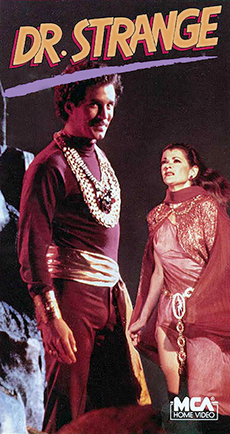
Dr. Strange (CBS-TV pilot aired Sept. 6, 1978) Starring Peter Hooten as Dr. Stephen Strange; with Jessica Walter and John Mills
If you’ve got a fever for fantasy TV even the Winds of Watoomb won’t quell, then this might be just the prescription.
Doctor Strange, The Master of the Mystic Arts and Sorcerer Supreme created for Marvel Comics by writer Stan Lee and artist Steve Ditko, first appeared in Strange Tales No. 110, dated July 1963, a year before I was born.
He came to television in a much watered-down version, via a pilot film that even abbreviated Strange’s title as Dr. Strange, in the autumn after I turned 14. I was already a fan of the source material and at the perfect age for a good horror-tinged magical adventure. I watched the show on my Dad’s TV in the living room area of a mobile home he was renting in Gonzales, Florida, if I'm recalling correctly.
It was miles ahead of other Comics-to-TV efforts of the era, from a Hulk with green body paint, to a Spider-Man who couldn’t realistically fight bank robbers (much less a super villain), to a Captain America who traded his winged mask for a motorcycle helmet. At least with Strange you got to see magic lightning bolts and weird dimensions.
Disco Strange
The treatment was written and directed by Philip DeGuere, whose writing credits included episodes of Bionic Woman, Baretta, Alias Smith and Jones, and many others, and who would go on to create Simon & Simon and much more. A made-for-TV movie intended as a pilot for a potential TV series, Dr. Strange even had Stan Lee as a consultant.
The movie diverged from the original material, although Lee apparently felt it was one of the better of Marvel’s 1970s TV adaptations. In an interview published in Comics Feature magazine (January 1985), Lee recalled being “pleased with Dr. Strange and The (Incredible) Hulk.” He added that Strange might have had higher ratings if it hadn’t been broadcast opposite Roots.
In the comics, Stephen Strange is a gifted but arrogant surgeon who loses his dexterity after a car crash and becomes a drunk because he can’t make tons of cash as a surgeon any more. Hearing talk of an “Ancient One” in Tibet who can heal anyone, he travels there on a quest to restore his hands so he can regain his medical practice.
Instead, he is initiated into the hidden world of magicians and eventually becomes the “Sorcerer Supreme” of Earth. He takes on a servant, Wong, and lives in a weird brownstone in Greenwich Village, NYC. And he soon gets a hot silver-haired girlfriend from another dimension, Clea, who becomes his pupil as well as his lover.
Strange has adventures in other dimensions, superbly psychedelic and appropriate for the 1960s, as originally conceived by Ditko. He fights entities like Mephisto, Nightmare and Dormammu, as well as his mortal enemy, Baron Mordo. He hangs out in his Sanctum Sanctorum and gets into scraps alongside the Defenders (initially, Silver Surfer, Hulk and Namor the Submariner).
These battles and other-dimensional jaunts were beyond the scope of 1978-era special effects (at least, on a TV movie budget), but the pilot film makes a valiant effort. Before it’s over, Strange visits a nether-dimension, we catch glimpses of the demon Balzaroth (voiced by Ted “Lurch” Cassidy, uncredited), and our cast exchange magic lightning blasts.
It’s the changes to the mythos for its TV incarnation that don’t ring true to this True Believer, and one wonders if they were made for fear of how audiences would respond to an Asian master in post-Vietnam USA, or a devilish Mephisto (this was a time when Bible-thumping caused all sorts of censorship in fantasy TV; Google some of the censors’ reactions to Star Trek reruns some time just to boggle your mind).
Wong and Lindmer
For example, the Ancient One is now a disembodied voice (the late, great Michael Ansara, uncredited), while Strange’s mentor is now the British actor Sir John Mills as Thomas Lindmer (or “Merlin” — get it?). Strange (played by Peter Hooten and his spectacular disco mustachio and Caucasian afro) is a thoughtful, slow-to-act psychiatrist who initially seems to get his magic mojo from a ring left to him by his father.
The usually mesmerizing Jessica Walter (lately seen on Arrested Development and heard on Archer) plays Morgan Le Fay, Merlin’s old enemy (who was, as you may recall from repeated viewings of Excalibur, the half-sister of King Arthur and the mother of his bastard son, Mordred). While she is physically voluptuous and tempting in her low-cut tops, her delivery of dialogue is flat, and she’s played a bit too cold for you to ever believe Strange could be swayed to her side of the battle.
Clea is presented as a college student haunted by Morgan; she’s played by Eddie Benton (who later acted under the name Anne-Marie Martin in episodes of Buck Rogers and other 1980s shows, but is perhaps best known as co-writer of the 1996 film Twister with her then-husband, the late author Michael Crichton). Clea falls under Morgan’s spell, and Strange seeks alternative therapies for her.
Strange and Morgana
Lindmer tries to convince Strange that the girl’s troubles are magical rather than medical; he’s also trying to prepare Strange to follow in his footsteps as the next Sorcerer Supreme.
The film opens with an image to excite any Strange fan’s heart: We’re in a weird realm of rocky islands floating in space. A stop-motion demon gives Morgan the chance to redeem her earlier failures by defeating Lindmer and turning his chosen apprentice to the Dark Side, or some such. So far, so good.
But the interest dissipates pretty fast. The film becomes overly talky, and little action of any consequence takes place for the next hour, putting the majority of effects and action in the final segment of the show. Strange doesn’t even dress — well, strange — until the last act, first in a very cool cloak and chains bestowed on him by Morgan, and later in a lame disco blouse with a starburst and yellow cape. Both costumes hearken to the various comic versions of Strange’s attire, but neither one captures the spirit.
Strange by any Other Name
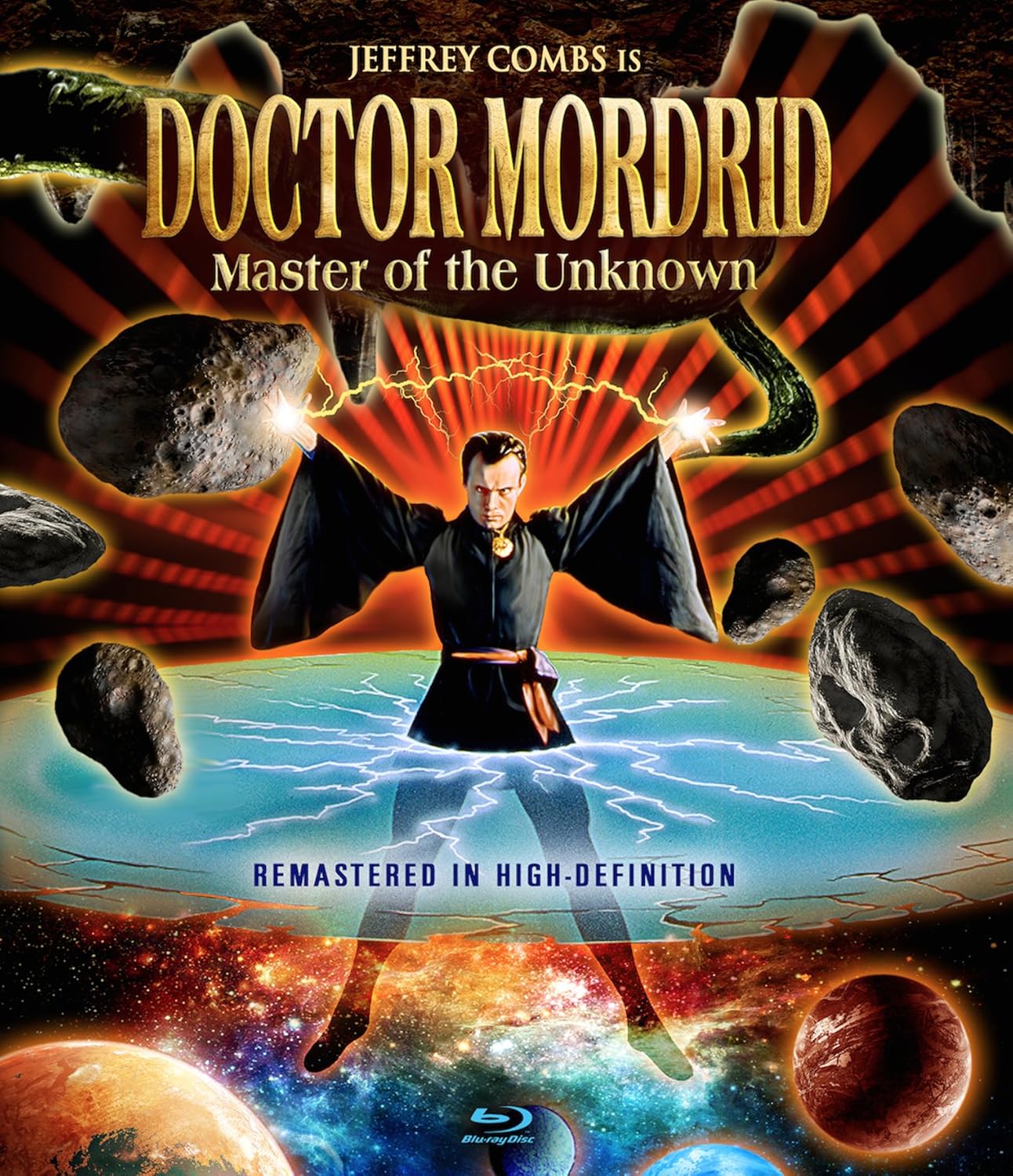
(NOTE: The low-budget movie grindhouse, Full Moon Features, made a Strange-esque film called Doctor Mordrid in 1992 after losing the option for Doctor Strange; it starred Jeffery Combs as an ageless sorcerer assigned to protect our world, and it’s worth checking out. Also pretty good is the 2007 direct to DVD animated feature Doctor Strange: The Sorcerer Supreme from Marvel Studios.)
Over the years, the comic Strange has been rebooted, retooled and refocused. He’s been de-aged, split into multiple persons with different names, and even gave up his face for a while, replacing it with a blue “mask.”
Likewise, in some writers’ hands, he’s selfless and heroic, while others paint him as distant and possibly deviant, acting to protect his own power base as much as the innocent souls in this reality. His recent appearance in Matt Fraction’s short-lived Defenders title made him a little scary.
I always was happier seeing Strange as a mixture of the two extremes, much as he was initially portrayed: A self-righteous man who was knocked down, broken, and in the process of rebuilding himself spiritually as he learns to serve others — a hero overcoming deep faults against massive odds.
That’s kind of what this pilot film embodies: It’s obviously broken, but it contains enough magic to make you believe that, if it had gone to series, it could have developed into something deeper — until you realize it was the 1970s and even the Hoary Hosts of Hoggoth couldn’t have energized it enough.
We’re probably better off watching Kolchak reruns, dreaming of what might have been, and looking forward to a Marvel motion picture starring Benedict Cumberbatch and Tilda Swinton. But until then, here's the whole movie from YouTube:
PANAMA CITY — I first met Chris Stock and Christina
Gilbert in a steampunk panel at Pensacon, a sci-fi convention in Pensacola, in
February 2014. He was disguised as The Winter Soldier and she was Black Widow,
a pair of Marvel Comics characters that were appearing in the new Captain
America movie at the time.
It was his second big convention, and her first, and
they assured me they were “super nerds, basically.” They’ve been actively
building a reputation as creative costume designers and character players
(i.e., “cosplayers”) ever since, and will present a panel for beginning
cosplayers at PC Creative Con in Panama City on Aug. 1.
I recently visited them at the Dragon Dojo off State
390, where Chris works as an instructor, to talk about their passion.
“My dad read comics, and he thought comics would get
me into reading — and he was right,” said Chris, 23, who was born and raised in
Panama City.
As a child, Chris became a fan of The Mighty Morphin
Power Rangers — specifically, “Billy” the Blue Ranger, who was a massive nerd.
Since he couldn’t become a Power Ranger in real life, Chris focused on the
martial arts aspect, and under mentor Dorje Jangbu has become an instructor.
One of the highlights of his life, he said, was meeting David Yost the actor
who played Billy, at Pensacon. Chris hopes his cosplay can serve as an
inspiration as well.
“When you see someone really appreciates it, it
touches you,” he said. “It not only inspires them, it inspires you to keep
going.”
Photo: Daron Adkins Photography
Christina, 28, is originally from Dothan, Ala., but
has lived in the Panama City since she was 9. A hair stylist and operator of
the local Shear Design, she has two daughters, ages 4 and 6. Chris’ interest in
costumes drew her in, and she has a particular interest in steampunk (a
subgenre of sci-fi that derives from 19th-century steam-powered technology and
aesthetics).
“It’s a way for me, personally, to escape from
reality for a few hours,” she said of building props, making costumes, and
playing dress-up. “And when someone compliments your work and wants a picture
with you, that’s great.”
Chris keeps composition notebooks filled with
designs, doodles, patterns and ideas. He uses it to work out details, like the
knotwork design on the edges of his home-built Mjolnir (the hammer of Marvel
Comics’ Thor), or the horned helmet of a gender-swapped Loki. Then the projects
take shape in his workshop — i.e., apartment.
“Our apartment has little projects all over the
place,” Christina said, mentioning Captain America’s shield, which hangs in
their laundry room.
Winter Soldier was Chris’ first full costume, and
the character’s “robotic” arm was created by riveting dozens of individual
pieces together. (Chris has added some muscle since creating the costume, and
the riveted arm no longer fits him.)
“Before that, I basically did anime characters (from
Japanese cartoons), but Winter Soldier I really spent time on,” he said. “I
built everything but the pants and shoes. I broke down each part. It was — a
lot of hours.”
Chris and Christina discussed how they created many
of their costumes and props — from a repainted toy gun or a dowel that became a
walking cane, to a wiffle bat repurposed as Harley Quinn’s weapon of choice and
socks that became her elbow-length gloves. The most important aspect of
building these items, they said, is the willingness to make mistakes and learn
from them.
“I find nothing but flaws in everything I do,” Chris
said. “I’m a perfectionist. But art is being able to make a mistake look
beautiful. Art is never finished, you just walk away from it.”
BASIC COSPLAY
TIPS
C&C Cosplay offered these basic considerations
to prospective cosplayers:
•Dress for the weather. “You don’t want to walk
around wearing a skimpy Harley Quinn costume in February,” Christina said — a
lesson she learned the cold way.
•Props don’t have to be functional, they just need
to look right and feel good. “You don’t need to actually be able to climb up
walls if you’re (dressed as) Spider-Man,” Chris said. “It’s a costume. It’s all
about the look. ... But whether it’s a prop or costume, if it’s not
comfortable, you’re going to hate it.”
•Make sure you can move, see, fit through doorways,
sit down — and get out of the costume for bathroom breaks. “I’ve seen this
happen badly,” Chris said. “If you’re going to design a really complicated
costume, make sure you know how to go to the restroom. I suggest wearing it a
full day around the house before you go to a con.”
•Most of all, have fun. Be creative. And feel free
to ask other people for help.
It
would be wrong for me to claim this film had any sort of influence on my early life,
as I didn’t see this in its original broadcast; all I knew of it was a photo of
the Gorn-like Asmodeus demon shown in Starlog
magazine.
Don’t recall how I
managed to miss this; at the time, my parents were on a kick to be sure we
didn’t get too much horror/occult intake, but I don’t think I was forbidden to
watch this. I know some network
affiliates across the country refused to air it because of its demonic and
sexual content, but I don’t know if that included my local channels. More
likely, it just slipped by.
Culp and Young
Instead,
I first caught it on an afternoon movie rerun sometime in the late 1980s, and I
watched it again recently, streaming on YouTube. Careful which version you try to watch: One was
apparently videotaped from a Syfy (at the time “Sci Fi Channel”) show called Pilot Playhouse, hosted by Robert Englund.
The version I initially saw on YouTube appears to be missing some scenes, and not just
the nudity in the final orgy/sacrifice sequence. At one point, Sebastian and
Ham are speaking with Inspector Cabell and ask questions about “these killings”
— apparently a series of gruesome murders have taken place, but no one has
mentioned them previously in the film. I don’t know if there was a mention
excised from this version to allow more commercials, or if the original cut of
the film was missing that scene.
Note: Some versions of the pilot contain topless and bottomless (rear) nudity that was
inserted into the pilot's climactic sacrificial scene for a theatrical release overseas.
Also, I think Gig Young might have been inebriated in every scene, listening to his
words slur.He killed himself shortly
after the pilot aired.
Also also,
Robert Culp is a badass. That is all.
Created,
written, and produced by the father of Star Trek, Gene Roddenberry, Spectre
was a supernatural mystery starring Culp as criminal psychologist and
paranormal investigator William Sebastian, with Young as his old friend and skeptic Dr.
“Ham” Hamilton.
Ham obviously served as a sort of “Watson” to Culp’s “Holmes” —
or “Scully” to Culp’s “Mulder” — but their relationship also mirrored that of
Questor and Robinson from Roddenberry's other genre pilot of the time, "The Questor Tapes," (or Spock and McCoy of Star Trek) as Sebastian was often brusque and
coldly logical, while Ham was better with people.
Englishwoman
Ann Bell (as Anitra Cyon) appears at Sebastian’s home in the U.S. to withdraw
her earlier request for the men for help her family; she does so while standing
in front of a fireplace that makes her dress nearly translucent, so we
shouldn’t be surprised that she turns out to be a succubus. Even so, the Cyon
family jets the two to London
to solve the mystery of the family curse, which devolves into a safe-for-TV
version of a Hammer Horror film, with not-too-subtle references to sexual
depravity. It seems the family has unleashed Asmodeus, the demon of lust, and
one of them is possessed by it.
Culp walks the edge.
In
the end (not to anyone's surprise, so this isn't really a SPOILER), Sebastian defeats the demon, and a curse he has suffered is cured. But
once they return to America,
Sebastian receives a painting from the surviving Cyons, and on it is the symbol
of Asmodeus — freeze frame and fade to black as the violins screech.
Co-written
by Samuel A. Peeples, and directed by Clive Donner, the film also features a
(relatively) young John Hurt as Mitri, the younger brother in the
Cyon family. Majel Barrett Roddenberry appears as Sebastian’s housekeeper (and
witch) Lilith, who cures Ham’s alcoholism with a spell. The older Cyon brother is played by James Villiers, a British character actor who appeared in numerous movies and TV shows including Hammer's "Blood from the Mummy's Tomb."
Watch the complete pilot here (it is one with momentary nudity, but blink and you'll miss it):
PANAMA CITY BEACH — The producers of an apocalyptic web series set in and around Birmingham, Ala., took a detour to Panama City Beach this week to shoot scenes of zombies coming ashore in the fog.
Carey Rayburn, the director and co-writer of the series, “The Unfriendlies,” worked the cameras with the help of actors Marc Sellors and Jim Brucke, both of Birmingham. Locals Daphne Lewis and Don Keene played mostly-dead in the cold surf.
“If I wasn’t a Florida girl, I’d probably think it was just right,” Daphne said of the water temp.
“The Unfriendlies” is the story of a family that goes camping in the woods and doesn’t realize that the world has been swallowed in a zombie uprising. Carey described it as being “quirky” like “Buffy the Vampire Slayer.” One of the opening shots in the pilot episode will show the initial zombies emerging from the ocean and trudging inland.
“The pilot episode is mostly comedy and a little exposition, but they get darker,” Carey said. “The comedy will remain, but there will also be some dramatic story lines. Season one will consist of six episodes, and we will have five different directors.”
While in town, Carey was also working on two other longterm projects dealing with the history of the beaches: a documentary short about Petticoat Junction, and a longer documentary about “Old” PCB and its attractions.
Carey has gathered aid on the documentaries from author Tim Hollis, whose new book, “The Minibook of Minigolf” focuses on PCB’s Goofy Golf attraction, and J.D. Weeks, author of “Panama City Memories.”
“I’ve been interviewing people about former attractions such as the Hangout, Tombstone Territory, The Sui-Slide, Long Beach Amusement Park, Jungleland, etc.,” Carey said. “I’m gonna spend the next year or so coming to PCB to interview whoever I can find that has stories to share about what it used to be like.”
Recently, Carey filmed a reunion special with the Rader family looking back at their Ocean Opry years. His goal is to have it completed by December and show it in Panama City Beach.
“I was a big fan of theirs when I was a kid, and years later when I became a filmmaker one of the first projects I did was a documentary short on them in 2004,” he said. “They closed a year later. I’ve been in touch with Debbie Rader Clanton for awhile on Facebook, and I told her I thought we should do a video of them telling stories about their 27 years. We talked about it for a few weeks and decided to do it part memories and part documentary.”
Meanwhile, the zombies slogged out of the surf several times for takes at different angles. Marc got some underwater footage using a Go-Pro. Tourists walked through shots, forcing retakes, and the morning fog caused cameras to lose focus.
Finally, Daphne and Don trudged past Jim, playing an older gentleman relaxing on a beach towel. They passed him by without notice.
Chris Oneisom and Jennifer Creamer pose in zombie makeup before taking the stage for “Night of the Living Dead.”
LYNN
HAVEN — They may have been coming to get Barbara, if you recall the old movie
line, but the living dead I hung out with last Friday were mostly just ...
walking.
Oh, they hissed and moaned. They growled from time
to time, and pounded on the walls. And if a couple fought off smiles as they
shuffled and limped behind the windows of the set, that might be expected.
I was invited to perform among the legion of the
living dead as a “celebrity guest zombie” at the opening night of Kaleidoscope
Theatre’s presentation of “Night of the Living Dead.” Before the double feature
started, I signed some of my books for unsuspecting readers in the lobby, but
as soon as “Hecate Hill” began — the first play of the night’s show — I headed for the makeup room.
(The plays continue each weekend through Oct. 26,
and I will be signing books before each Friday show.)
I was excited to participate. I’ve done one other
community play in my adult life — Shakespeare By The Bay’s “Othello” in 2006 —
and for the first time had a role that might not exceed my acting ability,
which is best described as lifeless and monotone.
Daniel and his clown.
Daniel Gehrken, who also designed the promotional
posters for the plays, spent about an hour finger-painting my face in shades of
gray, blue and purple, before dripping blood from my eyes and smearing bloody
handprints on my T-shirt. He said there was no extra charge for the face massage.
Some of the other zombies in the mob had neat
prosthetic appliances that gave them the look of terrible injuries. Others had
specific costumes — a cheerleader, a Girl Scout, a prom queen — and some, like
Jennifer Creamer’s “bride” character, had both.
Daniel pronounced me an evil clown zombie, which
made fellow zombie Madison Leighann Googe order me not to look at her. She had
no difficulty stalking about with a zombie baby tearing its way through her
abdomen, but she drew the line at evil clowns.
Zombie Master Chris Oneisom (or as I like to think
of him, “He Who Walks Behind The Sets”) paired me with a zombie buddy, Juliet,
who showed me how to shamble and indicated
that there would be various times during the play when we would be expected to
be louder, or quieter, depending on what else was happening on stage.
Juliet, at right.
When she
sat and hid, I sat and hid. When she pounded on the walls, I pounded on the
walls. When she got out of the way of starring performers running through, I
got confused and almost run over.
Twice, while lurking in the background, zombies
whispered to me that I could take a break
by dragging myself off-stage for some water and air if I needed it. I took that
to mean my makeup was impressive enough to fool the other zombies into thinking
I was in a state of advanced decomposition — or at least, I looked like death
warmed over.
None of this could help me in the closing dance
routine, however. The best I could manage was to look befuddled, which is how I
tend to look whenever anyone suggests dancing.
(Rest in) Peace.
Ramona Hagan, left, won the grab-bag giveaway at Kaleidoscope Theatre in Lynn Haven last Friday. A season-ticket patron, she was sitting in the seat number randomly chosen by the author, shown in his zombie makeup. She received a graphic novel, DVD, comic book, paperback, and a copy of my collection of zombie short stories, “Tales of the Awakening Dead.”
PANAMA CITY — So we made a short film about writing — and we made it in a local art gallery and studio.
In the movie, an old fellow hovers on the outskirts of a class where an artist teaches children to weave on makeshift looms. He is inspired by their activity to write a story called “The Weaver.”
And then — facing the choice that all artists must make — he puts his work on display for the public to view, interpret, critique or disparage. “The Weaver” goes on the wall as if it somehow fit among the embroidery, rugs, needlepoint and other woven arts and crafts on exhibit.
Is it art? That’s the question. The answer is less obvious, perhaps.
The film, “Stringing a Yarn,” was directed, photographed and edited by Lou Columbus, a resident of St. Andrews. It was shot at Floriopolis, the new art hub in the historic district, with the cooperation of artist-in-residence Heather Parker and her young students.
To complete the scenes we had in mind, Lou and I also conscripted artist and natural improviser Deborah Kivett, who happened to be in the wrong place at the right time, and whose critiques of the work had us in stitches.
Now the film, like the short story, is out in the world. It’s a thing that is no longer strictly “ours,” but that the viewing public can take and make of it what they will.
Weaving is a natural metaphor for the craft of writing, of pulling together the disparate threads of story to create a meaningful whole. It works as well for film-making, as the director envisions the writer’s scenes and the editor connects pieces shot out of order to form a narrative, often tying everything together with the perfect melody.
It’s not the first time I’ve been inspired by the art of the weaver. I once wrote a piece about a woman who saw in the patterns of her crochet all the quantum secrets of the universe, all the ways we’re connected and how simple it is to become entangled, frayed, knotted or cut off.
Life is a series of interconnected stories, and art is steeped in story (and vice versa). Later this month, Floriopolis will host some examples of storytelling arts you might enjoy:
* A “1940s Noir Night” will be 6-8 p.m. on May 24 to celebrate the release of local author Michael Lister’s latest mystery novel, “The Big Hello.” The book represents the conclusion of his “Soldier” Riley trilogy set in 1940s Panama City. Details: MichaelLister.com.
* Bay Storytellers will hold a Panama City Story Slam at 7 p.m. May 30. Participants must tell — not read — a 5-minute story. No poetry or songs are allowed, and the key word “bay” must be included in the tale. Cash prizes will be awarded. Details: Call Pat at 814-2616, or visit Facebook.com/BayStorytellers online.
Meanwhile, “The Weaver” remains on display at Floriopolis, part of the “Spinning a Yarn” exhibit. Visit the shop at 1125 Beck Ave., and decide for yourself if it should be there.
Peace.
---
(This is my Undercurrents column this week for PanamaCity.com and The News Herald.)
PANAMA CITY — The stage goes dark and a spotlight picks out the lone figure bending under the weight of her despair. She begins, quietly at first but with growing intensity, to sing about a dream of a life worth living.
Susan Boyle famously leaped from obscurity to international renown in 2009 for her rendition of the song “I Dreamed a Dream” from “Les Miserables.” It’s a song of desolation and hopelessness, sung as the character Fantine loses her job and drifts into prostitution, illness and death.
In the Gulf Coast State College production of the musical, opening Friday to a sold-out theater, the role and the song is performed by GCSC student Leeah Taunton.
“Fantine is a tragic character,” Taunton said. “She’s iconic for the women in poverty back then and the things they had to go through. She dreams of a life that she has always wanted and longed for, but unfortunately she doesn’t get that.”
As Clinton McCormick explains, that’s because people couldn’t change their stations in life in the days before the French Revolution. McCormick, as Jean Valjean, stands taller than just about anyone else on the stage — and it’s a suitable visual metaphor.
“Jean Valjean is the ultimate underdog,” McCormick said. “He got sent to prison just for stealing food to feed his family. … He’s given this chance by God to make something better out of himself. Back in this time period, this never happened. If you were poor, you stayed poor.”
McCormick said playing Valjean was the chance of a lifetime because he’s a symbol of hope and endurance, the struggle to make a better world one soul at a time: “It shows the goodness a man has in his heart. You hope to be this man in your own personal life. It inspires me to be a better person.”
(Which makes his struggle also, if you consider it, a fitting metaphor for the community college experience as well.)
Valjean’s nemesis is the police officer Javert, whom we first meet as the overseer of a group of convicts. Javert gives Valjean his parole papers and sends him off into the world, warning Valjean that he will always be a criminal in the eyes of the law and society.
“He’s often villainized, but he’s not a bad guy,” said Stephen DeVillers, who portrays Javert. “He is a good guy, he’s just strict to the letter of the law.”
DeVillers has played the lead in a number of productions at Gulf Coast, but he said “Les Mis” is like no other show he’s done: “It’s the biggest show we’ll ever see, probably, here — probably the biggest show I’ll ever do. It’s just been awesome doing this show.”
Taunton echoed his experience, saying her favorite thing about the production is the complexity and challenge: “It’s the most difficult show I’ve ever been in. The challenge every day — it’s very rewarding.”
Not everyone lives the dream they dreamed. Not all can change their station. But that doesn’t make the challenge less rewarding. It’s the journey, after all, and not the destination.
I don't know why, exactly. Maybe it's the idea that they are us, just with our morals switched off and our hunger turned to 11.
Maybe it's the idea that they can't be reasoned with (insert your favorite political joke here), or that they never tire, they never stop, and it seems like they come out of nowhere by the multitudes.
Maybe it's the overwhelming dread of a worldwide plague turning the planet into a dead zone where the slightest noise or a change in the direction the breeze blows can mean death.
I seldom have nightmares about zombies. I generally recall my dreams in detail, and my really bad dreams are usually about demons. (Don't even get me started.)
Then one night I dreamed that I was a zombie. I "woke up" in the middle of a feeding frenzy, at first frightened and confused by the walking corpses all around me and the prey they were devouring, and suddenly a weird calm came over me.
My new e-book of short stories
I realized what I was and why the horde wasn't trying to attack me. I was just like them. And I realized that was okay with me (in this dream, at least) — knowing what I was, I could deal with that. (I've tried to decipher the psychological implications of this dream. In fact, I'm writing a book to deal with them.)
But see: There was a sense of personal freedom that set in once I realized that my continued existence had been made so simple. There were no worries, because the worst had already happened. All I had to do was feed myself, and the rest of the world could go to hell.
Like I said, I'm working this out: That's where the opening scene of my new novel takes place — as an undead man "awakens" (becomes self-aware) in the middle of an afternoon snack he's sharing with another undead man. (You can read this opening scene in my new ebook, "Tales of the Awakening Dead," only 99 cents on Kindle!)
I spent last year's NaNoWriMoexploring what happens next — a simple thing, as the man recognizes that the food stocks are being depleted while the number of predators rises. That won't do, of course, so he has to find a way to reduce the feeders and fatten the prey and ensure a steady supply of "This Mortal Flesh."
The trailer video for Tales of the Awakening Dead
As I wrote in the introduction to'Tales of the Awakening Dead,' there's some cultural backlash already rising that indicates people think the zombie apocalypse is played out as a source for storytelling. That's being floated out there at a time when "The Walking Dead" is a hit comic book and a super-hit TV series. (It returns for its fourth season Sunday, and AMC is now developing a spin-off series to fill the seasonal hiatus next summer.)
The Walking Dead Season Four Trailer
So obviously, there are still plenty of stories to tell.
Myself, I write about zombies for a variety of reasons beyond my own desire to understand my dreamstates. One, they make excellent metaphors for just about any massive, mindless groupthink you want to apply. Two, you can set up different rules for how the creatures multiply and how they operate (can they speak? do they run or shamble? does only a bite spread infection?). Three, exploring how your human characters relate to one another and the zombies in such an environment reveals so many things about the human condition.
But an added bonus, and probably most importantly: You can tell any story in this framework. When it comes to human relationships, action/adventure, or even buddy cop stories, zombies are like bacon — they can make any story better.
Don't believe me? Next time you're writing and you hit a wall, and you don't know what happens next, have a zombie come through the window. Instant writer's block solvent.
The event played out under threatening gray skies,
with gusts of wind kicking up the moss and palmetto fronds, and knocking over
banners printed in patriotic colors. Deep South Bluegrass
played music, and folks from the Historical Society of Bay County led tours of
the Sapp and McKenzie houses. Public Eye recorded videos of old timers telling
their personal histories, and J.R.’s Rib Shack served burgers (with Sugar
Boogers providing cupcakes).
The ghost of 100 Fourth of July gatherings
moved through the crowd, as familiar today as it was in 1913. Exactly 100 years
prior, the public had gathered in what was then
called City
Park
to hear political speeches and live music, eat barbecue and celebrate the birth
of a new county.
As I wandered the park and watched the people in
their folding chairs and Hoverounds, I wondered what those folks of olden days would
make of our current world if they could have traded places with us for the day.
A lady sitting under a palm tree talked of how the
crowd of 100 years ago probably would not have complained about the heat or
humidity, since they had yet to be spoiled by air conditioning. But aside from
technological marvels, they probably would wonder why things haven’t changed
that much.
For the past several weeks, I’ve been gathering clippings of articles from newspapers of the
day, including the Panama City Pilot and
the Lynn Haven Tribune, to post on The News Herald’s online Centennial page.
And it shouldn’t be too surprising to learn that the Bay Countians of that time
were concerned about much the same things as today’s residents.
They thought their government was ineffective. They looked
forward to a brighter future, and beheld much of the past as some kind of
Golden Age before the world turned so dark and dangerous.
But there were also elements of their personalities
expressed in those news pages that are glaring in this age. To put it mildly,
let’s just say that, at their best, they treated women and minorities as
second-class citizens.
I looked around an integrated crowd on Monday and
realized that we had at least that much on our forefathers. It makes me glad to
be living today rather than 1913.
After all, it doesn’t matter how old you get, so
long as you’re growing and improving. It’s not the years, after all, but the
impact you have during them.
Peace.
-------------------------
(This is my "Undercurrents" column for The News Herald and PanamaCity.com this week.)
-------------------------
Centennial
Events
A couple more official events are planned this
summer to commemorate the Bay County Centennial:
l The Visual Arts
Center Centennial Exhibit will open July 12
and run through Sept. 6, showcasing photographs and artifacts from the past 100
years. Contact Bonnie Jones (769-4454 or bonnie@bonniejonesphoto.com) if you
have photographs or items you would like to share for this exhibit. They are
also looking for exhibit sponsors. The Visual
Arts Center
is at 19 E. Fourth St.
in Panama City.
l The Bay County Centennial Gala will be 6 to 11 p.m.
on Aug. 17 at the Panama Country Club, 100 Country Club Drive, Lynn
Haven. Enjoy fine dining and entertainment while celebrating Bay County’s
proud past and bright future. (Reception 6 to 7 p.m.; four course dinner 7 to
8:30 p.m.; dancing to the sounds of SolShine 8:30 to 11 p.m.) Details:
248-8277.
I have a friend and former coworker, Brian Parsley, who is pretty great at making superhero costumes. Great enough that he does that full-time now. He appears in this as "Magog."
From Wikipedia
It's based on a groundbreaking graphic novel (originally a four-part prestige format series) from 1996 that explored a near-future in the DC Comics world that saw Superman coming out of retirement to try to reign in the out-of-control super-powered folks and fight a cabal of bad guys. There's much more to it than that — there kind of would need to be for it to remain a fan-favorite storyline nearly 20 years later — and if you want to read it, just hit this link.
PANAMA CITY
BEACH — Ford Seeuws is a
surfer, a violinist, a filmmaker, a seeker. A Bay
County native, he’s husband to Melissa
and father to Satya and Rohan, and they all recently returned from a two-year
stay in India.
Ford’s feature-length documentary on their time there
is called “American~Indian.”
It’s now for sale online, as a way to help Ford finance future film work upon
their return to India, and it will be
available to view on YouTube soon.
“We had always been interested in India, but we wanted to see if we
could really make it home,” Ford said, explaining the process that led to the
film. “At first we started taking Hindi classes. I landed a job with a
tourism/travel company to make short videos that could be used to show clients
famous cities and destinations.”
All the while, the camera rolled on just about
everything the family did, and Ford used these as video blogs on YouTube. (You
can link to these videos in the online version of this column at
PanamaCity.com.)
“In January of this year, I met with some of the
good people who manage Kunzum Travel Cafe in Delhi’s
Hauz Khas Village,”
he said. “They were hosting a film series and after seeing one of my YouTube
videos, wondered if there was anything I wanted to show. As much as I believe
in YouTube and the power of vlogs, I felt a bit self-conscious showing these
low-production value vlogs on a larger screen.”
He edited together footage from the vlogs with
higher-definition travel videos for a feature length presentation shown at the
café on Jan. 25, but he wasn’t satisfied with the result.
“People
really liked the first half, but the frenetic pace of vlogs was too annoying to
sustain for a full 75 minutes,” he said. He decided to make some changes, slow
the pace, add some narration and extra content, and: “What you will see is the
new and improved final version incorporating some of the feedback I got from
viewers of the first film.”
Ford’s past travels have been partially financed by
family, friends and churches, as well as his corporate work, but he’s hoping to
transition into a business model that will allow him to focus on filmmaking
alone. He wants to further his immersion into India
and open the minds of people on both sides of the world.
“It has been a great experience. Every time I travel
overseas I learn something new,” Ford said. “Getting down on the ground, the
immersion process is something I really resonate with. … It made me realize so
many preconceived notions we have are not fair.”
India is a diverse
place, he said, with 18 major languages and 1,000 dialects. And yet, there are
only three official religions (Christian, Hindu and Muslim) and you have to
register with the government as belonging to one of them.
“You can’t be an atheist,” he said.
Tensions are
often high in the country, with people breaking
into factions along religious, ethnic or geographical lines. But it’s also a
time that seems on the threshold of bright changes, with start-ups and NGOs
opening up new forms of business and revenue.
Ford plans to return to India
in about six months.
“I see myself more as a non-governmental
ambassador,” he said. “I try to get these cultures to understand each other, to
show them that not all Westerners are colonial jerks. … I hope to be a
peacemaker, I guess.”
Thanks to Lou Columbus for shooting and editing this chat between me and Michael Lister. It's a bit long, but if you have the time, we both read from our work in the second half; Michael reads from his newly released novel, The Big Beyond, and I read from a work-in-progress, Giants in the Earth.
Defiance premieres tonight on Syfy. I got the chance to watch the premiere with family and friends a few weeks ago, and we all agreed it has potential. Obviously, it has its work cut out for it, because it's an ambitious storyline, filled with strange alien creatures all coexisting on Earth after a fleet of alien arks crashed and burned all over the planet; their ecosystem is mixing with ours, and apparently the intervening years have included massive geological and environmental disasters as well as wars between the various races.
A war is hinted at, and a disaster that caused the arks to fall to the earth; these things will no doubt be explained further as the show commences.This is from the Defiance wiki entry: "The series takes place sixteen years later in 2046, and largely revolves
around the character of Joshua Nolan. Nolan was only ten years old when
the Votans arrived in 2013 and he served in the military during the
war. With the war now over, he returns to his hometown of St. Louis
to find that it is no longer the city he left; it is little more than a
border town renamed "Defiance". Deciding that his services are needed,
Nolan takes up a position as the Chief Lawkeeper in Defiance, so he can
protect the town from dangerous clashes between humans and aliens,
military scavengers and other dangerous visitors who occasionally enter
the town."
The series is being produced in conjunction with what is called a "massive multiplayer online game," in which the outcome of missions will have repercussions on the TV show, apparently. Like I said, it's ambitious.
Stephanie Leonidas as my favorite character so far, Irisa.
The actors include several genre favorites: Julie Benz (from Buffy, Angel and Dexter); Jamie Murray (from Dexter and Warehouse 13); Stephanie Leonidas (from Mirrormask); Tony Curran (from Underworld, League of Extraordinary Gentlemen and — as Vincent Van Gogh — Doctor Who); and Academy Award winning actor Graham Greene (Dances with Wolves).
The show's creators include Rockne S. O'Bannon (who created Farscape, another ambitious series with dozens of alien races); Kevin Murphy (lyricist for Reefer Madness, also worked on Caprica); Michael Taylor (a writer for Deep Space Nine, Voyager and The Dead Zone).
Peter Stormare as the Nazi interrogator. This is what Wonder Woman could be on the big screen. Why can't DC Comics/Warner Bros. get its act together?
Female Super Hero Fan Film from Jesse V. Johnson on Vimeo.
PANAMA CITY — Back when Steve Martin was still funny, he released an album titled “Comedy is not Pretty.”
It doesn’t make linear sense in that I always think of that title when I’m talking to someone about art. That is, I can’t draw a direct correlation between the two, though I know the connection exists.
I was thinking about that Tuesday evening as I watched a rehearsal of a scene from “How I Learned to Drive,” the latest production by the Division of Visual and Performing Arts at Gulf Coast State College. I’m not familiar with the Pulitzer Prize-winning play by Paula Vogel, except from what the actors and director related to me, but I’m guessing it’s not pretty, either.
Art is often not pretty. It takes us as creatures with a shared origin and common ways of viewing the world to uncomfortable places to examine parts of our human psyche that we’d rather not bring into the light. The things that scare us about the strangers all around us. The things that possibly scare us about ourselves.
“How I Learned to Drive” is being presented in the Amelia Center Theatre Lab at GCSC, otherwise known as the “black box theater.” Seating is extremely limited and the audience is so close to the action that the space is often described as “intimate.”
Director Jason Hedden, associate professor, said that forced intimacy will likely make audience members uncomfortable as they view this play, which is about forced intimacy itself. He added that he would not be surprised if some of the viewers exit before the final bow.
“It’s right there in your face and hard to ignore,” Hedden said.
The story is introduced and narrated by a woman named “Li’l Bit,” who grew up in the 1960s and doesn’t have much in common with her family, according to a synopsis at Broadway.com. Her only connection is with her Uncle Peck, a troubled veteran who seems to be the only adult in her life willing to listen. The two begin spending a lot of time alone together when he starts teaching her to drive.
Driving becomes a metaphor for many things in the play, and their relationship leaves her damaged.
“I’m not a very touchy-feely person,” said Jennifer Fuller, who portrays Li’l Bit. Fuller most recently played Puck in GCSC’s production of “A Midsummer Night’s Dream.”
“The show has kind of tested my boundaries, having to be close and comfortable with my fellow actors,” she said.
The show opens Friday night for a two-weekend run. Show times are 7:30 p.m. Feb. 15, 16, 22 and 23; and 2:30 p.m. Feb. 16, 17, 23 and 24. Admission is $10, or free for GCSC students, faculty and staff with valid ID. Advance tickets are available online at GulfCoast.edu/arts.
This performance is for mature audiences only. The 90-minute show will be followed by a talkback with the director, cast and crew. The box office opens 1.5 hours before curtain. Details: email jhedden@gulfcoast.edu or call 872-3886.
PANAMA CITY — Andrew Bouchard started Blues and Lindy in the Panhandle (BLiP) in 2010 because he wanted a place to dance in Panama City. BLiP grew into more than he ever imagined and is making plans to reach out to people who never imagined they could dance.
They are shooting for $20,000, and they offer a number of incentives for donors. As of Wednesday, and with only 10 days remaining in the campaign, they have logged pledges totaling just over $5,100.
“We travel to exchanges together, celebrate birthdays and holidays together, and help each other out when we get in a jam,” Andrew said. “Most inspiring to me has been watching one of the first dancers to join us go from a wheelchair to dancing on her own feet. That is a gift that I never anticipated, and I want to share it with as many people as I can.”
The KickStarter campaign is to raise funds for a larger venue downtown. Currently, BLiP shares a small dance studio at CityArts Cooperative with three other groups, and Andrew said the schedule and space have become restrictive. He hopes the fundraiser will help BLiP make up the difference between the small fee they charge for admission and the cost of a dedicated dance studio.
“Even better, we’d like to do this in one of the vacant buildings in downtown Panama City and be part of revitalizing this city,” he said, adding that the vision is of “taking an abandoned 1935 department store and turning it into a community center supported by dancing but offering space to all sorts of great things.”
The second part of the project is perhaps the most inspiring: BLiP wants to develop a curriculum to teach people with disabilities to dance.
“I will never forget watching this young lady roll into one of my first lessons in a wheelchair, and watching her slowly move from getting pulled around the floor to dancing on her own feet has been a blessing beyond words,” Andrew said. “I didn’t do much other than support her efforts, but we believe that by involving professionals in the dance community and the medical community, we can teach others to do what she has figured out herself.”
The plan is to generate a series of lessons to be released for free as videos, written instructions, information on the limitations and abilities of various conditions, and anything else that might be needed.
To help keep costs low, the group is starting side businesses making dance T-shirts and hosting events. (See the T-shirt designs at the KickStarter page.)
The group also is planning a Valentine’s Ball, a semi-formal dance where BLiP members can party, show off to the community, and formally announce the results of the campaign. The event will feature men and women in vintage getups, suits and dresses, heavy hors d’oeuvres, classic and modern music, and a dance floor.
The young lady Andrew mentioned is Ashlyn McWhorter, who suffers from spina bifida. The Mayo Clinic describes spina bifida as a developmental disorder in which a portion of the neural tube fails to close properly, causing defects in the spinal cord and in the bones of the backbone.
“I always loved dancing, but I had a condition that kept me from dancing. I had surgery, so I couldn’t,” Ashley told me in January 2012. “But I found out about this group from a friend of mine at school, and she said they would be willing to try to teach me what they could, and see how far I could go with it. I’ve gotten much farther than I expected. I love it. It’s wonderful.”