Showing posts with label review. Show all posts

Friday, August 26, 2016

'Adventures in the Arcane' gets some ink

Adventures in the Arcane

A Syndicate Publication
$5.99 in print
$1.99 on Kindle
 
This new anthology of four tales and three essays reignites the fire of old-fashioned weird pulp adventure. It was featured today in The News Herald's weekend Entertainer section.
 
It will make its debut at Panama City Creative Con on Sept. 16-18.
 
Here's the cool book trailer I made:


Some days the evil loose in the world can’t be beaten by two fists, a trusty sidekick, and a pump shotgun.

Some nights reek of deep time, musty tombs, and creatures spawned from beyond the stars.

When monsters attack, you need heroes with a strong moral compass...and a little supernatural help.

Adventures in the Arcane contains four fantastic stories of pulp heroes, werewolves, pirates, and wizards. Prepare to be thrilled! A Syndicate Production featuring the work of Mark Boss, S. Brady Calhoun, Lou Columbus, Jayson Kretzer and Tony Simmons. 

Saturday, August 08, 2015

Drive-In Saturday: 'The Norliss Tapes' still scares

(Continuing our look at the occult detectives that influenced my thinking...)
THE NORLISS TAPES
(NBC - Feb. 21, 1973)
Starring Roy (The Invaders) Thinnes, Don Porter, Angie (Police Woman) Dickinson, and Claude Akins; directed and produced by Dan (Dark Shadows) Curtis; screenplay by William F. Nolan (Logan’s Run) from a story by Fred Mustard Stewart.
This backdoor pilot, presented as a TV movie, owes much to Curtis’ better known effort, The Night Stalker, as it has many of the same characteristics, from the cinematography to the music, to specifics of the plot and how Norliss narrates when supporting characters are about to meet their grisly fates.
Thinnes is writer David Norliss (in this case a journalist who writes non-fiction books and has set out to debunk the supernatural) who, like Carl Kolchak, dictates his work onto a series of tapes; he has disappeared after a cryptic call to his editor, who later breaks into Norliss’ beach house to discover the tapes. The story at hand unfolds as the tape unspools...
Norliss is called to investigate when the widow of a rich and famous sculptor finds her dead husband at work in his studio. He’s sculpting a giant, demonic figure out of clay mixed with human blood. She barely escapes from him. Cops think she’s nuts, of course. There’s a subplot involving an Egyptian scarab ring, tunnels under the property, and an empty coffin. The sculpture is meant to become a living receptacle for a demon lord, who begins to manifest in the fiery climax of the tale.
And as the first tale ends, the editor begins playing Tape No. 2... a story we’ll never know now, as the there were no sequels to the film.
Somehow I watched this movie in my Grandmother Simmons’ living room, on her old TV that was hidden inside a wooden cabinet. It’s possible the adults were watching something else in another room, or just sitting around and telling old family stories. I don’t really remember. What I do recall is hiding behind the couch each time the ashen-faced vampire showed up.
The film is now available on DVD here. The entire film is also on YouTube in a grainy, low-resolution and pixelated format, but is still watchable — and still quite spooky.
There's one shot as a woman opens the curtains at her hotel room that made me jump when I rewatched the movie for the first time in 42 years — and I knew it was coming. I still recalled it, thanks in part to my Uncle Joe having done the very same thing to me about a year or two before the movie came out: I heard a noise at my window one night and looked out, and he jumped up from behind the azaleas to scare me.
Er, "Spoiler alert"?

Thursday, July 16, 2015

Reviewer: Simmons' latest is fearful symmetry

S. Brady Calhoun of The News Herald reviewed "Giants in the Earth" this week.
>>Here's the article<<

"The thing that strikes you first, like classical music in the back of your mind, is the dreamlike and lyrical quality of 'Giants in the Earth.'"

Thanks, Brady!

Saturday, July 11, 2015

Drive-In Saturday: Gene Roddenberry's 'Spectre'

Not a Gorn.
Spectre
(NBC, May 21, 1977)

It would be wrong for me to claim this film had any sort of influence on my early life, as I didn’t see this in its original broadcast; all I knew of it was a photo of the Gorn-like Asmodeus demon shown in Starlog magazine.
Don’t recall how I managed to miss this; at the time, my parents were on a kick to be sure we didn’t get too much horror/occult intake, but I don’t think I was forbidden to watch this. I know some network affiliates across the country refused to air it because of its demonic and sexual content, but I don’t know if that included my local channels. More likely, it just slipped by.
Culp and Young
Instead, I first caught it on an afternoon movie rerun sometime in the late 1980s, and I watched it again recently, streaming on YouTube. Careful which version you try to watch: One was apparently videotaped from a Syfy (at the time “Sci Fi Channel”) show called Pilot Playhouse, hosted by Robert Englund. The version I initially saw on YouTube appears to be missing some scenes, and not just the nudity in the final orgy/sacrifice sequence. At one point, Sebastian and Ham are speaking with Inspector Cabell and ask questions about “these killings” — apparently a series of gruesome murders have taken place, but no one has mentioned them previously in the film. I don’t know if there was a mention excised from this version to allow more commercials, or if the original cut of the film was missing that scene.
Note: Some versions of the pilot contain topless and bottomless (rear) nudity that was inserted into the pilot's climactic sacrificial scene for a theatrical release overseas.
Also, I think Gig Young might have been inebriated in every scene, listening to his words slur.  He killed himself shortly after the pilot aired.
Also also, Robert Culp is a badass. That is all.
Created, written, and produced by the father of Star Trek, Gene Roddenberry, Spectre was a supernatural mystery starring Culp as criminal psychologist and paranormal investigator William Sebastian, with Young as his old friend and skeptic Dr. “Ham” Hamilton.
Ham obviously served as a sort of “Watson” to Culp’s “Holmes” — or “Scully” to Culp’s “Mulder” — but their relationship also mirrored that of Questor and Robinson from Roddenberry's other genre pilot of the time, "The Questor Tapes," (or Spock and McCoy of Star Trek) as Sebastian was often brusque and coldly logical, while Ham was better with people.
Englishwoman Ann Bell (as Anitra Cyon) appears at Sebastian’s home in the U.S. to withdraw her earlier request for the men for help her family; she does so while standing in front of a fireplace that makes her dress nearly translucent, so we shouldn’t be surprised that she turns out to be a succubus. Even so, the Cyon family jets the two to London to solve the mystery of the family curse, which devolves into a safe-for-TV version of a Hammer Horror film, with not-too-subtle references to sexual depravity. It seems the family has unleashed Asmodeus, the demon of lust, and one of them is possessed by it.
Culp walks the edge.
In the end (not to anyone's surprise, so this isn't really a SPOILER), Sebastian defeats the demon, and a curse he has suffered is cured. But once they return to America, Sebastian receives a painting from the surviving Cyons, and on it is the symbol of Asmodeus — freeze frame and fade to black as the violins screech.

Co-written by Samuel A. Peeples, and directed by Clive Donner, the film also features a (relatively) young John Hurt as Mitri, the younger brother in the Cyon family. Majel Barrett Roddenberry appears as Sebastian’s housekeeper (and witch) Lilith, who cures Ham’s alcoholism with a spell. The older Cyon brother is played by James Villiers, a British character actor who appeared in numerous movies and TV shows including Hammer's "Blood from the Mummy's Tomb."
Watch the complete pilot here (it is one with momentary nudity, but blink and you'll miss it):

Friday, July 10, 2015

Reviewing a bombastic weekend, ‘super’ pilot

Jerry Dorsey by the rocket's red glare
PANAMA CITY BEACH — It was a low-impact July 4th at our place: We cooked a rack of ribs, grilled burgers, splashed in the neighborhood pool, and watched “Independence Day.” At dark, we carried folding chairs to view the Panama City fireworks from the beach side of St. Andrew Bay, sitting in the dark along the sand at the public access off Delwood Beach Road.

“These chairs are about worn out,” my wife said, and I told her they still had life in them. A minute later, mine collapsed and I hit the sand.

Nearby, a group of sky-watchers played the radio, listening to patriotic music synchronized to the fireworks — until the guy a little further down the beach drowned them out by cranking up his boom box to play country songs. (He also shouted profanity at invisible terrorists, who we were better than because, in his words, “we’re sending rockets into the sky.”)

When the second song began, my son said, “He’s playing the same song again,” but I corrected him: “It just sounds like the same song. Every country hit these days sounds like every other country hit. 
In a second, it’ll turn into just a list of adjectives and nouns, followed by a guitar solo.”

About the time the third song started, my wife’s cell phone chimed in, playing a YouTube video of Englebert Humperdinck singing “What’s Up, Pussycat?” — while we kvetched, she googled. Once again, it’s Debra for the win.


**

Melissa Benoist as Kara Zor-El/Danvers
Speaking of things that fly and cause explosions, I also got a chance to view the upcoming CBS “Supergirl” TV series pilot (premiering Oct. 26), and it’s both exactly what I feared and most of what a comic book fan could ever hope for.

That is, it falls prey to both superhero and romantic-comedy tropes (though it plays with them appropriately, such as the trying-out-costumes montage) and it manages to take its heroine seriously, setting up her battle against a slew of bad guys worthy of her prowess.

The central actor, Melissa Benoist as Kara Zor-El/Danvers, is delightful. At turns goofy and determined, she provides all the emotions needed to ground a crazy concept like this. Unlike the brooding heroes of “Arrow” and “Daredevil,” this young woman seems happy to have powers, and isn’t afraid to use them to help people.

The effects are well done for television (such as a crashing jetliner segment glimpsed in the teaser), and the acting is above par for genre shows. I also appreciate the nods to “Super” history, from characters pulled from the comics to the actors filling cameo roles as Kara’s adoptive human parents. 

I’m looking forward to seeing what the show runners (who are also responsible for the breakout CW hit “The Flash” as well as “Arrow” and the upcoming “DC’s Legends of Tomorrow”) can pull off on a weekly basis. So far, so good.

Up, up and away!


Saturday, July 04, 2015

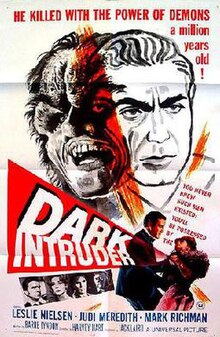
Drive-In Saturday: 'Dark Intruder'

(Welcome to the new iteration of 'Drive-In Saturday.' I'm going to be reviewing a new "dark detective" or paranormal investigator story each week. We'll start with one I watched this week with my son, "Dark Intruder," which you may never have heard of, but in weeks to come we'll also look at more well known such stories of occult detectives, including Kolchak, Dresden, and others.)

I learned about Dark Intruder via an email from Lovecraft Ezine, which regularly reviews and shares movies and books influenced by H.P. Lovecraft's work. There's a great examination of this little 59-minute movie at this link.

The short version: It's 1890, and Leslie Nielsen (best known these days for the Police Squad TV show that gave us the Naked Gun films — though I'll always think of him as the saucer commander on Forbidden Planet) plays the lead, Brett Kingsford, who carefully cultivates the outward appearance of a laughing dandy, while secretly helping local police battle occult menaces. He even disguises himself (a la Sherlock Holmes) to keep the beat cops from recognizing him when he needs to talk to the commissioner and access a crime scene.

This was a pilot for a TV series, but wasn't picked up for any number of reasons. It's easy to see why networks would be uneasy about it, as it is scary (for its day) and doesn't shy from demonic references. Using the black-and-white production limitations to good effect, it incorporates great noirish use of shadows and mist to heighten suspense. It plays almost like a Hammer film, in that respect, and as the above-linked article notes, its writer had some experience in that area also.

But what amazed me most was the fatalism in the script (which, given the Lovecraftian elements, probably should not have been so surprising). Without SPOILING too much (I hope), it shows us a hero who fails at every turn. Like John Constantine in the Vertigo comics, Kingsford manages to survive, but may have a mob of ghosts haunting him — the spirits of those whose lives he failed to save.

>>You can watch the film for yourself here.<<

Of interest to fans of Lovecraft will be mentions of creatures from his mythos, as well as the concept of them returning to our world. I was intrigued also by the body horror inherent in (possible SPOILER) the way the deformed conjoined twin plot line was built.

Finally, it's worth noting that Nielsen is a wonder to watch, shifting from the easily amused socialite to the deadly-serious occult investigator in the blink of an eye. I'd have gladly followed a series of his adventures before the turn of the century.

Thursday, January 22, 2015

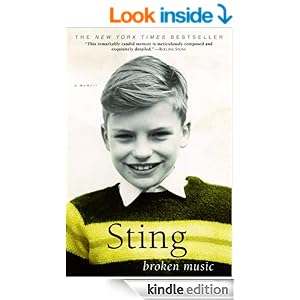
Book Review: 'Broken Music' by Sting

Though the pages are numbered/ I can't see where they lead/ For the end is a mystery/ No-one can read/ In the book of my life. 
-Sting, 'The Book of My Life' (Sacred Love)

"The Early Life and Misadventures of Gordon Sumner (Abridged)" would have sufficed for a title, but it would have been far too literal for the author of the engaging autobiography, Broken Music (352 pages; $26 Hardcover).

In this sometimes shocking self-portrait, the post-punk musician and poet known to the world as Sting first meets readers in the rainforests of South America in the 1990s, and takes them along on an hallucinatory semi-religious experience induced by ingesting a native plant — through time and memory — back into the life that molded him into a front man for The Police.

"It is a story very few people know," Sting writes in his introductory notes. "I had no interest in writing a traditional autobiographical recitation of everything that's ever happened to me. Instead I found myself drawn to exploring specific moments, certain people and relationships, and particular events which still resonate powerfully for me as I try to understand the child I was, and the man I became."

Often as eye-opening in its normalcy as it is in the offhand way it deals with what should have been outlandish, the narrative is always engrossing.

Here are unflinching examinations of young Gordon's family members, their hard lives, and the circumstances of his upbringing. In the process, those who know Sting's music and lyrics will find themselves recognizing the origins of his "summoner's tales" — the shipbuilders, the "Saint Agnes," the fortress round his heart.

It's little wonder that, reading Broken Music, I was repeatedly reminded of specific lines and images from Sting's albums — especially The Book of My Life, a track from his 2003 album, Sacred Love.

"Having been a songwriter most of my life, condensing my ideas and emotions into short rhyming couplets and setting them to music, I had never really considered writing a book," Sting writes in the book flap.

The title comes from a remembered moment when young Gordon, searching for an emotional outlet after realizing that his mother is having an affair, bangs on an old piano at his grandmother's house; the woman comes in and asks if he can't play something other than that "broken music."

And so he begins trying to use music to put things back together.

---
(This review originally appeared in The News Herald on Jan. 30, 2005.)

Thursday, November 20, 2014

TBT: Something From The Nightside

(This originally ran in The News Herald on Sunday, Nov. 28, 2004) 

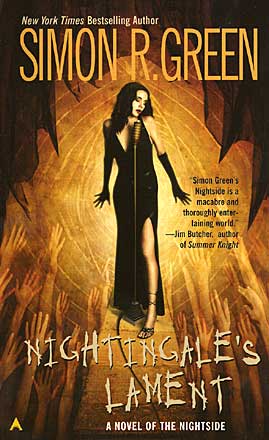
WHAT WE'RE READING: The Nightside novels

In Something from the Nightside, private detective John Taylor returned to the dark, magical heart of London where he was born to find a teenage girl who had been eaten by a house that was not really a house.

The 2003 Ace book introduced Taylor, his preternatural gift for finding things, and the strange segment of the city where it's always 3 a.m., the moon is always full and things are never what they seem.

In the second book (late 2003) of Simon R. Green's projected six-part Nightside series, Agents of Light and Darkness, Taylor found himself fighting angels from both Above and Below after he was hired by a rogue priest to recover the Unholy Grail — the cup from which Judas drank at the Last Supper. Seems both sides thought it would give them the edge they needed to win their eternal war; needless to say, Taylor didn't like the odds of the Nightside surviving Judgment Day.

Now the third book, The Nightingale's Lament (2004), finds Taylor trying to figure out why fans are dying at their own hands after listening to the songs of the Nightside's latest singing sensation, Rossingnol — and what unearthly power her spiderlike managers hold over her.

(In March 2005, Ace is scheduled to release the fourth book, Hex and the City.)

Green is perhaps best known for his science fiction and fantasy series — the Deathstalker books chief among them. But the Nightside novels promise to supplant these, both in depth and scope.

Taylor runs the razor's edge, trusting neither the light nor the darkness — and trusted by neither side. He's an anti-hero for the ages, one who can reference both Obi-Wan Kenobi and Merlin the Magician, for instance. One who is as at ease jousting with knights as with biker chicks hopped up on demonic steroids.

The books are quick reads, mixing pulp detective yarns with Lovecraft all wrapped in wicked British humor. They also tend to follow a pattern that sets their protagonist and his few surviving friends against overwhelming odds — to which they respond with a shrug, a pull on a cigarette, and begin rolling up their sleeves.

You know this is liable to hurt later, but it's better to just get to it.

Now, that's the guy I want at my back when the traffic gets hungry and the spiders come out of the rotted woodwork and the angels turn people to salt at the fast-food joint and the nightingale's song makes death seem like a good idea. Someone to watch over you — to whack you upside the head and kick you in the behind and cast a protective spell and find the hidden path out of this mess.

Someone from the Nightside.

Wednesday, April 23, 2014

Sample my upcoming new novel for free!

Image from Amazon.com
My latest manuscript was entered into this spring's Amazon/CreateSpace Breakthrough Novel competition, and has made it through the first two cuts (it's a quarter-finalist!). Which means you can now read the first 5,000 or so words for free by downloading the Kindle file (you don't have to own a Kindle device to read it; you can get a Kindle app for your smartphone or laptop or pad or desktop system for free from Amazon).

>>Go here to download the excerpt and see some reader reviews<<

I'm really thrilled by the reception it got from the judges so far. Two reviews by "expert reviewers" were posted to my CreateSpace account, and here are some of their notes:

"Beautiful writing, really terrific. Love the description of the car crash and its immediate aftermath.
Sweet character-building for Arthur Magus. ... Super beginning to what promises to be a great story. Really looking forward to reading it."

"The writing is great, it really shines. It seems like someone put a lot of time into perfecting it and it felt like part of a finished novel. ... I'm stumped. I can't find anything weak about it. ... This is a very well written piece. As long as the rest of the book is as strong as this excerpt, it could go to print right now and I'd want to read it. From the use of italics to the unhurried pacing and switching of story back and forth between characters, the whole thing is quite a treat."

Wonder how this tale evolved? >>You can read the story behind the story here<<

Some 10,000 entries (so I understand) were trimmed to 2,000 on the first cut, which is now at 500 (100 in each of five categories). The next cut will determine 25 semi-finalists, which will be announced on or about May 23. I'm holding on to hope that the tale will make the next cut. The final level will call for voting by Amazon users to determine a grand prize winner, so I'll let you know if that ever becomes a concern for me. The grand prize is $50,000 and a book contract; the four second-place winners will receive $15,000 and book contracts.

It's been an honor just to make this far. Seriously. "Caliban" is in the world now. People are reading it. That's something I dreamed about since I was a teenager. I hope they like him and root for him as much as I do. I hope you will too.

Peace.

Friday, July 12, 2013

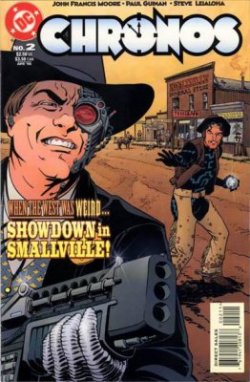
Flashback Friday: Reviewing the 'Chronos' comic series

(I really miss this comic book. I'm an easy mark for time travel stories, and when they're done right I can't let go of them. I want to revisit them time after time (see what I did there?). I'd love to see Walker Gabriel show up in the current DC "New 52" universe. Anyway, here's my review of the series, Chronos, from the May 13, 1998 edition of The News Herald. This appeared in our "Generation NeXt" section, which often had comic book content.)

From BigRedHair.com
Catching up with 'Chronos'

Time is like light, according to Walker Gabriel.

"It's both a wave and a particle," he explains. "It can be diffused and reflected. The suit I'm wearing generates an energy field that bends time around me."

Walker is the not-too-bad bad guy — who just might turn out to be a hero after all — at the center of DC Comics' new monthly series, Chronos, about the rehabilitation of a time-traveling ne'er-do-well.

Writer John Francis Moore and penciller/co-creator Paul Guinan, joined by inker Steve Leialoha, have woven a tapestry of detailed characters, adventure and pseudo-science supported by artwork and pacing that bring disparate times and places to life with astonishing realism.

The first issue of Chronos was a dense mix of new and old DC characters and concepts. The second was less bewildering — Walker's misadventures trapped in 1873 in Smallville, Kansas, where he meets the Clark and Kent families and runs afoul of a Linear Man, one of the guardians of DC continuity, posing as a U.S. marshal.

(Think Back to the Future III meets The Terminator.)

By issue three — and the introduction of a devilish immortal who seems to have met Walker before — the weave of the storyline's tapestry begins to coalesce.

Walker's travels hold the promise of plenty of guest stars from DC history — from the weird West of Jonah Hex to the far future of the Legionnaires. Still, guest stars galore don't matter if there's not a strong character at the core — which, I think, Walker will come to be.

Perhaps the most appealing aspect of the story is his journey, not his destination. Walker is on a voyage of self-discovery, learning about how his past and future actions have (or, depending on the era, will have) affected people — and discovering the hero within the jaded young scientist.

The first glimmer of this greater man he will (did?) become is seen in issue one, when an older Walker materializes in time to save his younger self from a time-traveling enemy; his first real step toward heroism follows in issue two, when he plans to steal money from the family that gave him a home and a job — but his conscience won't let him.

Monthly from DC Comics
Highly recommended

-------

(Another note: The series lasted only 11 regular issues, plus a "1 million" issue as part of a DC crossover. It ended with Walker erasing himself from history (actually creating an alternative timeline) in order to save his mother's life. It had so much potential. >>Just check out this page, where Walker meets Martha and Jonathan Kent on a dark country road one night just before they see a rocket crashland <<)

>>Also, I recently compared an image from Doctor Who to a cover of Chronos in this blog.<<


Friday, June 14, 2013

Flashback Friday: An early review of 'Starman' comic

(On May 21, 1996, the News Herald printed the following review of James Robinson's revival of the Starman character at DC Comics. It was as much a love letter to that series as a statement in reaction to what comics had become in the 1990s. I remain a fan. (Please ignore the use of the 'x' in 'comix,' which was how we spelled things in the 'Generation NeXt' section back then.))

Jack Knight, From Wikipedia
The heroes of old are, with a few notable exceptions, gone from the pages of four-color comix. That bright world has lost its innocence — and much of its creative energy — to teams of muscle-bound vigilantes toting semi-automatic plasma bazookas, and to impossibly endowed females flirting with loss of circulation if their rubber corsets were any tighter.

 Then came Starman.

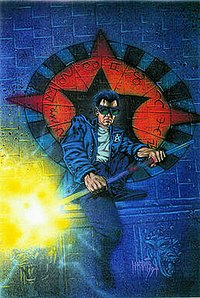
As created by writer James Robinson and artist Tony Harris, Starman is Jack Knight — a small figure of a man, a tattooed late-20-something, obsessed with all things rare and antique. He'd rather scour rural flea markets for View Master reels and Depression glass than dress in Spandex and duke it out with the villains.

His idea of a costume is night-vision goggles and a leather jacket.

But as the younger son of a 1940s superhero, Jack has become the epitome of the chicken-or-egg question that haunts history: Do great events conspire to create heroes, or do great men and women arise to make history?

In Jack's case, events sought him out and he rose to the challenge. His big brother, David, was first to don Dad's mantle, only to be killed by a sniper's bullet in the first pages of the first issue.

(Jack has since had two surreal visits with his deceased brother — the first as they fought in a grave yard over the right to the Starman name, and the second as David sought to warn Jack of future events.)

With his father injured, his brother dead and his own antique shop razed by the children of an old foe, Jack uses his dad's "star rod" to rout the bad guys and restore order to Opal City.

Through Jack and his supporting cast, Robinson has crafted a book with the multiple layers of history, personality, foreshadowing and drama usually found only in works print-only fiction. His characters are distinct and react with realism — as seen in the frustration and distance between father and son that slowly dissolves into a growing respect and admiration for their individual strengths.

The periodic "Times Past" stories allow guest artists to explore events in the history of Opal and its citizens, giving us a glimpse of the Golden Age of heroes; or a tale of the nigh-immortal. sometimes-villainous Shade and his friendship with Oscar Wilde.

Meanwhile, artist Harris has crafted a vision of retro-deco cities, of characters delineated by quirky swirls and outlines, of shadows and black bordered pages.  No larger-than-life people dominate his panels — save for the lumbering Solomon Grundy. Though stylistically rendered, these are anatomically realistic human beings with an expressive range far removed from the grimacing brain-bashers in other comix.

Like our own shared version of reality, this can be a dark world. People die. Bad guys revel in the pain of others. Some cops are less-than-true to their code. Evil is powerful.

But now there's a beacon in the night.

"Starman has always been around," Robinson said in his introduction to the series, "a light in the darkness, in his own little corner of the DC universe."

Friday, March 29, 2013

Looking Back at 'Logan's Run' (1977-78)


(The following is a segment from a memoir writing project I'm playing with. Hope you like it. Share your own recollections of 1970s Sci-Fi TV shows in the comments.)

Logan 5, Jessica 6 and Rem (Wikipedia)
A spin-off of the 1976 movie that starred Michael York and Jenny Agutter, the Logan’s Run TV series suffered from the common practice of dumbing down scifi to try to appeal to mass audiences and to make the show more “kid friendly.”  The series starred Gregory Harrison and Heather Menzies in softer, less sexualized versions of the characters played by York and Agutter, Logan 5 and Jessica 6, with supporting actors Donald Moffat as the android Rem and Randy Powell as Francis 7, Logan’s former best friend, fellow Sandman, and now relentless pursuer.


Carousel (Ebay image)
In the post-nuclear holocaust world of the 23rd Century, Logan is a Sandman; Sandmen are a sort of police force that patrols the City of Domes, where the last humans known to be alive chose to live a hedonistic existence in what looks like an upscale shopping mall, and then give up their lives at age 30 (age 21 in the original novel).  The populace believes they will be reincarnated via the “Carousel” ceremony, but they are simply killed to make room for new test-tube babies.  Sandmen track and kill any citizens who try to escape rebirth by running, i.e., “runners.”

(The series recycled many of the movie’s special effects, including the Carousel sequence, but exchanged the spectacular image of exploding bodies used in the film for a freeze-frame and a “crystallizing” effect.  Probably to keep little kids from trying to blow up their friends at home, which seemed to be the prevailing thought process at TV studios.)

In the film, Logan is placed undercover by the ruling computer to infiltrate a subversive group that is seeking to escape the city for some mythical “Sanctuary” where they can live out their lives in peace.  He gets Jessica to help him, and the two make it through a series of adventures to the ruins of Washington, D.C.  There, they meet an old man and Logan realizes there’s no reason to continue supporting the old ways of the City of Domes. He decides to return there, overthrow the computer ruler, and set the people free from Carousel.

The series wanders from the film’s plot, however, almost as soon as it begins.  Logan is already questioning the rite of rebirth, and he runs with Jessica.  Francis is taken before a secret council of old men and told he can join their number if he successfully brings Logan back for re-education.  It is never really made clear why Francis — not to mention all the other Sandmen dispatched into the outside world — would want to prop up the City of Domes when it’s obvious that there are many other survivors and civilizations in the outside world, which appears to be fully recovered from the war, and they no longer have a reason to die young.

So we once again have the familiar “Fugitive” structure for our episodes:  Innocent of any crime, our hero is on the run from relentless pursuit, meeting new people each week that need help, and then being forced to move on just one step ahead of the long arm of the law.  But rather than a search for proof of innocence, we have innocents searching for a place they can belong and experiencing true freedom — not the false freedom of consumerism and hedonism in exchange for giving up their personal power to a faceless authority — for the first time in their lives.

Logan and Jessica in the film (Screened.com)
I didn’t see the movie in theaters (I was 12 when it was in theaters), catching it only after it had been “Edited for Television” in advance of the series premiere.  And somehow, I rarely caught an episode of this series all the way through in its original run, and never at my own home.  The night of the premiere (Sept. 16, 1977) I was at Grandma and Pawpaw Massey’s house.  The grownups were playing canasta in the dining room, and about the time the pilot got to its secondary story, they took a break to come into the family room to talk; they started making jokes about the show, and I came to realize it was not as good as I was willing to believe.  It was like the Penguin running for Mayor, all over again — though it didn’t stop me from drawing pictures of Logan’s Sandman gun and trying to make a wooden version in my shop class.

Screen capture from 'Captured' (ShareTV.org)
I was at my friend Troy Gandy’s home for the third episode (“Capture,” broadcast Sept. 30, 1977), in which our heroes (and Francis) are hunted by the guy who was the young hot-head gunslinger wannabe from the original Magnificent Seven feature, (Horst Buchholz, bringing some presence to the screen).  Troy was eight months older than me, born in December 1963.  His brother, Robert, was a couple of years older than the both of us.  Troy and Robert fought constantly, either mouthing off at each other, or literally fist-fighting, which was a family dynamic I was not familiar with.  The night of this episode, Robert had picked at Troy until he lost his temper and lunged at his older brother.  They threw each other around the living room, overturning tables and chairs, scattering snacks on the floor.  I just stayed out of the way.

Looking back, I wonder how much of that activity was play-acting, like a TV wrestling match.  I couldn’t tell.  I also wonder how much of it was prompted by sheer boredom after the brothers discovered this was what I wanted to watch on TV.  When we all saw headlights on the driveway, a sudden calm hit the room.  The boys separated, a whirlwind of cleaning occurred, and by the time their mother came in the door, the place was back in the shape it had been in before the fight.  The three of us, sitting on the couch together, eating potato chips and watching Logan’s Run.

I thought about this and other times at the Gandy home a few years ago, when I learned that Troy had taken his own life.

And I realized that Troy and Robert, in their sibling conflict, had mirrored the dynamic of Logan and Francis in that very episode:  One former friend — a brother in almost every way — hunting and fighting the other until a common enemy appeared to force them to work together, at least until their next opportunity to struggle for dominance.  In the theater of my memory, I would have to cast Troy as Logan, as he was only trying to maintain his freedom and his sense of self that night.

I guess that makes me either Rem or Jessica in that scenario; I’ll go with the dispassionate and pacifistic Rem, if it’s all the same to you.  I don’t look that good in short skirts.

On Halloween of that year, I was again at the Gandy house for the only boy-girl party I was ever invited to during my middle- and high school years.  A game of spin-the-bottle was happening on the back porch, and the girl I liked (one of Troy’s cousins) didn’t want to participate.  Moreover, when the bottle pointed at me early in the game, the girl who should have kissed me begged off, lying to the crowd that we were cousins and it wouldn’t be right; I didn’t dispute her.

Screen grab from 'Half Life' (SnowCrest.net)
Instead I went inside to get some snacks, and discovered the TV was on in the living room.  No one was watching it.  Logan’s Run was playing (“Half Life” written by Shimon Wincelberg, broadcast Oct. 31, 1977).  I just stood there, watching Jessica 6 being duplicated, which is a familiar enough idea in sci-fi TV.  Except her personality was being split between the two bodies, so that one Jessica was good and the other evil.  Anyone who had seen Star Trek (specifically “The Enemy Within” episode) knew that we need both expressions of our personality to make us whole, and that people can’t go on as half-people.  (This episode also features a very young Kim Cattrall.)

I heard laughter outside and somewhat reluctantly left Jessica to seek out the party again.  This might have been when I began to recognize that real people didn’t hold as much allure to me as the ones on TV, or maybe I just told myself that because no one wanted to play spin the bottle with me.  Strangely, my situation again mirrored the very episode that was broadcast that night, except that I was the outcast whose personality didn’t conform to the accepted group, and no amount of video effects would make me right for them.

Screen grab of 'The Crypt' (OVGuide.com)
A week later, I saw the next episode from start to finish at my friend Chuck’s house.  Chuck and I had known each other since before we were born.  That is, our fathers and mothers had been in school together and were close friends; our mothers were pregnant within a couple months of each other, and we had playdates from a very early age.  The only real fist fight I ever had in middle school was against Chuck, and we both ended up getting paddled by the principal.  (I remember sitting in the office and Chuck telling me, "You were punching and crying at the same time. That scared the crap out of me.")  Probably one of the first times I ever slept over at a friend’s house, it was at Chuck’s.  He never had quite the same fascination with scifi that I did, though, so it wasn’t surprising that I sat and watched “The Crypt” episode (Nov. 7, 1977) more or less on my own.

Taken from a story by Harlan Ellison, who would later be one of my favorite authors, “The Crypt” concerned a group of people in suspended animation, endangered by earthquakes and stalked by one of their own.  I watched it while sitting on the wood floor in the living room.  Chuck was off somewhere else.  His mother, Elizabeth, was sitting on a chair drawing; later, she showed me the sketch she had done of me as I concentrated on the show.  It embarrassed me to know she had been watching me, but also made me feel special.  She was an English and Literature teacher, and as I grew up and started trying to write fiction, she would be one of my first readers and encouragers.

DVD box set (TheWickedLocal.com)
Recently, I purchased the box set of Logan’s Run from the Warner Archive Collection (WBshop.com) and enjoyed seeing the 14 episode series from the beginning.  Watching the fourth outing, “The Innocent,” I turned to my wife and muttered, “This show did not deserve to live.”  However, there were many bright moments:  “The Crypt” holds up, as does “Man Out of Time,” written by scifi author David Gerrold (most famous in the genre for writing the Trek episode “The Trouble with Tribbles”), who was unhappy with changes to the script and used a pseudonym, “Noah Ward” (as in “no award”) in the credits.  The latter concerned a time traveler who is trying to forestall a nuclear war, but learns that his success at jaunting into the future precipitated the first strike; Logan and his friends have to decide if the traveler should be allowed to return to his own time, even if his success means that their world — and by extension, each of them — might be wiped from history.

I appreciated, even in ’77,  the bravery and earnestness of Logan, the optimism and innocence (girl-next-door and yet Farrah Fawcett-like hotness) of Jessica.  And the lead actors (particularly Donald Moffat) are always fun to watch; you can see they recognized the limitations they were faced with each week and were determined to rise above.

The show was often preempted by the network (only 11 episodes were ever shown on the West Coast during the initial broadcast, according to Internet sources), and it ended its run on Feb. 6, 1978, with “Stargate,” a story written by comic book legend Dennis O’Neil, that failed to bring a conclusion to Logan’s search for Sanctuary.

Thirty-odd years later, I have a daughter named Jessica Heather (and it wasn’t until I began writing this segment that I realized she shares names with the character and the actress); our family lives in a gated community called Sanctuary Beach, where I have taken issue with the runners (at least the ones who trespass into the neighborhood and let their dogs run off-leash).

I have become a Sandman, but I still don’t have a working pistol.

Monday, November 19, 2012

Something someone said once

I'm feeling a bit off today. My name (sort of) was in today's obituary page. It wasn't me, but it was about as close as I'd ever like to see.

So I wondered what people might say if it was me; what eulogy would I receive? And that reminded me of one of the nicest things a coworker ever wrote about me. It was upon the release of my book, "Dazed and Raving in the Undercurrents," a collection of my better columns at the News Herald in my first 10 years of employment there.

The writer was Claude Duncan, at the time our Editorial Page Editor. Here's what he wrote, as taken from our electronic archive at the paper:

Thursday, January 20, 2005

Bay County perspective: Words as flashes of light

By Claude Duncan Editorial Page Editor

Tony Simmons is a journalist in, for newspapers, a post-journalistic age. With family to support, he thus also practices the bread-and-butter craft of editoring and has during his decade at The News Herald been beat reporter and columnist.

Simmons is good at all that. But he was born a journalist, with fingers connected to the mind’s eye. By training, intent and design, modern reporting in that respect is mindless work, albeit hard work.

Journalism was born of travel writing when much of the world was new to much of the world, and everything — everything — was about discovery. The writer inescapably was a part of his journey, as was self-discovery.

The poet Sarah Manguso, referring to the 18th century French philosopher most remembered for his encyclopedia, wrote that to Diderot, "the word is not the thing, but a flash in whose light we perceive the thing." Journalists like Simmons invoke masterfully what Manguso calls "codependent impulses" with readers. His new book, Dazed and Raving in the Undercurrents, is nothing if not flashes of light exposing this eternal co-dependency.

"Despite what you may have heard, you can go home again," Simmons writes in one entry, from 1995, "but you probably won’t enjoy it very much. … The faces I recall sometimes recall mine. In the Piggly Wiggly, we pass and they ask where I’ve been, what I’ve done with myself. I ask the same. Smiles circulate around uncomfortable silences. Then: a parting with promises to keep in touch."

Simmons often refers to himself on these visits home as "the prodigal." In morality tales, a prodigal is a rejecter who comes to happily embrace that which he rejected. So it is with Simmons, eventually.

Early on, though, Simmons can’t even remember his high school graduation ceremony, presumably as his mind already was in flight from town. When he returns for a niece’s graduation, he connects old slights to newly aging faces. Yet, by then, he also has written of a boyhood friend injured as an adult in a car wreck, perhaps for life. Simmons titled the rumination, "Now is the time to look up old friends."

In one visit home he found, "I am no longer familiar with the landscape of the hamlet where I wandered in my childhood. Trees have grown and grayed. Roads have widened. The houses of old friends have burned or fallen to disrepair or had their stiff, wooden skins covered by synthetic transplants of aluminum and vinyl." By this fall, too late for this volume but memorable to readers of this newspaper, upon seeing a photograph of his grandmother’s house, Simmons "thought of how he missed that front porch, and those days of play and work, and the old woman who had lived there, who always had been an old woman in his memory."

This is journalism eternal. Made peculiar to the time, it could have been written centuries ago, or centuries hence. Something like it was, and will. Self-discovery is human nature at its most unchanging. Simmons’ words are flashes of light for the reader to perceive things. His fingers are connected to his co-dependents’ mind. That is his art.

Dazed and Raving in the Undercurrents, as Simmons notes in his introduction, "is not just a collection of columns. It also is the story of a life — an unwitting autobiography composed as it unfolded." Rather little is nostalgic. It is full of observations about the ordinary modern world’s technological and cultural facets that Simmons, like his co-dependents, inhabits with dizzying degrees of confidence and confusion, skepticism and satisfaction. Always, though, Simmons seems not bored.

This is a book for the excitable who want to feel understood, and for the bored curious who want to understand the world outside their door. Always, it is about Simmons, the journalist, and therefore, always to some extent about the reader.


----
Claude passed away suddenly on Oct. 29, 2008, after retiring from his position at the News Herald. He was 62.

Wednesday, September 05, 2012

After the lights go out

I watched the pilot episode of NBC's new sci-fi-ish adventure series "Revolution" last night. It is still up on the NBC website as of this writing, to view for free (you will have to sit through some commercials during the show, and be warned that the volume on the commercials is about 4 times that of the program).

After a brief teaser that shows the power going out all over the world, the episode jumps 15 years into the future, where the survivors have formed 18th-century villages that pay tribute to feudal lords and "republics." Nothing electrical operates, not even batteries. A young woman named Charly (read as "Katniss" -- she's a hunter and awesome with a crossbow) is sent on a quest to find her uncle in Chicago after some bad stuff goes down at home.

That's all the plot I'm giving away.

I enjoyed the show, though I would have liked to have seen a little more hardship on the road between the village and Chicago; it didn't seem like that much of a trek, which made me wonder why the characters didn't have more of a connection to each other. If Chicago is only a day's march away, you'd have thought Charly and her uncle might have met before.

'Life After People'
Revolution is produced and directed by John (Iron Man) Favreau, executive produced by JJ Abrams (Star Trek), and stars Billy Burke as a swordswinging badass and costars someone you never heard of (Tracy Spiridakos) as Charly. It has epic scope, a neat conspiracy, some teasers of things to come. The action sequences are engaging and the scenery is epic.

Seeing the wreckage of the modern world, I was reminded of a History Channel show called "Life After People" that showed you what would happen to our world if we all just disappeared one day. It really wouldn't take all that long for the drains to back up and the wilderness to eat away our proudest constructions.

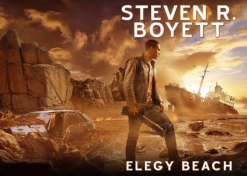
The concept also brought to mind the excellent novels "Ariel" and "Elegy Beach" by Steven R. Boyett (a former Gainesville resident), except "the Change" that swept over the world in these books ended all technology and brought magic and magical creatures into our world. (I highly recommend these novels; Boyett's treatment of magic as a sort of mental mathematics is incredible, and his characters are human and engrossing.) One of my favorite scenes in the second novel takes place when the characters locate a "bubble" where technology still works and magic doesn't; they take turns listening to an iPod; the young ones are in tears because they've never heard such incredible music, and never will again.

"Revolution" has no fantasy or magical elements to the story, but it has a palpable sense of danger and loss. There is clearly a scientific reason that the lights went out, and I suspect Charly will get to the bottom of it by the end of the season, opening new questions to explore. Check the show out. It premieres Sept. 17 on NBC, if you don't want to stream it.

Peace.