(This article originally published Wednesday, Dec. 6, 2000, in The News Herald's "Bay Book" column.)
PANAMA CITY BEACH — Christmas Tree Lane, a meandering paved trail on the western reaches of Panama City Beach (Laguna Beach), is lined by everything but what you might expect, given the name.
More oleanders and palms grow here than spruce and cedar, more scrub oaks than even scraggly Charlie Brown-style pine saplings.
There's no snow to frolic in, either — an early morning frost is the most one might hope for. Ground cover consists of sand, red clay, weeds and one yard given over to white marble rock and gravel.
You'll find no igloos or enchanted elf castles on Christmas Tree Lane. Instead, lines of mobile homes give way to abandoned houses, old tourist properties for sale or rent, and empty lots.
But sprinkled among these are pockets of brightness, houses where people have planted roots (and grass). One such place is a modest home that, despite being situated about halfway along the lane, is labeled "The Rhodes End" by a sign at its entrance.
In the front yard stands a brightly-painted 3-foot-tall wooden Santa Claus and a similar snowman that may or may not represent good ol' Frosty.
Homeowner Richard Rhodes, 65, has lived on the lane since 1987, and he said the Christmas spirit has always moved him to decorate.
"I came here from Colorado," he said. "I bought a little hotdog stand on the beach, and I've been working on the beach ever since."
When Rhodes first moved onto the lane, none of his neighbors did any holiday decorating.
"I've always done that all my life," he said. "My wife died four years ago and my son died two years ago on Christmas Eve, so last year was the only year I didn't do any decorating."
He's gotten back into the spirit this year — a toy train runs around the Christmas tree inside the home, much to the delight of his two grandchildren — and he has plans for an even bigger display for Christmas 2001.
"I want to plant a Christmas tree in the front yard in January so I'll have one to decorate next year," he said.
And finally, Christmas Tree Lane could live up to its name.
Showing posts with label Throwback Thursday. Show all posts
Showing posts with label Throwback Thursday. Show all posts
Thursday, November 26, 2015


Thursday, October 29, 2015
Throwback Thursday: Best ‘witches’ for the happy birthday ghoul

(Originally published Sunday, October 31, 2010 in The News Herald.)
She arrived squalling in the dark and early hours of a Halloween morning, an absolute treat after a frightening and tricky delivery, our own tiny gremlin. Later that day, a boy dressed as the Flash gave her a kiss — through his face mask — before zooming off to trick-or-treat.
She has worn many costumes in the 19 (all too short) years since then: baby pumpkin, fairy-tale princess, pink Power Ranger, witch, Indian princess, police officer, Dorothy Gale, gangster moll and many more. She’s even been known to create a costume and makeup out of boredom (see above).
She won a prize in a sci-fi convention costume contest one year for the Star Trek outfit we dressed her in — mostly because she was an awfully cute 4-year-old at the time. The grownups in their expensive “uniforms” were not amused.
Over the years, we developed a tradition of taking the birthday ghoul out to eat before going trick-or-treating; the whole family would wear costumes to whatever restaurant she chose. That came to an end the year I wore a Star Trek costume and everyone in the joint came by the table to make jokes.
She absolutely refused to let me wear a Mr. Fantastic outfit a couple of years back, but that might have had more to do with the way my gut stretched the fabric.
I suppose there’s only so much humiliation a young woman will endure from her father.
For the last few years, she has wandered the neighborhoods of the Hammocks in Lynn Haven with her friends and has hauled home loads of candy — so we’re a little disappointed that she has finally decided she’s “too old” for trick-or-treating. Looks like we’ll have to hit the after-Halloween sales on All Souls Day.
All this is to say that, no matter what outward outfit she wears or how many Halloweens she has seen, she’ll always be our little monster under the surface.
Happy Halloween!
Thursday, October 22, 2015
Throwback Thursday: Don't wait for Godot's great pumpkin
(Originally published October 30, 2005 in The News Herald)
As you read this, it's the morning after my daughter's first-ever hosted multi-guest sleepover party.
If all went according to plan, she had youngsters traipsing through the halls in Halloween costumes, eating snacks and birthday cake, half-watching scary movies, staying up to all hours, and dancing to music at a volume that probably was turned down over and over again by weary grownups.
Pray for them.
Bad enough that I can be grouchy on the best of mornings. Worse that my daughter is even more grouchy than me. But that's not really what this is all about.
It's about The Great Pumpkin, and the girl who came to us on a Halloween morning 14 years ago,
and the lessons she teaches.
The Great Pumpkin, like Godot, never arrives. It's the anticipation of his arrival, and our loneliness in the waiting, that matters. Linus sends letters that are never answered; he waits in the patch all night and never sees a sign. He believes in things the rest of us find laughable.
For many years, despite requests from our own "peanuts" gallery, somehow we seldom had a jack-o'- lantern on the doorstep. This year, we got a great pumpkin. We chose it from the patch off State 77 in Lynn Haven and brought it home to lovingly mutilate. It wasn't huge by any means, but it had a good shape and size. And it was ours.
We went to get the pumpkin because our Hallowed Eve princess wanted it, of course, and because her mother's insistence overcame my considerable inertia. And after a few days of having the pumpkin sitting patiently unmolested by the front door, for much the same reason, we took it into the backyard to carve.
As her mother watched, I showed the spooky little girl how to trim off the top and dig out the guts — or brains, if you prefer — to stick to the gourd-as-head analogy. I skimmed seeds out of the fibrous orange mucous and put them into one bowl to be cleaned and roasted. The brains and inner meat went into another, to be made into pumpkin pie or something else Mom might decide to make.
Then daughter and I drew the face, and I helped her cut the holes. She outlined the holes with red paint to increase the daytime scariness. We have since placed the candle inside and shined the light, and it is one formidable jack-o'-lantern.
But there was a moment in between those steps, a moment when I was up to my elbows in pumpkin brains, fingers coated in goo, when I realized my place in all of this. The role I had taken, though active in these final steps, was not the role that had put the gourd on its journey to the front porch.
"This is cool," said the Halloween girl. "Thanks, Mom."
Peace.
As you read this, it's the morning after my daughter's first-ever hosted multi-guest sleepover party.
If all went according to plan, she had youngsters traipsing through the halls in Halloween costumes, eating snacks and birthday cake, half-watching scary movies, staying up to all hours, and dancing to music at a volume that probably was turned down over and over again by weary grownups.
Pray for them.
Bad enough that I can be grouchy on the best of mornings. Worse that my daughter is even more grouchy than me. But that's not really what this is all about.
It's about The Great Pumpkin, and the girl who came to us on a Halloween morning 14 years ago,
and the lessons she teaches.
The Great Pumpkin, like Godot, never arrives. It's the anticipation of his arrival, and our loneliness in the waiting, that matters. Linus sends letters that are never answered; he waits in the patch all night and never sees a sign. He believes in things the rest of us find laughable.
For many years, despite requests from our own "peanuts" gallery, somehow we seldom had a jack-o'- lantern on the doorstep. This year, we got a great pumpkin. We chose it from the patch off State 77 in Lynn Haven and brought it home to lovingly mutilate. It wasn't huge by any means, but it had a good shape and size. And it was ours.
We went to get the pumpkin because our Hallowed Eve princess wanted it, of course, and because her mother's insistence overcame my considerable inertia. And after a few days of having the pumpkin sitting patiently unmolested by the front door, for much the same reason, we took it into the backyard to carve.
As her mother watched, I showed the spooky little girl how to trim off the top and dig out the guts — or brains, if you prefer — to stick to the gourd-as-head analogy. I skimmed seeds out of the fibrous orange mucous and put them into one bowl to be cleaned and roasted. The brains and inner meat went into another, to be made into pumpkin pie or something else Mom might decide to make.
Then daughter and I drew the face, and I helped her cut the holes. She outlined the holes with red paint to increase the daytime scariness. We have since placed the candle inside and shined the light, and it is one formidable jack-o'-lantern.
But there was a moment in between those steps, a moment when I was up to my elbows in pumpkin brains, fingers coated in goo, when I realized my place in all of this. The role I had taken, though active in these final steps, was not the role that had put the gourd on its journey to the front porch.
"This is cool," said the Halloween girl. "Thanks, Mom."
Peace.
Thursday, October 15, 2015
Throwback Thursday: Some leave monuments when they go
(This column originally appeared in The News Herald on Sunday, October 23, 2005.)
Hugs all around, and smiles, and some laughs.
We compare bald spots, and aches and pains like the guys on Jaws comparing their scars. We brag about our children, their grades and accomplishments, bestow compliments and accept them.
(We live through our children, after all. We put our arms around them and hang on for dear life. The future is there. Here is the past, we say to the child as we brag to our forefathers about the living future.)
So many faces in the crowd. We don't see them any more, except at family reunions, or weddings or funerals. We don't have family reunions any more, and those of us who were once considered the kids of the family are now at that intermediate age when it seems like nobody's getting married.
I guess you know what that leaves.
I'm thinking it's a shame that it has been so long since I saw so many of these people, and I'm thinking Bobby would be glad to see so many of them gathered up in one place. He'd have something inappropriate and hilarious to say about it.
There are pictures and flowers, as there always are. And tears. But there are inordinate amounts of smiles. Bobby would have appreciated that — it's what he brought into rooms.
Later, after the service at the Flomaton Funeral Home and another one on the green hill overlooking the town, we gather at his house. We are greeted there by a wooden sculpture Roland Hockett might have conceived on a whim.
Bobby built the monument to the recent hurricanes Ivan and Dennis after they dropped trees — twice — on his house. The second time, after repairs from the first time had been significantly completed.
The freeform sculpture stands at the end of the walkway that leads from the street to the front door of the home. It's made of pieces cut from the trees as they were removed from the house, as well as various other debris.
Maybe it's a warning of what can happen if you fight the forces of nature, I thought. Maybe it's a kind of pine ju-ju meant to appease the hurricane gods. Most likely, it's just a typical joke — Bobby's way of saying he's not going to let something like a one-two punch from Mother Nature get him down.
Some people leave memories. Some leave legacies. Some leave monuments.
I snap a picture, and wonder.
Peace.
Hugs all around, and smiles, and some laughs.
We compare bald spots, and aches and pains like the guys on Jaws comparing their scars. We brag about our children, their grades and accomplishments, bestow compliments and accept them.
(We live through our children, after all. We put our arms around them and hang on for dear life. The future is there. Here is the past, we say to the child as we brag to our forefathers about the living future.)
So many faces in the crowd. We don't see them any more, except at family reunions, or weddings or funerals. We don't have family reunions any more, and those of us who were once considered the kids of the family are now at that intermediate age when it seems like nobody's getting married.
I guess you know what that leaves.
I'm thinking it's a shame that it has been so long since I saw so many of these people, and I'm thinking Bobby would be glad to see so many of them gathered up in one place. He'd have something inappropriate and hilarious to say about it.
There are pictures and flowers, as there always are. And tears. But there are inordinate amounts of smiles. Bobby would have appreciated that — it's what he brought into rooms.
Later, after the service at the Flomaton Funeral Home and another one on the green hill overlooking the town, we gather at his house. We are greeted there by a wooden sculpture Roland Hockett might have conceived on a whim.
Bobby built the monument to the recent hurricanes Ivan and Dennis after they dropped trees — twice — on his house. The second time, after repairs from the first time had been significantly completed.
The freeform sculpture stands at the end of the walkway that leads from the street to the front door of the home. It's made of pieces cut from the trees as they were removed from the house, as well as various other debris.
Maybe it's a warning of what can happen if you fight the forces of nature, I thought. Maybe it's a kind of pine ju-ju meant to appease the hurricane gods. Most likely, it's just a typical joke — Bobby's way of saying he's not going to let something like a one-two punch from Mother Nature get him down.
Some people leave memories. Some leave legacies. Some leave monuments.
I snap a picture, and wonder.
Peace.
Thursday, October 08, 2015
Throwback Thursday: On the road — I remember the warrior
(The following originally was published in the Sunday edition of The News Herald, October 16, 2005.)
I remember a time of chaos, ruined dreams, this wasted land. Most of all, I remember the man we called Max, the road warrior.
Here, the signs stripped of numbers, the bags over the nozzles. There, cars backed up 10 deep and into the street with a police officer directing the lines and watching for drive-offs as the last drops are drained of premium.
And finally, cars following a tanker as it drives from the Chevron terminal on St. Andrew Bay to deliver thousands of gallons to a station on U.S. 231. There, the lines form again, and only hours later the underground tanks again are dry.
There's desperation in the eyes of those who sat at the ends of the lines, those who did not get a taste of the golden juice, those whose needles rest on the red "E."
Without fuel they were nothing. They'd built a house of straw. Suddenly their machines sputtered and stopped. Their leaders talked and talked and talked, but nothing could stem the avalanche. Their world crumbled.
I was one of the lucky ones during the recent shortage who found gasoline — enough to make a trip out of town — and there I found gasoline enough to make it back home again. It was a worrisome thing to do.
You become afraid to travel. If you give any thought to the ready availability of fuel, then you do. Can you get from here to there? And if you make it one way, can you get back home again?
Traveling last weekend, we passed any number of gas stations with empty signs and bagged nozzles in Walton, Okaloosa, Santa Rosa and Escambia counties. We paid more to travel one way to the old homestead and back again than it would have cost to drive three times that far a year ago.
Abandoned cars sat on roadsides, more than I've ever seen on that journey, and I wondered how many of them simply were out of petrol.
We'd been making Road Warrior jokes for weeks around the office because of the shortage, and now I was facing the images for real and wondering: Where was Lord Humungus? Where was the lawman, Max? How far were we from feral children roaming the wasteland with boomerangs?
To understand who he was we have to go back to the other time. When the world was powered by the black fuel, and the desert sprung great cities of pipe and steel. Gone now, swept away.
Strangely enough, AMC's "A One and A Two" (in which the cable network plays a movie and its sequel as a double feature) on Wednesday night showed Max Max followed by The Road Warrior.
And Thursday, the prices on the convenience store signs began to fall. I wondered if there was some karmic connection.
"You want to get out of here? You talk to me."
Here he would learn, amid the dark wreckage, that the fire which burns in the heart of man, will endure. Hope survives.
Peace.
I remember a time of chaos, ruined dreams, this wasted land. Most of all, I remember the man we called Max, the road warrior.
Here, the signs stripped of numbers, the bags over the nozzles. There, cars backed up 10 deep and into the street with a police officer directing the lines and watching for drive-offs as the last drops are drained of premium.
And finally, cars following a tanker as it drives from the Chevron terminal on St. Andrew Bay to deliver thousands of gallons to a station on U.S. 231. There, the lines form again, and only hours later the underground tanks again are dry.
There's desperation in the eyes of those who sat at the ends of the lines, those who did not get a taste of the golden juice, those whose needles rest on the red "E."
Without fuel they were nothing. They'd built a house of straw. Suddenly their machines sputtered and stopped. Their leaders talked and talked and talked, but nothing could stem the avalanche. Their world crumbled.
I was one of the lucky ones during the recent shortage who found gasoline — enough to make a trip out of town — and there I found gasoline enough to make it back home again. It was a worrisome thing to do.
You become afraid to travel. If you give any thought to the ready availability of fuel, then you do. Can you get from here to there? And if you make it one way, can you get back home again?
Traveling last weekend, we passed any number of gas stations with empty signs and bagged nozzles in Walton, Okaloosa, Santa Rosa and Escambia counties. We paid more to travel one way to the old homestead and back again than it would have cost to drive three times that far a year ago.
Abandoned cars sat on roadsides, more than I've ever seen on that journey, and I wondered how many of them simply were out of petrol.
We'd been making Road Warrior jokes for weeks around the office because of the shortage, and now I was facing the images for real and wondering: Where was Lord Humungus? Where was the lawman, Max? How far were we from feral children roaming the wasteland with boomerangs?
To understand who he was we have to go back to the other time. When the world was powered by the black fuel, and the desert sprung great cities of pipe and steel. Gone now, swept away.
Strangely enough, AMC's "A One and A Two" (in which the cable network plays a movie and its sequel as a double feature) on Wednesday night showed Max Max followed by The Road Warrior.
And Thursday, the prices on the convenience store signs began to fall. I wondered if there was some karmic connection.
"You want to get out of here? You talk to me."
Here he would learn, amid the dark wreckage, that the fire which burns in the heart of man, will endure. Hope survives.
Peace.
Thursday, January 22, 2015
Book Review: 'Broken Music' by Sting
Though the pages are numbered/ I can't see where they lead/ For the end is a mystery/ No-one can read/ In the book of my life.
-Sting, 'The Book of My Life' (Sacred Love)
 "The Early Life and Misadventures of Gordon Sumner (Abridged)" would have sufficed for a title, but it would have been far too literal for the author of the engaging autobiography, Broken Music (352 pages; $26 Hardcover).
In this sometimes shocking self-portrait, the post-punk musician and poet known to the world as Sting first meets readers in the rainforests of South America in the 1990s, and takes them along on an hallucinatory semi-religious experience induced by ingesting a native plant — through time and memory — back into the life that molded him into a front man for The Police.
"It is a story very few people know," Sting writes in his introductory notes. "I had no interest in writing a traditional autobiographical recitation of everything that's ever happened to me. Instead I found myself drawn to exploring specific moments, certain people and relationships, and particular events which still resonate powerfully for me as I try to understand the child I was, and the man I became."
Often as eye-opening in its normalcy as it is in the offhand way it deals with what should have been outlandish, the narrative is always engrossing.
Here are unflinching examinations of young Gordon's family members, their hard lives, and the circumstances of his upbringing. In the process, those who know Sting's music and lyrics will find themselves recognizing the origins of his "summoner's tales" — the shipbuilders, the "Saint Agnes," the fortress round his heart.
It's little wonder that, reading Broken Music, I was repeatedly reminded of specific lines and images from Sting's albums — especially The Book of My Life, a track from his 2003 album, Sacred Love.
"Having been a songwriter most of my life, condensing my ideas and emotions into short rhyming couplets and setting them to music, I had never really considered writing a book," Sting writes in the book flap.
The title comes from a remembered moment when young Gordon, searching for an emotional outlet after realizing that his mother is having an affair, bangs on an old piano at his grandmother's house; the woman comes in and asks if he can't play something other than that "broken music."
And so he begins trying to use music to put things back together.
---
(This review originally appeared in The News Herald on Jan. 30, 2005.)
-Sting, 'The Book of My Life' (Sacred Love)
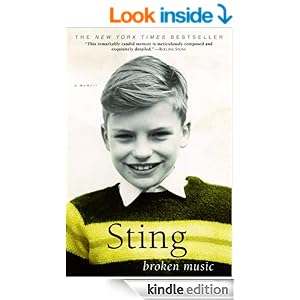
In this sometimes shocking self-portrait, the post-punk musician and poet known to the world as Sting first meets readers in the rainforests of South America in the 1990s, and takes them along on an hallucinatory semi-religious experience induced by ingesting a native plant — through time and memory — back into the life that molded him into a front man for The Police.
"It is a story very few people know," Sting writes in his introductory notes. "I had no interest in writing a traditional autobiographical recitation of everything that's ever happened to me. Instead I found myself drawn to exploring specific moments, certain people and relationships, and particular events which still resonate powerfully for me as I try to understand the child I was, and the man I became."
Often as eye-opening in its normalcy as it is in the offhand way it deals with what should have been outlandish, the narrative is always engrossing.
Here are unflinching examinations of young Gordon's family members, their hard lives, and the circumstances of his upbringing. In the process, those who know Sting's music and lyrics will find themselves recognizing the origins of his "summoner's tales" — the shipbuilders, the "Saint Agnes," the fortress round his heart.
It's little wonder that, reading Broken Music, I was repeatedly reminded of specific lines and images from Sting's albums — especially The Book of My Life, a track from his 2003 album, Sacred Love.
"Having been a songwriter most of my life, condensing my ideas and emotions into short rhyming couplets and setting them to music, I had never really considered writing a book," Sting writes in the book flap.
The title comes from a remembered moment when young Gordon, searching for an emotional outlet after realizing that his mother is having an affair, bangs on an old piano at his grandmother's house; the woman comes in and asks if he can't play something other than that "broken music."
And so he begins trying to use music to put things back together.
---
(This review originally appeared in The News Herald on Jan. 30, 2005.)
Thursday, November 20, 2014
TBT: Something From The Nightside

WHAT WE'RE READING: The Nightside novels
In Something from the Nightside, private detective John Taylor returned to the dark, magical heart of London where he was born to find a teenage girl who had been eaten by a house that was not really a house.
The 2003 Ace book introduced Taylor, his preternatural gift for finding things, and the strange segment of the city where it's always 3 a.m., the moon is always full and things are never what they seem.

Now the third book, The Nightingale's Lament (2004), finds Taylor trying to figure out why fans are dying at their own hands after listening to the songs of the Nightside's latest singing sensation, Rossingnol — and what unearthly power her spiderlike managers hold over her.
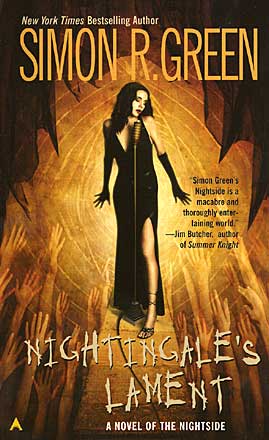
Green is perhaps best known for his science fiction and fantasy series — the Deathstalker books chief among them. But the Nightside novels promise to supplant these, both in depth and scope.
Taylor runs the razor's edge, trusting neither the light nor the darkness — and trusted by neither side. He's an anti-hero for the ages, one who can reference both Obi-Wan Kenobi and Merlin the Magician, for instance. One who is as at ease jousting with knights as with biker chicks hopped up on demonic steroids.
The books are quick reads, mixing pulp detective yarns with Lovecraft all wrapped in wicked British humor. They also tend to follow a pattern that sets their protagonist and his few surviving friends against overwhelming odds — to which they respond with a shrug, a pull on a cigarette, and begin rolling up their sleeves.
You know this is liable to hurt later, but it's better to just get to it.
Now, that's the guy I want at my back when the traffic gets hungry and the spiders come out of the rotted woodwork and the angels turn people to salt at the fast-food joint and the nightingale's song makes death seem like a good idea. Someone to watch over you — to whack you upside the head and kick you in the behind and cast a protective spell and find the hidden path out of this mess.
Someone from the Nightside.
Thursday, June 19, 2014
Throwback Thursday: Buy, beg, borrow a boat
(Originally published June 27, 2004, on the Lifestyle page of The News Herald)
No one who knows David Angier would consider him a trusting soul. He's a crusty old cynical courts reporter, after all, which makes his decision to offer me the use of his boat during my recent vacation all the more mystifying. Unless, as he said, the insurance was all paid up and he'd like a new boat anyway.
Now, I know about as much about boating as I know about flying an airplane. That didn't improve much after an afternoon's "training" voyage out on the bay with David, even with a handy-dandy notebook he supplied.
(Some representative notes: Sandbars bad. Avoid hitting other boats. Sunscreen good. Slow down before approaching a pier.)
As a longtime reader of David's "Dangierous Waters" column in the Waterfront section, I took the offer with a grain of salt. This was, you know, the boat that each month refused to run, went in for repairs, wouldn't go in reverse, sank to the waterline or otherwise tried to get out of doing its job.
My fear was less that I would hurt the boat, and more that it would hurt us. I had visions of being stranded with my family in the middle of St. Andrew Bay, in sight of land, and having to resort to cannibalism to survive.
However, the boat cranked and performed just fine on the Sunday evening David put it in the water and I drove it from the Panama City Marina. (So what if I steered close enough to the pier to count barnacles - I didn't technically hit anything.) And we crossed without incident to our waterfront campsite at St. Andrews State Park, where we anchored for the night.
The plan was to take the boat to Shell Island on Monday and return it to David that evening, but when the boat wouldn't start Monday morning, I figured it was a bad sign. It wouldn't start any of the other times I tried it that day, either. David finally returned my frantic voice mails after he got off work, talked me through steps to flush the engine, and we tooled around Grand Lagoon that afternoon.
"Keep it another night. Bring it back tomorrow," he said. So Tuesday, we took the boat through the narrow pass, around to Audubon Island and the Hathaway Bridge, circled almost to East Bay, then back to Shell Island. We played in the surf, collected sand dollars and snorkeled on the bay side. We saw dolphins everywhere. The weather was perfect; the water was crystal clear.
It was cool. It was also hot and sunny, but you know - it was cool.
My wife caught boat fever, and I came to a conclusion that I never had considered before experiencing the freedom that a boat provides: If you live close to the coast, you should buy a boat. And then loan it to me.
Peace.
---
And here's David's column of the same date, telling his side of the story. It appeared on the Waterfront page, under the column header "Dangierous Waters" :
I honestly wasn't too worried when I loaned my boat to co-worker and friend Tony Simmons earlier this month. "It's insured," I told him, smiling. "Just be safe." I had no idea what I was doing. There I was, standing with arms folded and pained grimace, watching my boat head toward the Panama City Marina's seawall with Tony at the helm. But he swung it around and missed, by a frog's hair, before steering her cleanly out into the gulf.
I resumed breathing and put it all out of my mind.
The boat was running great and I didn't think there'd be any problems with it breaking down. How much trouble could he get in? He was just taking it for 24 hours.
I had given him a crash course (so to speak) the day before on a few hundred of the things he would need to know when he was in charge.
Tony, his wife Debra and daughter Jessica joined my dog and me on an afternoon trip from Watson Bayou to Shell Island. The water had a light chop and there was a spattering of traffic, both good for a lesson.
I talked nonstop about things to keep in mind: plugs, gas, oil, lights, life vests, etc. Of course, boating is the easy part compared to preparation, launching and recovery. I went through all those until my head hurt.
Then came the big moment; I allowed someone else to drive. First Tony took the helm, then Debra. They had problems with the finer points of working the throttle.
Debra, I discovered, is a very literal person. Tell her to get ready to slow down to take a wake, and you get a sudden pull back on the throttle. I'm just glad my boat has a walk-through, or in this case a fall-through, windshield.
Tony, on the other hand, has an interesting bump-and-grind docking technique.
But overall, both did fine.
So, on a fine Sunday afternoon, Tony set off from the marina and pointed the bow toward St. Andrews State Park. He called later to say that he'd made it safely.
He called the next morning to say he couldn't get the boat started.
Should have seen that coming.
Flooded motor. I talked him through getting it started and told him to just let it run. I was certain, however, that Tony wouldn't be confident enough in the boat to venture anywhere with it and thought I'd have to spend a few hours taking it back to the marina myself.
But by this time, Tony was proving that he had the right stuff to be a boater - blind faith and unreasonable optimism.
The boat started for him the next morning and that was enough for the Simmons family. They spent the day riding around, exploring the bay and soaking up all the benefits of access to areas that only boaters know.
They even took the boat out of the water, cleaned it and parked it in my front yard.
It all worked out.
Yeah, I know, I can't explain it either. But then, I'm not going to try. See I've been a boater long enough to know that you never question a miracle.
Buy, beg, borrow a boat
No one who knows David Angier would consider him a trusting soul. He's a crusty old cynical courts reporter, after all, which makes his decision to offer me the use of his boat during my recent vacation all the more mystifying. Unless, as he said, the insurance was all paid up and he'd like a new boat anyway.
Now, I know about as much about boating as I know about flying an airplane. That didn't improve much after an afternoon's "training" voyage out on the bay with David, even with a handy-dandy notebook he supplied.
(Some representative notes: Sandbars bad. Avoid hitting other boats. Sunscreen good. Slow down before approaching a pier.)
As a longtime reader of David's "Dangierous Waters" column in the Waterfront section, I took the offer with a grain of salt. This was, you know, the boat that each month refused to run, went in for repairs, wouldn't go in reverse, sank to the waterline or otherwise tried to get out of doing its job.
My fear was less that I would hurt the boat, and more that it would hurt us. I had visions of being stranded with my family in the middle of St. Andrew Bay, in sight of land, and having to resort to cannibalism to survive.
However, the boat cranked and performed just fine on the Sunday evening David put it in the water and I drove it from the Panama City Marina. (So what if I steered close enough to the pier to count barnacles - I didn't technically hit anything.) And we crossed without incident to our waterfront campsite at St. Andrews State Park, where we anchored for the night.
The plan was to take the boat to Shell Island on Monday and return it to David that evening, but when the boat wouldn't start Monday morning, I figured it was a bad sign. It wouldn't start any of the other times I tried it that day, either. David finally returned my frantic voice mails after he got off work, talked me through steps to flush the engine, and we tooled around Grand Lagoon that afternoon.
"Keep it another night. Bring it back tomorrow," he said. So Tuesday, we took the boat through the narrow pass, around to Audubon Island and the Hathaway Bridge, circled almost to East Bay, then back to Shell Island. We played in the surf, collected sand dollars and snorkeled on the bay side. We saw dolphins everywhere. The weather was perfect; the water was crystal clear.
It was cool. It was also hot and sunny, but you know - it was cool.
My wife caught boat fever, and I came to a conclusion that I never had considered before experiencing the freedom that a boat provides: If you live close to the coast, you should buy a boat. And then loan it to me.
Peace.
---
And here's David's column of the same date, telling his side of the story. It appeared on the Waterfront page, under the column header "Dangierous Waters" :
My baby's back, and all in one piece
I honestly wasn't too worried when I loaned my boat to co-worker and friend Tony Simmons earlier this month. "It's insured," I told him, smiling. "Just be safe." I had no idea what I was doing. There I was, standing with arms folded and pained grimace, watching my boat head toward the Panama City Marina's seawall with Tony at the helm. But he swung it around and missed, by a frog's hair, before steering her cleanly out into the gulf.
I resumed breathing and put it all out of my mind.
The boat was running great and I didn't think there'd be any problems with it breaking down. How much trouble could he get in? He was just taking it for 24 hours.
I had given him a crash course (so to speak) the day before on a few hundred of the things he would need to know when he was in charge.
Tony, his wife Debra and daughter Jessica joined my dog and me on an afternoon trip from Watson Bayou to Shell Island. The water had a light chop and there was a spattering of traffic, both good for a lesson.
I talked nonstop about things to keep in mind: plugs, gas, oil, lights, life vests, etc. Of course, boating is the easy part compared to preparation, launching and recovery. I went through all those until my head hurt.
Then came the big moment; I allowed someone else to drive. First Tony took the helm, then Debra. They had problems with the finer points of working the throttle.
Debra, I discovered, is a very literal person. Tell her to get ready to slow down to take a wake, and you get a sudden pull back on the throttle. I'm just glad my boat has a walk-through, or in this case a fall-through, windshield.
Tony, on the other hand, has an interesting bump-and-grind docking technique.
But overall, both did fine.
So, on a fine Sunday afternoon, Tony set off from the marina and pointed the bow toward St. Andrews State Park. He called later to say that he'd made it safely.
He called the next morning to say he couldn't get the boat started.
Should have seen that coming.
Flooded motor. I talked him through getting it started and told him to just let it run. I was certain, however, that Tony wouldn't be confident enough in the boat to venture anywhere with it and thought I'd have to spend a few hours taking it back to the marina myself.
But by this time, Tony was proving that he had the right stuff to be a boater - blind faith and unreasonable optimism.
The boat started for him the next morning and that was enough for the Simmons family. They spent the day riding around, exploring the bay and soaking up all the benefits of access to areas that only boaters know.
They even took the boat out of the water, cleaned it and parked it in my front yard.
It all worked out.
Yeah, I know, I can't explain it either. But then, I'm not going to try. See I've been a boater long enough to know that you never question a miracle.
Subscribe to:
Posts (Atom)