Showing posts with label creative process. Show all posts

Sunday, June 19, 2016

Flashback Father's Day: The Drama of Life

(This article originally was published by The News Herald in Panama City on Father's Day, June 18, 2006.)


The drama of life
By David Angier

Most parents cringe at the drama their teenagers bring into their lives, but Tony Simmons applauds it.

Even when his son, Nathan, is engaging in drunken brawls, kissing random women and acting crazy,

Tony simply smiles and watches - at times from front-row center.

In the years before Nathan, now 17, discovered acting, the drama he brought into the Simmons' household was nothing to smile about. But next weekend, father will join son on stage for a Shakespeare in the Park production of "Othello," in an activity that has drawn them closer together.

Admittedly, Tony Simmons' part is a small one - he has a few lines that he says he's struggled to learn - while Nathan takes center stage as the too-trusting and honorable Cassio, the unwitting tool of Iago's complex scheme of treachery and murder. Director Chuck Clay said he picked "Othello" - the tale of a war-weary general who returns home after defeating his enemies abroad, only to find his greatest enemy in his own home - because it seemed relevant to the times.

"Of all of Shakespeare's plays, 'Othello' is universal," Clay said. "It's something that's going on in our lives today. It has events and themes that we identify with, that we read about every day in the papers."

Act I, Scene I

Tall, lanky Nathan Simmons steps on the 25-by-12-foot stage at Gulf Coast Community College's theater lab and stops being Nathan Simmons. He's still dressed in jeans and black Chuck Taylors. His eyes are still nearly obscured by shaggy blond hair, but his mannerisms alter noticeably. He stands taller and speaks with a force that is absent away from the spotlight.

He's Cassio.

"Reputation, reputation, reputation," Cassio exclaims. "O, I have lost my reputation! I have lost the immortal part of myself, and what remains is bestial."

The only time Nathan Simmons comes out is when he misses a line. He stumbles over his words, smiles, rephrases and exits. Off stage he jumps up and down in frustration, then darts to a chair to study the line.

Nathan Simmons entered his first theater class during his freshman year at Bay High School. Before then, he describes himself as "pretty anti-social." Nathan's entrance into the theater magnet program coincided with doctors finally determining, after years of misdiagnoses, that he had a seizure problem.

Doctors initially thought he had an attention deficit condition and put him on medication that aggravated his seizures. Doctors finally realized the problem when Nathan was in eighth grade, but the damage to his reputation was done. Nathan was an outsider.

"I didn't have a lot of friends," he said. "But theater is a big family, and as I got into it I grew closer to all those people."

In four years of theater, Nathan has performed in more than 20 plays. He's won awards, acclaim and found a goal for the rest of his life.

"When mom and dad see me on stage, they're really proud of me, and that makes me feel good," Nathan said. "Before I started high school, I had no idea what I wanted to do. Now I have a goal to shoot for. I have a plan. I would like to major in theater and go to New York and perform there. If I can't do that, I'd settle for teaching theater."

He said he enjoys sharing his latest project with his father.

"We connect a lot more," Nathan said. "Before I joined the theater program I kept to myself a lot. Since then, I've become a nicer person, a happier person. Dad and I, we get along really well. He enjoys watching me on stage. Having him do this show is great because he doesn't have to sit in the audience this time; he can see it from the inside."

Nathan said it's nice the roles have changed in this aspect of their lives. "He's come up to me a couple of times and asked me, 'What exactly am I supposed to be doing here?'" Nathan said. "I've helped him in memorizing lines, and he's said that this is a lot more difficult than it looks. Dad's been more than willing to learn, and it's nice that he's let me be the teacher for once."

Act I, Scene II

Tony Simmons, online editor for The News Herald, is having a hard time "loosening up." He has to remember where to face, what to do and, above all else, what to say - while making it all seem completely natural. At the same time, he's got to project.

Shakespeare in the Park is a physically demanding endeavor. The actors don't have walls to bounce sound out to the audience, and it's up to the actors to make their voices carry. Simmons doesn't have a problem turning to his son for advice.

"He's having to teach me how to loosen up," Tony Simmons said. "This is an alien thing to me; these other people are just letting go. There's no sense of self, or self-consciousness, I guess, and that's something I have to learn."

His only prior acting experience was his senior play in high school 24 years ago. He agreed to do "Othello" — "because they asked me to. They assured me it was a small role. I thought this is something that Nathan and I can do together."

Tony Simmons isn't the type of father who rolls his eyes or shakes his head when he thinks about his son pursuing a career in acting - a difficult profession to succeed at. He's seen too many positive changes in his son's life occur in four years of theater to be pessimistic about the future.

"He's got a lot of promise, and I'd just like to see him take it as far as he can go," Simmons said, noting that Nathan has talent as a playwright. For now, Tony Simmons is learning to loosen his control of his son's life as well.

"I have to be almost less involved than I used to be," he said. "Nathan's found a way to make his own way."

Wednesday, March 16, 2016

‘Be Ye Also Perfect’

'Be Ye Also Perfect' by Robert O. Hodgell
(From the painting by Robert O. Hodgell)

By Tony Simmons

In the end, naked as the stars and black as the night, the girl knelt before the old woman and waited. The wise woman, holder of the village history, clutched her book of secrets to her shriveled breast — blind eyes focused on the future. Skin ashen with years and etched like bark, limbs like dried reeds, the woman hovered between the girl and her hut. She would almost disappear into the grain pattern of the wooden walls if not for the simple cotton dress she wore, its colors having faded to a uniform yellow, the flower pattern barely discernible.

The girl, head bowed and hand raised in supplication, caught her breath. For a moment, she thought she smelled the perfume of the flowers on the dress, but then she realized her own bare feet and bended knee crushed the nectar from a hundred night-blooming wildflowers. It was their lifeblood she scented, not the past, not the old woman. She hoped the wise woman had not perceived her confusion, and she bowed deeper, closed her eyes, trembling as the future bloomed and hovered.

“Have ye learned the words of the book?” the old woman asked.

“I know them,” said the girl.

“Are ye frightened of the truth?” the old woman asked.

“No longer. I am amazed and sorrowful.”

“Can ye keep a secret?” the old woman asked.

“If I could, I would not tell you.”

“Then ye are prepared,” the old woman said, lightly placing one palm on the crown of the girl’s head. “Be ye also perfect.”

The woman shrugged out of her dress, bent and folded it, and set her book of secrets upon it by
the girl’s bended knee. Her soundless feet treading night flowers, she walked away from the hut and the girl, naked as the stars, into the night and the jungle.

The girl took the dress and the book. She stood and slipped the dress over herself and stepped into the hut, her head raised, her eyes clear, her future having played out before her.

The Beginning

--

(Author's note: This flash fiction arose from an assignment I gave my creative writing students. We meet at the Panama City Centre for the Arts, and I directed them to stroll the gallery and pick out a painting that spoke to them. Then I challenged them to write a short piece based on the story they got from the painting. This is mine.) 

Friday, March 04, 2016

Ceramics show a precursor to weekend of sculpture


Figure by Magda Gluszek
PANAMA CITY — The new art exhibit at Gulf Coast State College, “Raconteurs,” is a collection that bridges the visual and verbal worlds. Viewers are challenged to witness how narrative impacts the creation of physical objects.

The exhibit features work by internationally recognized artists Ben Carter, Carole Epp, Magda Gluszek and Jill Foote-Hutton. As contemporary makers with the wealth of history and materials at their disposal, each artist is actively engaged in mining their daily experience to generate narratives.

“Even in our most primitive state, we see a compulsion to record our history and call forth the future through visual narrative,” said Foote-Hutton. “Recording our history anchors us as individuals while also placing us within a tribe. The narrative of our journey makes us visible to ourselves. Fables and mythologies are catalysts, expanding our definitions of self and the world we populate.”

The exhibit will run through the weekend of April 15-17, when GCSC will host its second annual Ceramics Symposium featuring Carter, Epp, Gluszek and Foote-Hutton as presenters. The theme for this year is “Word and Object.”

“This is a great opportunity for attendees to learn from a diverse group of professional artists,” said Pavel G. Amromin, assistant professor and gallery director in the Division of Visual and Performing Arts at GCSC. “Together, they will share the ways story impacts and informs their creative process, studio output and their efforts to capture the contemporary story of American Ceramics.”

Art by Carole Epp
The symposium will be in GCSC’s Amelia Tapper Center, 5230 West U.S. 98, Panama City, and will consist of interactive workshops, lectures, panel topic discussions and demonstrations.

During the artist demos, the audience will see a variety of construction methods while panelists cover topics including narrative as a leaping-off point for form and decoration; the power of the frozen moment in sculpture; the vessel as a format for stories in the round; and development of character iconography.


“I reference symbols of my native Virginian identity, such as the dogwood flower, white picket fence and whitewashed brick,” said Carter, who creates utilitarian wares that commemorate and continue family traditions. “These nostalgic decorative motifs are familiar and accessible, conveying the graciousness of Southern hospitality. Through the act of use, my forms serve a commemorative role, highlighting the cultural importance of communal dining on the family structure.”


Flask by Ben Carter
Epp’s work demonstrates celebration and query. Her frozen moment vignettes present “humanity through a subversion of our utopic projections of ourselves,” she said. Pairing religious icons, news headlines, pop culture and kitsch, she lures viewers into a mirror reflecting an uncomfortable reality. She shows how to “investigate the things that are wrong and appreciate the things that are really right.”

“Beyond the work in the exhibition, there would be a void without addressing the role of storyteller both Carole and Ben take on outside of their visual art practice,” Foote-Hutton said. “Since 2012, Ben has produced and hosted the podcast ‘Tales of a Red Clay Rambler,’ featuring interviews with artists and culture makers from around the world. Carole has hosted the blog ‘Musing About Mud’ since 2005, where she provides a platform to showcase contemporary ceramic activity.”

Gluszek employs the figure to examine a collective sense of self. Her work pushes the viewer away with uncomfortable stares and awkward postures, while simultaneously pulling the viewer in to her projected stories with a candied palette.


Symposium 2015
“The figures are experimenting with different modes of self-representation,” Gluszek said. “They alternate between appearing submissive and threatening. It is indistinguishable whether they make these alterations for a self-serving purpose or for the pleasure of the viewer.”

Foote-Hutton’s work is a contemporary exploration of the power of personal narratives and collective mythologies. She employs the concept of the Monster (or Other) to engage a conversation about the disparities of what we think and what we do, about the distance between two human beings, and the nature of lightness and darkness.

“Monsters embody empathy for our own human frailties,” Foote-Hutton said. “Their literary history makes them the perfect vehicle to coax new stories from hearts and imaginations.”
 
---
 
  • ‘RACONTEURS’
  • Where: Amelia Center Main Gallery, Gulf Coast State College, 5230 West U.S. 98, Panama City
  • When: Opens March 7, runs through April 17; gallery hours are 10 a.m. to 7 p.m. Monday through Thursday, and 10 a.m. to 4 p.m. Friday
  • Admission: Free and open to the public
  • Details: GulfCoast.edu/arts

Tuesday, October 27, 2015

Behind the Writing (Part 3): Refilling the Creative Well

The following is the last in a three-part series about the craft of writing, specifically characters and situations, why we write stories, and how to refill the creative well. These conversations took place in early October 2015 with author Mark Boss and myself.

>>Click here to read the first installment<<
>>Or here to read the second one<<

Mark Boss, our friend Carole, and me at Books Alive 2015.

Mark: One last thought. I’ve been thinking about this one a lot lately. I’m convinced — you’re torn so many different ways. You’re expected to blog, you’re expected to tweet and Facebook and all these different things. But every time you do that during the day, I think you use up a little bit of creative energy. Maybe not a lot, but a little bit. And then you have to wonder, is there any left over when you actually go to write? So my question is not whether that’s worthwhile or not — because it’s probably necessary — but rather, how do you refill the well after you’re tapped out, after a long week or a month, or even when you finish a long project? Because with a book, you might be committing to a year or two’s worth or work.

Tony: And that last push leaves you with the thousand-yard stare.

Mark: And by the end, you’re a zombie. How to you refill the well? What goes into that to bring the water level back up? ... I find that I do a flurry a reading as soon as I’m done (writing) a book. All the stuff that’s been piling up on the Kindle or in stacks, and not just fiction, a lot of non-fiction. When I’m working, I might be reading about 50/50. But afterward, man, I’ve got to fill my brain back up. There’s wanting to catch up on all the TV shows you missed and all the movies you didn’t see. So, for like a month, I go nuts. But then, pretty soon, there’s that itch like, man, I’ve got to write something. You can’t wait until you feel full again to start writing.

Tony: For me, there’s a couple of things. One is, I give myself permission not to be obsessed or upset that I’m not writing. I didn’t always do that. I don’t really do a lot of reading while I’m in the middle of a project. I’ll read a comic book, or magazine articles, watch TV for an hour or two — during the writing process. After the writing, I want to go somewhere.
Mark: A change of scenery, literally, to refresh the brain.

Tony: Clear the palate, yeah, and I think that’s why going up to visit Birmingham even jumpstarted that (steampunk novel) idea. I was in the middle of a project, and it was driving me crazy trying to finish it so I could start the new one. I was writing notes on one and working on the other. That’s one thing I do, even if it’s just taking a day, me and my wife going to Apalachicola (about a 90-minute drive from home) and walking around. Just something to change the surroundings for a few hours and get your head out of the space it’s been in.

Mark: Get away from the computer. Plus, you bring up the point: Even though you have anew idea in your head, the discipline — the part that’s the difference between being a professional and not — is that you finish the project you’re on. And then you start the next one. You don’t get distracted and start something else. It’s a small point, but important for other writers out there, and readers.

Tony: Yeah, there’s really only two rules: (/Holds up one finger/) Sit your ass in the chair and write. (/Holds up second finger/) Finish what you start. Even if that means just getting to a stopping point. I spent too many years dropping a project and starting something new, just to drop that too.

Mark: I think that happens a lot.

Tony: Somebody said it’s like being in love. You’re committed to this project, and all of a sudden you see this nice shiny new idea over there. And you’re like, this project is just not as pretty as I thought she was. She makes me work too hard. But this idea is exciting. I think I’ll go play with this one a while.

Mark: I think it’s fear. I think people fear finishing. When you’re done, the dream is over. Now it’s time to let go. I really do think fear plays a big part in that. It’s easier to tinker than to finish.

Tony: Today, that fear goes even further. I can submit to all these (traditional publishers) and if they say no, then in the old days that was the end of the story. Now you can publish yourself so fairly easily that you don’t have any excuse to keep it hidden away in a drawer.

Mark: You can’t say, “Well, they kept me out. I never got my shot. I never had a chance.” Now, your baby has to get out there and compete, and it might get beat up on the playground. Those are my deep thoughts I had recently.

Tony: I appreciate it, because I had no deep thoughts to bring to the table.

Mark: You’re good at spontaneous deep thinking.

Tony: Or bullshitting.

Mark: It’s a craft.

Tony: It can be learned.

>>Check out Mark’s stories, available in ebook and paperback at Amazon.<<

Tuesday, October 20, 2015

Behind the Writing (Part 2): Why do we write?

The following is the second in a three-part series about the craft of writing, specifically characters and situations, why we write stories, and how to refill the creative well. These conversations took place in early October 2015 with author Mark Boss and myself.

>>Click here to read the first installment.<<

Mark Boss
Mark: That brings me to my second question: What is it in us that demands that storytelling? I think you go to your caveman, and other people (with him) like stories but there’s probably only one person in the tribe or village that’s a storyteller, and he’s probably a shaman or he’s painting on the walls — “Oh, that was the best hunt ever!” (The number of storytellers is) probably a bigger percentage of the population now because the tools are available to write, but telling stories has always (come from) a small part of the population. I think it only feels big now because there’s so many people publishing. Why is it a small part, and why are people like us driven to tell stories?

Tony: If you strip all the publishing away from it and get down to storytelling, I think everybody tells stories. Every conversation we have with our loved ones, we’re telling stories. If my Mom calls and tells me about an uncle that’s not doing well, she’s storytelling. As a people, a species, we developed language and writing — well, in part to keep track of what we were telling —

Mark: To give it permanence, because we wanted to give stories multi-generations.

Tony: But in those days, and up until recently, most people couldn’t read and write, but everybody would go down to the square to hear the town crier tell what happened in the court, or gather around their radio to listen to serials.

Mark: My grandfather told stories on the porch, and neighbors would come over to listen.

Tony: When it comes to writing, I think the difference between most people and people like you and me is the difference between a child drawing a picture with crayons and the artist painting a landscape or portrait. We found something in us that felt fulfilled and we were drawn further to continue filling that empty hole in our hearts.

Mark: You’re so driven, you spend years learning the technical skills, just like a painter. You take it way beyond what most people would do because you spent all these years developing it. If everyone else did that, you’d have a lot more people who were writers. They’d end up at the same place.

Tony: It is a craft, and it can be taught. It can be learned. Those of us who felt drawn to it also had to learn it —

Mark: Over a long period of time —

Tony: With a lot of trial and error. … If I turn away from it for too long, as you do from time to time, I actually feel heartsick, like there’s something missing. That ‘something’ is telling those stories. At least, for me it is.

Mark: Sometimes it’s the only way I can cheer myself up. If I sit down and start writing, within an hour or two I’m smiling and happy again. It’s unreal. It’s weird how sometimes you purposely turn away from it, then you think, “What the heck was I thinking? Why am I not doing that?”

Tony: What are we hoping to do is to write something that’s going to affect somebody. That they’re going to carry with them, share with other people, and it’s going to make their world a better world, and it’s going to go on beyond you, after you’re long gone. Or, we could just be writing stories to have fun with. If we’re lucky, we’ll be like H. Rider Haggard and a hundred years after we’re gone people will still be making movies out of our stories.

In the next post, we’ll talk about how writers and readers can refill the creative well.

>>Check out Mark’s stories, available in ebook and paperback at Amazon.<<

Friday, October 16, 2015

Get your write on this NaNoWriMo

NaNoWriMo Kick-Off Party
  • What: Tips and tricks for writers; light refreshments
  • When: 5:30-7 p.m. Monday, Oct. 19
  • Where: Bay County Public Library, at 898 W. 11th St., Panama City
  • Details: nanowrimo.org or call 850-522-2120
PANAMA CITY — Writers, it’s time to limber up those typing or scribing fingers, bulk up the brain muscles (or whatever) and get ready for the best month of the year.

November is just around the corner, and that means you’re invited (in fact, encouraged — nay, required!) to set your mind to writing a novel during the 30 days of National Novel Writing Month, or “NaNoWriMo.”

“NaNoWriMo challenges people to write 50,000 words of a novel in the 30 days of November,” said Regina Burgess, Community Relations and Marketing Coordinator for the Northwest Regional Library System. “Crazy? Yes. Doable? Absolutely!”

My recent novel of zombie survival, “This Mortal Flesh,” began as a NaNoWriMo project. I’m planning to write the bulk of a new steampunk novel in November.

As Regina notes, more than 250 NaNoWriMo novels have been traditionally published, including Sara Gruen’s “Water for Elephants,” Erin Morgenstern’s “The Night Circus,” and many more. Last year, NaNoWriMo welcomed 351,142 writers from around the world. Of those participants, 58,917 hit their goals, completing a 50,000-word draft of a novel in November 2014.

If you’ve always said you wanted to do so too, then now’s the time.

To help locals get the ink flowing, the Bay County Public Library will host a NaNoWriMo Kick-Off Party from 5-7:30 p.m. on Tuesday, Oct. 19. I will join local authors Michael Lister, Sharman Ramsey and others during that period to share some helpful writing tips and prompts. Friends of the Bay County Public Libraries will supply light refreshments.

Attendees may also enter a drawing for three gift boxes, each of which includes goodies and the book that started it all: “No Plot, No Problem: A Low-Stress High-Velocity Guide to Writing a Novel in 30 Days” by NaNoWriMo founder Chris Baty.

The library will also host “Come Write In” sessions 5-7 p.m. each Monday in November, with library staff on hand for support and encouragement; participants are welcome to bring their own refreshments.

Finally, the library will have a “Thank God It’s Over” party 5-7:30 p.m. on Dec. 7 to celebrate finishing (or at least attempting to finish) your novels. Again, Friends of the Bay County Public Libraries will supply light refreshments.

 “We have some staff members who are going to participate in NaNoWriMo this year,” Regina said. “I’m one of them, and I am both looking forward to it and scared out of my wits! So far, I have no idea what I’m going to write about or even what genre I’ll attempt. But the unknown is half the fun!”

In writing, it’s about the journey as much as the destination. Come with us into the trackless unknown.

Peace.

Tuesday, October 13, 2015

Behind the Writing: PART 1: Characters or Situations?

The following is the first in a three-part series about the craft of writing, specifically characters and situations, why we write stories, and how to refill the creative well. These conversations took place in early October 2015 with author Mark Boss and myself.

Mark Boss at PC Creative Con 2K15
Mark: We were talking the other day about characters. You read Stephen King’s “On Writing,” and he says he always starts with a situation; I started thinking, how predominant is that? How many authors start with a situation versus starting with a character? When you told me about your Alabama trip, it seemed like the seed of it, the germ was the character first. What triggered that idea, and then did you build the situation around that character?

Tony: I think that story came out of inundating — immersing myself in a bunch of unrelated ideas. I’m in Birmingham, and there’s a lot of stuff about the Confederacy, it’s an iron town — that whole blacksmithy, iron works, steam era feel to it. And I’m reading a lot of steampunk. All of those things fed into the mulcher, and then, driving home, seeing those old Southern city names —

Mark: Specifically, Jemison and Thorsby. Were they in that order?

Tony: Yes.

Mark: Because you might not have thought of it (if they were in the reverse order).

Tony: Right. That came from character first, from a mixture of the names and a time period I had floating around in my head. So in a way, the situation was kind of already there. I was primed to find a story that was steeped in the Old South.

Mark: Which is quite a departure, because I’d say most steampunk, maybe 90 percent of it, is Victorian England. At best, they cross the Channel to France. So Steampunk-USA is a departure.

Tony: With my Caliban stories, it definitely came out of character first. I was 14 years old and wanted to write Doctor Strange. Before I knew it, I wasn’t writing about the wizard, I was writing about the kid he trained and the development of his potential as a magic-user. Over the years, both of those characters kind of developed in the back of my head. — So, how about you, Mark? Character or situation?

Mark:  Looking at the last few books, I realize I’m going more ‘situation.’ My thing was a “what-if.” What if all these bad things happened at the same time? I love zombie things, and zombies were very big at the time. And yet I thought, okay, what if we ramped it up? Because one apocalypse is not enough for me. That’s just too slow. I want to see us get devastated. So you throw in aliens — the classic thing of alien invasion — and then you throw in a robot uprising, and then we’re starting to get it boiling. We’ve brought it up to temperature. Then I started thinking, everyone is going to be caught in this, but we don’t want to follow the people who just sit in their basement and wait for it to stop. We want to follow people out there actually doing things. The books jump around a fair amount to different characters. Even so, I tried to focus on the excitement: Let’s go look for the most important things happening or the most fun things happening. That was more a situation thing, but I had never thought hard about it until recently.

In the next post, we’ll address the question: Why do we make up stories?

Check out Mark's blog "Chimp With Pencil"<<
Mark's website<<
and his Amazon author page<<

Friday, September 11, 2015

Visiting author shares secrets of story


Kathy Bennett, me, & Lisa Wingate
PANAMA CITY — Most of Lisa Wingate’s novels develop as she discovers an untold story that piques her imagination. Her new novel, “The Sea Keeper’s Daughters,” began with a tale related by a reader.

“A woman was traveling with her father, driving through the mountains of Appalachia, and she saw these doorways in the sides of the mountains,” Lisa said. “He told her that, during the Depression when families would lose their farms, they would move into the caves and scrap the house for doors and other things to outfit the caves.”

Intrigued, Lisa started looking for documentation about the anecdote, but she found something else instead: The Federal Writers Project, an all but forgotten Depression-era program in which some 5,600 people produced 300,000 documents — millions of pages of poetry, essays, novels and journalism.

Created in 1935 as part of the U.S. Work Progress Administration, the project provided employment for historians, teachers, writers, librarians and other white-collar workers. The original purpose was to produce a series of sectional guide books focusing on the nation’s scenic, historical, cultural and economic resources.

However, most of it was filed away in vaults during the Red Scare, and stayed there for 80 years. Recently, the Library of Congress began putting the documents online. (Link to the documents here<<)

“There’s an unpublished play by Zora Neale Hurston, slave narratives — I could read them all day,” Lisa said. “I’ve been to school, you know, been in the business a long time — this is my 25th novel — and I had never heard of it. It’s sort of sad. ... It’s amazing to me all of this exists and no one knows about it.”

According to her online bio at LisaWingate.com, Lisa was inspired to become a writer by a first-grade teacher who said she expected to see Lisa’s name in a magazine one day. She also entertained childhood dreams of being an Olympic gymnast and winning the National Finals Rodeo “but was stalled by a mental block against backflips on the balance beam and by parents who stubbornly refused to finance a rodeo career.”

A born storyteller, Lisa equated the hidden stories of Depression-era America to the untold tales of families. It’s an important link to her, as her first novel was inspired by life stories her grandmother told. The tales changed her opinion of her grandmother, who she had regarded as a hard-edged woman.

“Sometimes there are things you don’t like about someone, but it’s because you don’t understand where they’re coming from,” Lisa said. “Ordinary stories can teach you, inform your life.”

That first mainstream novel, “Tending Roses,” is still in print after 15 years, and Lisa still hears from readers who were inspired by it. Most of them tell her they wish they had gotten their grandparents to open up and tell their stories. That’s why she shares “ice-breaking” techniques when she meets with readers, such as her visits this week to the St. Andrews Coffee House & Bistro on Tuesday and the Blountstown Library on Wednesday.

(You can also find a great list of story catalysts and interview techniques at her website under the heading “Storytelling forFamilies.”)

“People get intimidated. There needs to be a catalyst to get the stories flowing,” she said. “I worry sometimes where the next storytellers will come from.”

Probably, they will be inspired by storytellers like her.


Peace.

Friday, August 28, 2015

Superheroes Aliens Robots Zombies - First trilogy now on sale!

Cover art by Rob Woodrum
My friend Mark Boss has finally released the first three books of his new series, SUPERHEROES ALIENS ROBOTS ZOMBIES. If you like any one of those four subjects, you will devour these books. I have read them (during the editing/writing phase) and loved them. Each book comes with bonus materials, as well.

The story follows a boatload of vibrant characters, from Special Agent Kyle Kane, who first battles the zombies in a small town and eventually plays a major roll countering an alien invasion; Vigilant, the high-tech vigilante; Schroeder and Alvin, the sniper and his smartgun; Protor and his robot brethren; Hook, the singularity in human form, and his robot spider soldiers; and so many more!

<< The story starts with this volume, which is ONLY 99 CENTS for Kindle devices. (Disclaimer: Mark has included part of my THIS MORTAL FLESH novel as bonus material in this volume.)


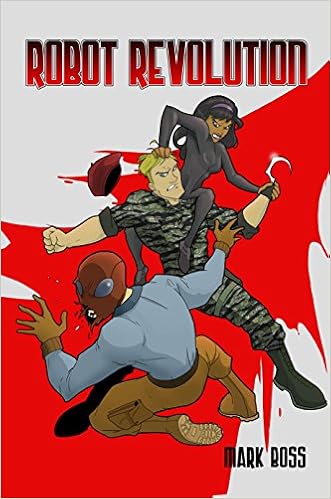
Cover by Jayson Kretzer
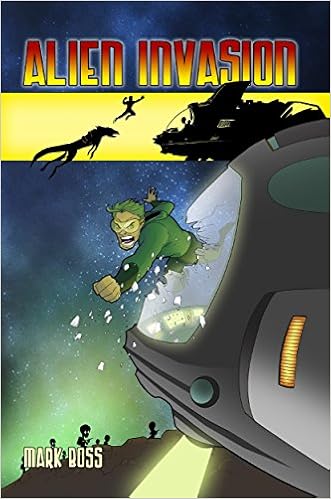
<< It continues with ROBOT REVOLUTION (which includes a short story about the character SCHROEDER), and comes to its interplanetary conclusion with ALIEN INVASION (which includes a behind-the-scenes essay about the origins of Mark's ideas, characters, and more).

Cover by Jayson Kretzer


You can find out more about Mark at these links:
>>His author website
>>His Twitter page
>>His blog site
>>His Goodreads page

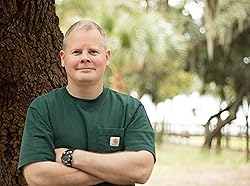
Mark Boss at CreativeCon 2K15
Mark is a fellow member of the Coffeehouse Syndicate (a group of friends that get together once a week for lunch and conversation about movies, comics, TV, creativity and how we're going to take over the world), as well as The Cheshires writing group in Panama City. We also shared a table recently at Creative Con, where we shilled each other's work. I'm telling you all this for two reasons: 1) Transparency, and 2) I know what I'm talking about. Mark puts real thought and love into his work, which is fast-moving, hard-hitting, full of surprises and big ideas, as well as the smaller moments that make the action worthwhile.

Wednesday, August 19, 2015

Coming Sept. 1: The final chapter of GIANTS IN THE EARTH!

Coming to Kindle on Sept. 1!
The third and final part of "GIANTS IN THE EARTH" will hit Amazon Kindle on Sept. 1 for only 99 cents! (The book is now available for pre-order!) For now, if you want to find the first two parts, visit my author page!

I've experimented with serializing this novel, the first book in my ongoing series, The Caliban Cycle, to see if it helps the book get traction that my previous efforts haven't enjoyed. So far, it seems like it's working — but the flipside of that is that so am I, constantly working to get the word out about this series, consistently working to ready the next installment.

The book will be released on Kindle in its entirety — with added bonus content! — on Oct. 1, and it will be published in paperback format Nov. 1. I hope to make a hardback edition available in time for Christmas, maybe on the heels of releasing a standalone story of young Arthur Magus to Kindle on Dec. 1.

The final chapters of the sequel novel, "AND THE MOON INTO BLOOD," are currently in the hands of my critique group, and I will begin the editing process on that book ASAP.

...And I can't wait to get going on my next project, a steampunk adventure unrelated to The Caliban Cycle! ...And then start work on the third Caliban novel. ...And then...

Friday, June 12, 2015

Artist's Touch: Bonnie Tate's 'Journal Portraits'

Bonnie Tate
  • ‘Journal Portraits’
  • What: Exhibit of photographs by Bonnie Tate
  • Where: Bay County Public Library, 898 W. 11th St., Panama City
  • Details: 850-522-2100 or NWRLS.com
  • About the Artist: BonnieTatePhoto.com

PANAMA CITY — A hand covered in dirt gingerly clutches a snapshot of soldiers as, caught under the edge of a canteen, a journal page below it lists “Impressions of Khe Sanh.”

With the corner of a diary showing her daily chores, a woman kneads dough on a scratched butcher block, her rings and wristwatch carefully set aside.

These and other images designed to put the viewer in the heads of strangers — seeing the world through their eyes, with tantalizing glimpses of their secret lives — make up the compelling “Journal Portraits” exhibit of work by photographer Bonnie Tate.

“I think of them as mysterious,” Bonnie said. “I’ve always enjoyed pairing photography with storytelling, and making series of connected pictures. My favorite pictures are usually of and about people, or at least have a human element.”

On display at the Bay County Public Library in Panama City through the end of June, the photos were inspired by actual entries Bonnie discovered in journals and diaries she found in thrift shops and other locations.


“Being a diary keeper myself, I am interested in how we interpret the events of our lives and string them together into narratives,” Bonnie said. “These are stories we almost always keep to ourselves. I stage each moment using a loose mix of the author’s description and my imagination.”

Including the actual diary or a page from a journal in each photo creates an interesting merging of past and present, she said, adding, “It also passes on the personal nature of reading another’s private thoughts.”

Those personal insights — the little things, the details — are a recurring theme in Bonnie’s work.

“It is the idiosyncrasies, the quirks, the hint of a story, that create the urge for a picture,” she said in an entry on her website, speaking specifically of portraiture. “Tuning in to an individual’s specifics and recording them is in some way important.”

Bonnie’s father was a journalist, who often told her “the devil is in the details.” She developed an appreciation for specifics and nuances, and this carries over to how she approaches photography. She even has a series she’s working on that shows both God and “the Devil” can be found with a macro lens setting.

“In all of my projects, I approach image-making with an eye for life’s small details,” she said. “I am shooting and organizing this series of photos by season so that when viewed as a whole, the photos will suggest the movement of time, the passing of a year observed in the smallest of moments.”

A series of moves around the country eventually brought Bonnie to Bay County, but she turned that period of transience to her advantage by finding a variety of subjects for her lens. One such move to Texas resulted in a black-and-white series she calls “American Home.”

“With the nature of our time in each place being transitory, my idea of home takes on an ephemeral quality,” she says in a posting at her website (BonnieTatePhoto.com). “Our temporary Texas home was a summer lake house fully furnished with the odds and ends and memories of another family. 

Using the artifacts and surroundings that were not mine, I hoped to create an intimate yet slightly distant sensation that matched my experience.”

Bonnie initially studied creative writing at Florida State University, then went on to receive an MFA in photography at the University of Memphis.

“I got into creative photography when I started studying art at FSU, around 1999, right before the digital wave,” she said. “I had a few great teachers who got me looking at projects by other photographers and also the history of photography, which opened up the possibilities for me.”

She currently teaches photography classes at CityArts Cooperative and Gulf Coast State College in Panama City, and is also available for private lessons. For information on these or other classes, email bonnietatephoto@gmail.com, visit BonnieTatePhoto.com or call 850-238-2077.


“By nature the camera is cold,” she said. “I think that a glimpse of someone’s home, belongings, habits, makes a portrait a bit warmer and richer. Ultimately, I hope that each portrait taps into the unique mystery of the person in it.”

Wednesday, March 25, 2015

Writing Caliban: New ideas come from creative research

(I've decided to do a regular bit here in which I'll give you a look at my writing process. We start with a chapter in the second Caliban Cycle novel, which I'm currently working on. Don't panic: You didn't miss the first Caliban Cycle novel. It hasn't been published yet.)

I had in mind a scene that would take place in a vampire bar in London, as one of my characters seeks a "ground level" informant that might have a lead for him. I thought I might call the bar The London Underground.

So before I started writing the scene, I hit up Google for some info on the actual London "Tube" system, learning about its age and some of the travails of its construction — and it struck me that it would have been almost infinitely easier in the 1860s to build an elevated railway over existing roads and between low-rise buildings than to tunnel underneath those roads and buildings. Workers had to remove tons of earth (without causing sinkholes, cave-ins and the collapse of structures above), shore up walls of clay, pump out ground water, pump in fresh air, electricity and heat, build platforms and so forth — most of which would not be necessary if building an El train.

Conclusion: Subways were invented by vampires for the express purpose of allowing them to travel anywhere in the city without exposing themselves to the sun. Who but a vampire would think underground travel is preferable to open air travel? That led me to the next idea...

If subways are actually for the benefit of vampires living in the cities, then their bars and hangouts would be accessible through these same tunnels. That meant I could place my vampire bar along the Underground route; but now I didn't want to call the bar by the same name.

Ramses 2 and Tekhit
What emblem or name would be appropriate for a vamp nightclub? I wanted to avoid ones I'd seen or heard in movies or books or comics. I didn't want something obvious or cliche. It occurred to me that beer was at least as old as one of the characters in this story — the Egyptians fed it to their slaves to keep them mollified — so I looked for a heiroglyph that represented beer or partying. I found Tekhit.

Tekhit, according to this source, is the Egyptian goddess of beer. Her name translates as both "drunkeness" and "slaughter" — and what creature would equate slaughter with drunkeness more than a blood-drinker?

So bar would be called Tekhit, and her heiroglyph would be its emblem. More so, I decided there's a Tekhit club in every major city; it's a franchise; it's the Hard Rock Cafe of vampire clubs. Thus, my characters would be meeting at Tekhit London, sampling vintage 1972 harvested from a willing donor.

Also, what good is a bar scene without a fight? They'd do that too.
...And so it goes.

Wednesday, January 07, 2015

Artist's Touch: Stress relief becomes way of life

Don Taylor and work-in-progress.
PANAMA CITY — Touring Don Taylor’s home off State 390 is a lesson in local history and art, as he and his wife, Louisa, recount the house’s former occupants and location while showing their collection of works from across the world.

Art has been in Don’s life since his childhood, growing up in St. Augustine.

“My father went to art school and did metal crafting,” Don said. “He turned down an animation job offer from Disney in 1930. He painted as a hobby and gave the paintings away to friends.”

Reaching his upstairs studio and classroom space, Don held up a work-in-progress showing three cooks busy in a kitchen. He photographed the men through a large plate glass window using a telephoto lens, then combined his favorite poses into a single composition.

“You’ll never get a photograph that’s got everything you want in the right places,” he said. “Don’t try to copy the photograph. Pick what you want out of it and recompose.”

(One of the day-classes he’s teaching at the Panama City Beach Senior Center this month covers sketching designs based on a favorite photo.)

“The thing I really enjoy, probably more than anything else,” Don said, is sketching and painting from real life. He’s filled books with sketches and watercolors of sites he’s visited in his travels, and he said every detail of that day is imprinted in his memory when he does so.

“I can take thousands of photos (on a trip) and six months later I’m hard pressed to tell your where in the world I was,” he said. “But with these (sketches) I become totally absorbed in it. I can tell you everything — where I was, what was going on around me.”

Sample from Taylor's sketchbooks.
Don had never heard of Panama City before he attended veterinarian school at Auburn University. His next-door neighbor had lived here though, and, “I came down and spent Christmas with them here, and when I finished school I moved here in 1972,” he said.

He established a veterinary practice, Gulf Coast Animal Hospital, which he sold 15 years ago to spend more time painting. Now, he only works relief days at the practice. Don is also a veteran of the Vietnam conflict, where he served in the U.S. Marine Corps.

Don started painting as a form of stress relief, and found he loved doing it.

“You forget all your problems and worries,” he said. “It’s not like work, it’s something I totally enjoy.”

Don began teaching painting “a number of years ago,” and has a waiting list for new students. He teaches in his upstairs classroom space, as well as local galleries and recreation centers, and far-flung workshops, such as one scheduled at Blue Ridge, Ga., in June.

He began entering shows almost as soon as he started painting fulltime, about 15 years ago, and has won numerous awards and recognitions across the country. Most recently, Don was recognized by the American Artists Professional League for his watercolor painting “Heaven’s Glow.”

“We are extremely proud to recognize some of America’s finest artists, and our award winners’ work epitomizes the quality of art that our organization strives to support,” said Peter Rossi, AAPL president, in remarks at the 86th annual Grand National Exhibition held in November 2014 in New York City.

Don also has served on many art association boards; he is a past president of the Southern Watercolor Society and past member of the Board of Directors at the Visual Arts Center of Northwest Florida.

“We have a wonderful local group of artists,” he said. “A lot of them have been painting 20 or 30 years, and still have a good time.”


In the artist’s statement on his website, DonTaylorArt.com, Don said he hopes his art will evoke the same feelings in the viewer that he experienced when first seeing the subject — “the sense that there is more to the subject than mere rendering. ... I attempt to apply the illusion of detail in many works so that viewers can use their imagination to complete the image. Sometimes less is more.”

Tuesday, November 25, 2014

Artist's Touch: Art in the Family

Sarah, Theresa, Taylor and Craig Bush at Floriopolis
PANAMA CITY — Craig Bush described his family as “unconventional” during a recent conversation at Floriopolis gallery.

“We all tend to be nonconformist,” he said. “We don’t listen very well.”

What they do well is pursue their muses. Craig, 64, is a retired educator, novelist and painter. His wife, Theresa, 62, is a retired paralegal, jeweler and crafter. Their daughters — Sarah, 36, and Taylor, 29 — are artists working in acrylics, ink and other mediums.

All four gathered on the couch and chairs at Floriopolis to talk about the way art is part of their lives, both as a family and as individuals.

“I was poor growing up, so there wasn’t a whole lot I couldn’t do,” Theresa said. “I still feel that way. I was taught if you want it, then you do it. You make it. I made things because I needed to have them.”

Theresa in her workshop.
Theresa has sewed and made crafts all her life, but retirement gave her time to focus on creative pursuits. After taking an Education Encore class on jewelry design at Gulf Coast State College, she discovered a love of jewelry making — though she wears almost none herself. She also does stained glass art, baskets, felt figures and more.

Her work is for sale at Floriopolis, RTA Designs, and Shipwreck Ltd., but she hopes to do more online sales in the new year. Her Etsy.com store is Four Free Spirits.
“I don’t want to make a lot of money, I  just want to make stuff and get rid of it so I can make more stuff,” Theresa said. Sarah responded, “I want to make enough (money) to replace my low-level job.”

Art by Sarah Bush
Craig said Sarah was in middle school when they all recognized her artistic bent. Her successes encouraged the rest of the family to “kind of dabble” in art more. But Sarah recalls always having art in their home.

“That’s what you do in life. You make stuff,” Sarah said. “When I was little, Pop would write messages in symbols and have me decode it, and that’s a lot of what I do now with iconography, symbology and archetypes. ... My parents have always been creative, as long as I can remember. Even my grandmother was always making a quilt or sewing something.”

When Sarah was in daycare, Craig would walk her home in the afternoons. They collected pieces of colored glass on the roadside each day and glued them to a length of driftwood.

“It’s still hanging on our wall today,” he said. “It’s a little bit bizarre.”

Sarah received an art scholarship to Gulf Coast State College, but kept taking art labs instead of other core courses. After some time focusing on drawing and “building sturdy things,” Sarah said she’s trying to go back to “actually painting.” Her work is online at SarahBushArt.com

Art by Taylor Bush
Taylor said Sarah was her early inspiration, and she took the same classes with the same teachers Sarah had. Taylor creates black-and-white designs and is looking into making prints, fabric designs and possibly T-shirt images, mass producing some of her drawings.
Craig’s debut novel, “Hometown,” was released this autumn, and he’s just completed the first draft of his next novel, “The Ninth Rainbow,” which he hopes to publish in early 2015. “It’s somewhat apocalyptic, but it ends up with a lot of hope,” he said.

Of the creative process, Craig said he follows where the characters lead him: “I often don’t have a clue what they’re doing. When it’s best for me, I can’t type fast enough to keep up with it.”

Craig also paints impressionistic landscapes that he describes as “a little bit Van Gogh-ish.” He has never tried selling any of his paintings, adding that “none of us is great at marketing ourselves.”

As a child, Craig’s imagination was encouraged by a teacher who gave him a copy of “Stranger in a Strange Land” by Robert Heinlein. But reading Herman Hesse in the 1960s made him want to be a writer. He studied journalism in college before shifting to education.

Craig at his writing desk.
“With the novel release, I think I had the right expectation, which was no expectations,” Craig said. “It’s shown me the importance of people in the arts being willing to help one another. It’s not a competition.”

The children have their own places now, but Theresa still had some trepidation about how Craig’s retirement could cut into her creative time. Over the years, each of them has learned to value a level of solitude, but she said it took “some adjustment” when he began staying home all day.

“I think we all appreciate our alone time a lot,” Taylor said, adding that the creative process requires solitude as well as preparation and openness. “Sometimes it’s sort of like a transmission from the universe, and you’re there to catch that. I think that’s the point of the whole thing. It’s super magical.”

Thursday, August 07, 2014

GCSC summer program reworks ‘Miracle’


Cover Artwork
PANAMA CITY — Summer has found Gulf Coast State College students molding something new out of a “miracle” story.

The GCSC 2014 Summer Theatre Project, taught by Associate Professor of Music Scott Kirkman and Associate Professor of Theatre Jason Hedden, is called “From Page to Stage, the Making of a Musical.”

In the six-week course, students formed an artistic team to adapt the novel, “Miracle of the White Leaves,” by Dr. Stephen Dunnivant, dean of GCSC’s Advanced Technology Center, and his daughter, Gina Dunnivant, with art by Gina Ricci. Students were tasked to produce a play script, create original music and design concepts for costumes, sets and props with a goal of preparing a workshop production at GCSC in the autumn semester, as well as a “world premiere” in 2015 at the Marina Civic Center.

“We've been trying for years to have them perform a free show for our elementary grades at the Marina Civic Center,” said Jennifer Jones of Bay Arts Alliance, who has been sitting in on workshop presentations this summer. “I’m a big advocate for adding the ‘A’ for ‘Arts’ into the STEM curriculum.”

“Miracle of the White Leaves” is the tale of a monk, two children, and the youngest daughter of Europe’s greatest king, destined to bond with unexpected allies no larger than your finger. Together, these unlikely heroes plant the seeds to unite a continent and save civilization in its darkest hour. Originally a screenplay, the elder Dunnivant refashioned the tale into a novel.

“It’s really fantasy-oriented, set in the time of King Charlemagne, so it also has the historical element,” Jones said of the work.


The summer program was open to GCSC students and community members with interest and skills in writing, storytelling, singing, songwriting, instrumental music, acting, dance, choreography, design, photography, costuming, videography, sound recording and visual art. The entire process was documented on video.


“We had 18 students registered in the class and two community collaborators,” Hedden said. “We will do a workshop production for fourth- and fifth-grade ESE students from Bay District Schools, and then the world premiere for 2,000 third-graders in April 2015.”

The show at the Civic Center will be part of the Very Special Arts Festival, an annual enrichment activity for students with learning challenges, Jones said. The Civic Center will also host a finished, full-scale musical production for the general public.

“The 2014 Summer Theatre Project has been, by far, the most fascinating, exciting, memorable college experience I’ve ever had,” said participant Jenny Hammond, who received her associate of arts degree in Liberal Arts at GCSC this year, graduating Magna Cum Laude. “I am so happy to be a part of something that will touch so many others if only for 50 minutes of their lifetime. It will be something that stays with me for years to come.”

Jacob Walsingham, a Mosley High School student dual-enrolled at GCSC this summer, said the class taught him that it can take “a lot of trial and error to make your ideas come to life.”

The Dunnivant family lives in Panama City Beach. Before joining GCSC, Stephen Dunnivant taught middle school grades in Bay County, where he has lived for more than 35 years. He has worked at Gulf Coast for more than 17 years.

The son of a musician, his early years were spent traveling from the mountains of upstate New York to the cotton fields of Arkansas. He credits his mother, Evelyn Audrey Beardsley, with instilling in him the joy of reading.

“Like so many sons, he grew up listening to stories from his mother,” Stephen Dunnivant’s Amazon biography states. “One day, an uncle in Arkansas sat in awe watching Audrey read to her children. He told her later that he had never seen anyone do that before. While this was the 1960s, sadly, many parents still do not read to their kids.

“As it was in the 8th and 9th century so long ago, education is the only enduring escape from poverty and ignorance.”


Peace

---

Tuesday, June 17, 2014

Blog Hop!

My friend Windy of the HouseBlend blog tagged me to play along in a "blog hop" Q&A. The Rules: Answer the following questions, then tag someone else (or someones elses; up to 5). I shall endeavor to play by the rules.

What am I currently working on?

Besides my day job, and the house that needs painting (etc.), I'm working on a novel about a sentient zombie. I have two notebooks full of notes, scenes, character sketches for a steampunk novel set in an alternate post-Civil War America, and another novel that is a sequel to my most recent manuscript (Caliban: Giants in the Earth, which made the quarter-finals of this year's Amazon Breakthrough Novel contest, but did not make the semi-finals, alas). My answers below will relate to my fiction writing, not my reporting or columns.

How do I write?

After years of working just in the digital realm, I have returned to writing longhand in unlined journals with a pen for my first draft. Then putting it all together and editing as I go with a keyboard. I tend to write with the keyboard late at night; I make notes, sketch scenes, etc., whenever the idea hits me throughout the day. (I try to keep my notebook handy.)

How does my work differ from others of its genre?

OOof. That's the most difficult question on this list. I like to think my stories have unique approaches stylistically as well as a willingness to be unblinkingly honest about everything, from a character's spirituality to a description of a violent act. Caliban, for instance, is a multi-generational Southern Gothic/Lovecraftian horror/fantasy. My steampunk novel will explore a Native American response to Euro-American expansionism, among other topics.

Why do I write what I write?

Because I can't stop it. I can't take a weekend trip with my wife without coming up with crazy story ideas. I hear a song and stories form in my head. I  see a movie and think how I would have done the story instead. I overhear a conversation at a coffee shop, and imagine the backstory. These things go into text so I can see what I'm thinking, and so I can revise and clarify them, and maybe make somebody feel something real. So few people ever read what I write, that I don't write for them at all.

How does my writing process work?

Like I said, I write down ideas, characters, scenes, questions, notes all the time. I will sometimes write a brief outline to help me recall my thoughts later, but when I sit down to the actual work, those outlines mean nothing. I color outside the lines until I find my way through. I try not to revise as I go, but keep moving forward to the end. I take chapters to my writers' group to get their edits and suggestions, then dive in to revise.

Who wants to play along?

Let me tag Mark Boss, author of One Bullet, and Milinda Jay, author of Her Roman Protector.