Friday, June 14, 2013

Flashback Friday: An early review of 'Starman' comic

(On May 21, 1996, the News Herald printed the following review of James Robinson's revival of the Starman character at DC Comics. It was as much a love letter to that series as a statement in reaction to what comics had become in the 1990s. I remain a fan. (Please ignore the use of the 'x' in 'comix,' which was how we spelled things in the 'Generation NeXt' section back then.))

Jack Knight, From Wikipedia
The heroes of old are, with a few notable exceptions, gone from the pages of four-color comix. That bright world has lost its innocence — and much of its creative energy — to teams of muscle-bound vigilantes toting semi-automatic plasma bazookas, and to impossibly endowed females flirting with loss of circulation if their rubber corsets were any tighter.

 Then came Starman.

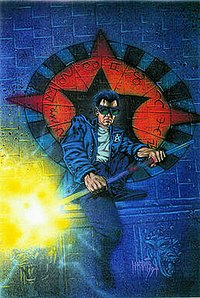
As created by writer James Robinson and artist Tony Harris, Starman is Jack Knight — a small figure of a man, a tattooed late-20-something, obsessed with all things rare and antique. He'd rather scour rural flea markets for View Master reels and Depression glass than dress in Spandex and duke it out with the villains.

His idea of a costume is night-vision goggles and a leather jacket.

But as the younger son of a 1940s superhero, Jack has become the epitome of the chicken-or-egg question that haunts history: Do great events conspire to create heroes, or do great men and women arise to make history?

In Jack's case, events sought him out and he rose to the challenge. His big brother, David, was first to don Dad's mantle, only to be killed by a sniper's bullet in the first pages of the first issue.

(Jack has since had two surreal visits with his deceased brother — the first as they fought in a grave yard over the right to the Starman name, and the second as David sought to warn Jack of future events.)

With his father injured, his brother dead and his own antique shop razed by the children of an old foe, Jack uses his dad's "star rod" to rout the bad guys and restore order to Opal City.

Through Jack and his supporting cast, Robinson has crafted a book with the multiple layers of history, personality, foreshadowing and drama usually found only in works print-only fiction. His characters are distinct and react with realism — as seen in the frustration and distance between father and son that slowly dissolves into a growing respect and admiration for their individual strengths.

The periodic "Times Past" stories allow guest artists to explore events in the history of Opal and its citizens, giving us a glimpse of the Golden Age of heroes; or a tale of the nigh-immortal. sometimes-villainous Shade and his friendship with Oscar Wilde.

Meanwhile, artist Harris has crafted a vision of retro-deco cities, of characters delineated by quirky swirls and outlines, of shadows and black bordered pages.  No larger-than-life people dominate his panels — save for the lumbering Solomon Grundy. Though stylistically rendered, these are anatomically realistic human beings with an expressive range far removed from the grimacing brain-bashers in other comix.

Like our own shared version of reality, this can be a dark world. People die. Bad guys revel in the pain of others. Some cops are less-than-true to their code. Evil is powerful.

But now there's a beacon in the night.

"Starman has always been around," Robinson said in his introduction to the series, "a light in the darkness, in his own little corner of the DC universe."

Thursday, June 13, 2013

Things My Kids Have Taught Me

On Father's Day, Sunday, June 20, 2004, my weekly "Undercurrents" column on the Lifestyle page was the following:

Things my kids have taught me

Jessi and Nate 2006
Educators and child development experts are fond of pointing out that the greatest influences on a child are his or her parents.

I’d go as far as saying that this rule holds true no matter the person who raises a child or what sort of traditional or nontraditional family that child has. The greatest influences are the mother and father — their presence, their absence, their attention or neglect — whether or not the child ever knew them.

A grandmother raising a grandchild as her own may do a wonderful job, but the absence of a mother/father duo will affect that child for the rest of his or her life.

That’s a long introduction to the idea that, as quantum theory suggests, the reverse is also true — the absence or presence of children makes a huge difference in an adult’s life. The child really is father to the man.

Or, in bumper sticker terms: Insanity is genetic — You get it from your kids.

Apropos of the day, listed hereafter are some of the things my children have taught me. Put simply, they made me the man I am today.


  • A quiet house means someone is up to no good.
  • I’m luckier to have the two of them than they are to have me. At least twice as lucky.
  • Child-proofing a house only succeeds in frustrating adults.
  • Somebody else started it. It’s my job to finish it.
  • I’m sure there are more painful things than a child’s tears. I just can’t think of one.
  • Respect has to work both ways or it won’t work at all.
  • Cleaning up is not nearly as much fun as making a mess, and takes much longer.
  • The hardest thing to explain is "why."
  • Being a kid is tougher than you recall.
  • If the rest of their generation is anything like them, then the future will be more complex, irritating, exhilarating and imaginative than you expect.
  • Noisy bodily functions are funny. Are too. Are too.
  • I am not my father, though I sometimes sound like him — and they are not me, though I often see myself in them.
  • That doesn’t mean I’m letting them get away with anything, though.
  • Kisses really do make booboos better.
  • Hard work never hurt anybody. Neither did an afternoon of cartoons and popcorn.
  • My folks were wrong when they said, "You’ll understand when you get to be my age."
  • There are more questions than there are answers.
  • Sometimes the best answer is still, "Because I said so."

Peace.

(And happy Father’s Day.)

-----

My Undercurrents column for Friday, June 14, is as follows:

Things my kids have taught me

Jessi and Nate 2013
PANAMA CITY BEACH — Several years ago, I made a mix CD that I titled, “Songs My Kids Taught Me.” It had tracks by Iron & Wine, the Killers, Postal Service and many others who were, at the time, fresh on the scene.

I always have prided myself on keeping up with new music — though not the plastic, manufactured pop dreck. I try to introduce my kids to new music (such as OK GO, Anna Ternheim and Airborne Toxic Event when they first broke out) thanks to sources like NPR and Paste magazine.

So, looking back, it was a big step to admit they were teaching me. I still enjoy answering them with “Yes I have,” when they ask if I’ve seen a certain new video or heard a certain new song — but it doesn’t happen as often these days.

With Father’s Day approaching, and these thoughts on my mind, I started wondering what else I used to teach them that they now teach me. The fact is, I can’t really say that I’ve taught them anything — though I’d like to take some credit for them being intelligent, curious, creative and compassionate souls.

But they have pretty clearly taught me a thing or two over the years. I even wrote a column based on that idea about a decade ago, featuring nuggets like: A quiet house means someone is up to no good; respect has to work both ways or it won’t work at all; and the hardest thing to explain is “why.”

There are many things they have tried to teach me, but that I refuse to learn. I still won’t eat sushi, for instance, no matter how they flavor it, and I still don’t ride amusement park rides.

But a couple of other items have become clear in recent years. They certainly have taught me:


  • Patience. I was impatient as a young man, easily frustrated, often angry. Now I’m patient almost to the point of oblivion. So patient, I make others impatient with me.
  • Never say “never again.” I mean it at the time, but when a similar challenge presents itself again, I’ll probably cave. It’s one thing to draw a hard line and another thing entirely to watch a child struggle when you can help.
  • Loosen up. I know it may seem unlikely, but I can be uptight when it comes to being “proper” in public. They’ve taught me it can be okay to laugh inappropriately, among other things.
  • Sometimes, peace is more important than justice. Sometimes, getting a job completed is more important than an even distribution of labor. And sometimes, if you wait long enough, even a patient Dad will get tired of asking.

But I maintain, as I wrote before, that I’m luckier to have the two of them than they are to have me. At least twice as lucky, though it’s more likely that I’m lucky-squared.

Peace.

Friday, June 07, 2013

Flashback Friday: 'Hitchhiker' journeys to syndication

From Wikipedia
(Once upon a time, I did a telephone interview with Lewis Chesler, creator of "The Hitchhiker," as the show moved from HBO to syndication (and got edited to a PG version in the process). This story was published in The News Herald on Dec. 6, 1995.)

The darkness is within us all, waiting for the right temptation — the particular provocation — that will allow us to damn ourselves.

The idea that evil is internal — not an external force — is the driving concept behind The Hitchhiker, a cable anthology series that is now available to local channels through the magic of syndication.

According to series creator/executive producer Lewis Chesler, the true nature of evil is best revealed through "conflicts within ourselves."

"With The Hitchhiker, we wanted to bring a level of psychological suspense that had not been present in mainstream television to that point," Chesler said. "The projection of that anxiety, psycho-erotic in a way, made for real engaging stories."

A dramatic, half-hour suspense series reminiscent of Rod Serling's The Twilight Zone, The Hitchhiker thumbed his way to 85 episodes, becoming the longest-running original dramatic series in cable TV history.

Hitchhiker first debuted in 1984 as Home Box Office's first dramatic series. Since then, it has won eight ACE Awards, delivered record-setting ratings for a cable series and paved the way for numerous imitators.

"In the '50s, science fiction was very popular, and people used it as an allegory of fears about communism and so on, manifesting `The Other' as people from outer space," Chesler said.

"I think today we also have anxieties and fears about what is within us, that subverts us," he said. "And as we approach the millennium, more people are realizing that we are more complex than we knew — that life is more ambiguous and paradoxical than we knew."

Using an anthology format to present "morality plays," each episode is introduced by the enigmatic Hitchhiker, played by Page Fletcher. When he appears, strange things follow: tales of greed, jealousy and the supernatural, that end in ironic twists of fate.

"He's a witness, not an avenging angel. He never interacts and he has an omniscience," Chesler said. "We chose the figure of a hitchhiker for two reasons: He represents the allure of freedom, the ability to transgress and break the boundaries, but he also represents danger and the unknown. He has that duality within him in that his behavior is not clear-cut — it's elusive."

The use of top movie and television talents is one of the reasons Hitchhiker has endured while hundreds of other cable-made series have faded to black. A number of major film directors, actors and writers were involved in the series.

Chesler is now working on Strangers, an HBO series he calls "the sequel" to The Hitchhiker. The pilot, shot two years ago in Paris, was directed by Wayne Wang (The Joy Luck Club), and features Linda Fiorentino, Tim Hutton and Joan Chen. The series will debut in January of 1996.

"The stories are about the American encounter with the mysterious `other.' They're like half-hour Last Tangoes in Paris, about Americans who go abroad and are on uncertain ground," Chesler said. "They're kind of dark, erotic, psychologically dense, very European."

Wednesday, June 05, 2013

Artists monkeying around downtown

PANAMA CITY — More than 200 handcut and handpainted apes will dangle from trees, poles, awnings — and anywhere else they can find to hang from — Saturday in downtown Panama City.

It’s a “public art” project spearheaded by Heather Parker from CityArts Cooperative. Like their tiny toy counterparts, the foam apes are shaped with hooked arms and tails.

“We chose this shape, from Hasbro’s ‘Barrel of Monkeys’ for several reasons,” Heather said. “A childhood connection (many adults had them or saw them as a child), their arms link together to form a chain (great alone as one monkey, but can connect with each other and have a big impact, kind’a like people, huh?), and well, they’re monkeys!”

Heather was joined by many people intrigued or amused by the project. Adults, children, school groups, professional artists, Friday Fest visitors, business owners and bunches of “regular people” helped make monkeys, she said.

“We’ve had at least 100 hands in the barrel helping to make this happen, from purchasing foam, donating paints, meticulously hand-cutting monkeys, or just dropping by to quickly add a splash of paint,” she said. 
“Some of the monkeys are impressive one-of-a-kind works of art.”

Heather pointed out that Wikipedia defines “public art” as works of art in any media that have been planned and executed with the specific intention of being sited or staged in the physical public domain, usually outside and accessible to all. Such cultural interventions have often been realized in response to creatively engaging a community’s sense of “place” or “well-being” in society.

“Imagine a downtown that is a place you want to be,” she said. “Would it be lively, colorful, lighthearted, joyful, playful, entertaining, filled with talent, self-expression and creativity? Mine would. So for one day, I’m filling it with colorful monkeys.”

Heather hopes this and other public art events will bring more people downtown and expose them to the possibilities of art. She would like downtown Panama City (along with St. Andrews) to become a regional art hub, and to make art a “living, breathing way of life” for everyone.

The day promises to be a full one in the downtown district, with Vintage Market 7:30 a.m. to 1:30 p.m., an artist meet-and-greet at Main Street Gallery 10 a.m. to 4 p.m., a paper-cutting workshop at CityArts 10 a.m. to 4 p.m., and the Art-Tique “tour” 10 a.m. to 3 p.m.

Monkey installation is from 6 to 9 a.m., if anyone wants to help Heather hang the monkeys. Display will be 10 a.m. to 3 p.m., after which the monkeys will be removed.

“We expect some to fall throughout the day, which is why they are all handcut from lightweight Styrofoam,” she said. “If a monkey falls on your head, you’ve got a great story, but no injury: ‘One time, I was downtown, you’ll never believe this, but a ...’ ”

Art is about more than murals and painting, Heather told me once. It’s about exploring, laughter and joy.


Peace.

Friday, May 31, 2013

Flashback Friday: Logging on to 'Internet'

(In 1994, I blew readers' minds with the idea of easy access to a global information filing system by which anyone at a community college might be able to access info all over the planet in only a few minutes. I know, it's difficult to believe now, but about 20 years ago this whole "Internet" thing sounded like sci-fi. Here's the story from The News Herald's Dec. 14, 1994 edition.)


GCCC will offer students access to the information superhighway


From July 25, 1994
Gulf Coast Community College is not just "surfing the Internet," it's ready to hang-ten, according to one of the school's on-line professors.

For years, computers on campus have been integrated into a closed network. But recently they have joined the Florida Information Resource Network, creating a gateway onto the international Internet.

During a recent meeting of the District Board of Trustees, Professor Joe Howell described the highlights of the system and the advantages Internet access will give to faculty and students in the future. Howell demonstrated how easy it is for someone sitting at a terminal in Bay County to access information sources around the world.

 In less than a minute, he had at his fingertips computer files in Iowa, Sweden and Asia — including professional journals, research information, job listings, electronic mailboxes and computer bulletin boards.

There was even a file on "UFO and Alien Information" — although he quickly skipped past it.

Howell accessed the U.S. Department of Education database and found an excerpt from his own doctoral dissertation on file. He looked at job listings in the Chronicle of Higher Education by reading the expensive journal on-line.

"In the not-too-distant future, we want Gulf Coast Community College to be a server site on the Internet," Howell said. "If someone wants an academic calendar, a catalog, they can get it through the computer system."

The cost would be very small with the appropriate software in place, he said.

Now, 30 terminals on campus have access to the Internet. In the future, open terminals may be installed in public areas such as the college library, so students could use the available wealth of information throughout the world.

"The challenges are doing it faster and better and using it in the instructional process," Howell said.

Meteorology students, for instance, could reach into public-access NASA files for satellite photographs less than four minutes old. They could gather information on a city's weather patterns and create forecasts in class.

"We can do that today," Howell said. "This is not science fiction."

Another challenge may be blocking student access to objective or offensive materials that can be found through the Internet. But Howell said no matter what safeguards are put in place, "some enterprising young person" will no doubt find ways to bypass them.

The ramifications of having so much electronic information at one's fingertips could make facilities like libraries — which are expensive to build, equip and staff — anachronisms, college President Bob McSpadden said.

"What role will a facility with 80,000 hardback books play in the future? A museum?" he said.

The project was made possible by a $12,000 grant from the George G. Tapper Foundation.

Howell said he had always wondered just what was meant by the term "information superhighway." The Internet, he said, puts anyone in the information fast-lane.

McSpadden said he thought trustees "would be astounded by the information" now available to the college. He was right.

"It has created a world of excitement," McSpadden said. "And its capabilities will carry us well into the future."

Friday, May 24, 2013

Flashback Friday: Melissa Etheridge

(Once upon a time I did a telephone interview with Melissa Etheridge in advance of her Pensacola concert, which was opening for Sting in Feb. 1994. This is dated Feb. 19, 1994, though I believe it ran earlier than that.)
Melissa Etheridge affirms: `Yes I Am'
MelissaEtheridge.com
Melissa Etheridge is at it again, so smile when you read the title of her latest album release, Yes I Am.

Is she becoming more politically active while disclaiming any agenda? Is she echoing her own ``coming out'' statement regarding her sexual orientation? Is she still writing gender-neutral lyrics to raw rock'n'roll music?

Ask her and she would have to say, Yes I Am.

Etheridge, 32, earned a Grammy for Best Female Rock Performance in 1993 for the single Ain't It Heavy from her 1992 album, Never Enough. Her throaty delivery, backed by deep emotion and searing guitar, would make tracks from Yes I Am Grammy contenders as well, if they were being awarded to female rockers this year.

 ``Needless to say, it's frustrating. I feel there's a real movement of female rock music, and (the lack of nominations in the category) is an oversight,'' Etheridge said. ``It points out to me a lack of rock radio play, which these nominations are based on.''

Etheridge points to the rise of the punk rock ``riot grrls'' as one of female rock's new movements. She said she ``likes the extremes'' represented by the militant feminism and blatant anti-male stance taken by the groups, which often hold no-men-allowed concerts and as a rule exclude men from front row seating.

``When the extremes move, they push the middle and I don't look like such a `bad feminist' anymore,'' she said.

Etheridge's current gig is opening for Sting on the Southeastern leg of his 1994 American tour. They will perform at the Pensacola Civic Center on Feb. 19. On the day before rehearsals began on the West Coast, she spoke via telephone about music, religion, and sexual expression.

So much has been written recently regarding Etheridge's sexual preference and her friendship with country singer k.d. lang, that one might expect the songs on her latest release to reflect her newfound openness. Not necessarily so.

Her new disc opens with the driving guitars of I'm the Only One, a song that could be interpreted for either straight or lesbian singers: she is losing her lover to another woman — is the lover male or female? In Etheridge's case, the answer would be the latter, but the song could be just as meaningful coming from the throat of straight female performers.

Wikipedia.org
``I made a decision a while ago that I would write the songs truthfully but still try not to exclude anyone. The passions and desires and feelings cross all boundaries. That is the same for everyone,'' she said. ``A man can listen to my songs and say `I know that feeling.' A straight woman can listen and say `I have felt that way.' I don't want to limit myself or that experience,'' she said.

Etheridge — who once said she was the product of a stale, white-bread midwestern environment — shares a home in Hollywood with a passle of pets and her companion, filmmaker Julie Cypher, who shot Etheridge's earliest music video. Although Etheridge said her music was open to personal interpretations, ``self-examination'' is her catch phrase. Any political, social or sexual message comes out of ``peeling back the layers,'' opening her feelings and thoughts for ``total revelation'' to the audience.

``I believe there is a way to create from and write from a totally honest part of yourself and speak directly from that,'' Etheridge said. ``But sort of like eye witnesses to a crime, everyone will see something different in it.''

Etheridge had a religious upbringing and performed both in Catholic and Protestant churches during her youth. She said she's ``not a religious person per se,'' but the influence of those years appears in her music, particularly in the new song, Talking to my Angel.

``On each of my albums there is at least one song that refers to angels,'' she said. ``I grew up in many different churches, and was struck by their icons and symbols and religious knowledge, and realized the power they have in our society. So the terms `angels,' `devils,' `God,' are incorporated into much of my writing. I'm talking about spiritual forces, a muse, inspiration, the spirit and memory of loved ones I've lost. They take on a new form that I call `angels.' ''

There is also a hint of darkness in Etheridge's songs, the plaintive voice of the outcast seeking approval and love, yet reveling in her differences. Having been embraced both by straight and homosexual audiences, and having gained public recognition through her award, she can afford to do both.

``In my personal exploration, I've found that there really is a `dark side' to all of us. You find it in our religions, books, even movies. People try to exorcise it, but there comes a point when you can't get rid of it,'' she said. ``So much fear and intolerance comes from that darkness. We're afraid of so much that we don't understand.

``I try to overcome my past inheritance of ignoring that side of me, so I draw it out, write about it, talk about it — shed come light on it. That's my philosophy, how to find some inner peace.''

(The rest of the story: I drove with my wife to Pensacola to see the concert; Etheridge's manager said I would have two tickets waiting at will-call. Instead, there was a pass to photograph the first two songs of Sting's performance, but no tickets. The show was sold out. We turned and walked away. Monday, the manager called to thank me for the article, and was apologetic when I told her about the ticket problem.)
Thursday, May 23, 2013

Undercurrents: Getting there one word at a time

Kayla and Nick at Writers Gallery
PANAMA CITY — One word at a time.

That seemed to be the lesson at Tuesday night’s gathering of the Writers Gallery.

On the third Tuesday of each month, local writers meet at Chez Amavida in the historic St. Andrews neighborhood to read something they’ve been working on, or to share a passage from their published work. The readings range from poetry to prose, and within those areas are encompassed true stories, dark fictions, regional farce, religious testimonials and philosophies. You might not like all of it, but chances are you’ll love some of it.

It can be a boisterous crowd, as some others in the coffee shop discovered Tuesday. We applaud each reader when they finish, and when those applause coincide with someone entering the shop, they can be taken aback.

Of course, a few of the regulars are lurkers. That is, they listen, they watch, they applaud when appropriate, but they don’t enter the spotlight to expose themselves (metaphorically).

One word at a time was how one of the readers progressed through his effort. Upon making acquaintance with the microphone after several invitations from our emcee, Kayla May, the man explained how he drew letters on a page until they made words, then grouped words on the page until they made sentences. However, he wasn’t sure if the sentences made sense, even as he began to read them.

I can relate. I suppose you, dear readers, can too.

(I flashed back a couple of days, to a morning when I stopped alongside Delwood Road to remove a small turtle from the street. I watched it plod, one step at a time toward the trees, and wondered how long it would take for it to reach its destination. I was reminded that life’s about the journey, the steps, rather than the goal, which is ever changing.)

One word at a time also was how Kayla bravely made her way through reading the story of a Gallery regular who prefers not to read his own work aloud. Her willingness to proceed through the pronunciation of unfamiliar words lent a new level of enjoyment to the experience.

The monthly event, beginning its third year, was organized by Nick May, Kayla’s husband, the author of “Megabelt” and “MinuteMen,” and a worship arts leader at Northstar Church in Panama City. On Tuesday, he read from a blog about his creative process and the importance of prayer. (You can see the whole thing at his site, HeyNickMay.com.)

Like most writers of any discernment, Nick gives himself a hard time. It’s no easy thing to find a balance between real-world obligation and the desire for creative expression, between family and fiction, between words and the Word.

His blog ends with a self-admonition we could all embrace: “So here goes … one word at a time.”

Peace.

(This is my Undercurrents column for PanamaCity.com and The News Herald this week.)