Saturday, April 30, 2016

Books Alive 2016 Photo Blog

Books Alive returned last weekend, expanded to three days and moved to venues in downtown Panama City. Here are some of the moments I managed to record:
Ginger Littleton, me, and Cheri Leistner (Books Alive committee members)

Local authors area at the Civic Center

Cool projections by Public Eye featured the local authors' work

David Angier, me


Me with Mary McDonough (Erin Walton)


JD from Public Eye and author Milinda Stephenson


Rick Bragg with a Destin book club


Connie Gittard introduces Ellen Urbani, Annie Quinn & Mary McDonough


Kwame Alexander, Kathie Bennett, and Mr. & Mrs. Middlemas


Kwame Alexander meets a young future reader.


Librarian Sandra Pierce and author Olivia Cooley


Refreshments at the library


Margaret Webster of Public Eye & Jennifer Jones of Bay Arts Alliance

Friday, April 29, 2016

Flashback Friday: Doc Savage and 'The River Extraction'

(Originally published Sunday, May 6, 2001, in The News Herald)

Cover Art by James Bama
As a youngster, one of my greatest literary heroes was Clark Savage Jr., better known as "Doc Savage: The Man of Bronze." A millionaire, surgeon and inventor, Doc traveled the planet righting wrongs with the aid of his World War I buddies, Monk, Ham, Johnnie, Renny and Long Tom (and sometimes his cousin Patricia Savage).

Written by Lester Dent under the pen name "Kenneth Robeson," Doc's adventures were set in the 1930s and featured in pulp magazines of the day. I became familiar with him in the 1970s when Bantam reprinted the serialized stories in the form of paperback novels, Marvel Comics published illustrated tales and Warner Bros. produced a campy movie starring Ron Ely.

Without doubt, Doc was the template on which other superheroes and adventurers were built. Clark Kent owes more to Clark Savage than a first name. (A "biography" of Doc released in the 1980s linked him by blood with the English nobleman called Tarzan, Sherlock Holmes and Lamont Cranston - "The Shadow.")

Ron Ely as "Doc"
Doc's base was on the 86th floor of the Empire State Building, but he also had a secret "Fortress of Solitude" in the Arctic where he exercised his mind and body to the pinnacle of human perfection. Invariably Doc's physical exertions and hand-to-hand battles resulted in his safari clothing being reduced to tatters. (The number of shirts he went through was used to comic effect in the film.)

That image came to mind this week when I heard the tale of Ebro dentist John Savage ripping off his clothing as he dived into the Choctawhatchee River to pull a patient out of a sinking car. (Call it an emergency dental extraction.)

"It was strictly an immediate reaction," Savage said later. "They asked me if the water was cold and I had to say I never even knew if it was cold or not. There was just too much tension and too much tragedy about to happen.

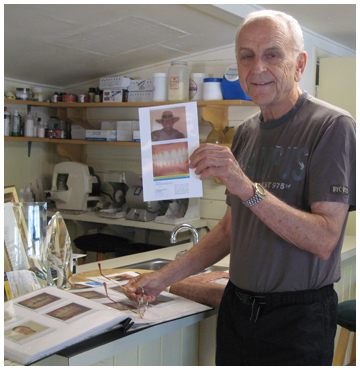
John Savage, DDS
"I tried to get my socks off, but there wasn't time to get them off."

The car had raced out of control and bounded between trees and over a sand bank where Savage's riverside office (and Fortress of Solitude) sits; the driver initially had trouble getting out of the car and then struggled to swim while wearing steel-toe work boots.

"I'd try to help anybody in that condition," Savage said. "I didn't have time to think about it."

Once again, "Doc Savage" was the hero of the moment. Now he's back at his day job - fighting for tooth, justice and the American way.

Peace.

Friday, April 22, 2016

Flashback Friday: Digressions in infinite complications

(The following was first published in The News Herald on Sunday, April 29, 2001.)

She needed a spoon for her cereal, but none were clean, so she washed all of the dishes, wiped down the counter tops, swept the floor, mopped, noticed dirt on the baseboards and instead of washing them pulled them off the wall and sanded the paint off of them, refinished them, reattached them to the wall, which she suddenly realized needed a new coat of paint in a different color so she went to Wal-Mart, where she bought paint and brushes, and came back home to paint the dining room (and living room and bathroom) walls — never having paused for breakfast.

Did anybody see where that rabbit ran off to?

She wanted to re-seed bare spots in the lawn, so she bought seed, bags of top soil and cow compost, flowering bedding plants, decorative trimming bricks, and went to find a hoe in the shed, but the shed was in disarray so she pulled everything out of it and stacked boxes and junk for a trip to the dump, and stacked other items for Goodwill, then organized the shed and realized that the hoe was not in the shed at all but rather on the side of the house where our spring garden is usually planted but where pine straw was still heavy on the ground, needing to be raked, so she raked the straw into trashcans that also would be carried to the dump — never having got around to seeding the lawn.

Could someone help us catch these wild geese?

She wanted to relax before bedtime with the latest Left Behind book, but the dog had gotten hair on the bed, so she stripped the comforter and sheets and started a load of wash and folded clothes that were in the drier and went to put them away, but the drawers were full of winter clothes so she sorted the winter clothes — setting many aside for donation — and put the remainder in a tote that wouldn't fit into the closet until the closet was sorted — setting several items aside, again, for donation — and by this time the comforter and sheets had been washed and dried so she made the bed and went to sleep — never having cracked open the book.

But I digress.

Getting to the point (if there is one): The walls would not be repainted now if I had run the dishwasher the night before, as I had promised; the shed would not be cleaned if I had put away the hoe; the winter clothes and closets might not be sorted yet, if I had not played with the dog on the bed.

What would she do without me?

Wednesday, March 16, 2016

‘Be Ye Also Perfect’

'Be Ye Also Perfect' by Robert O. Hodgell
(From the painting by Robert O. Hodgell)

By Tony Simmons

In the end, naked as the stars and black as the night, the girl knelt before the old woman and waited. The wise woman, holder of the village history, clutched her book of secrets to her shriveled breast — blind eyes focused on the future. Skin ashen with years and etched like bark, limbs like dried reeds, the woman hovered between the girl and her hut. She would almost disappear into the grain pattern of the wooden walls if not for the simple cotton dress she wore, its colors having faded to a uniform yellow, the flower pattern barely discernible.

The girl, head bowed and hand raised in supplication, caught her breath. For a moment, she thought she smelled the perfume of the flowers on the dress, but then she realized her own bare feet and bended knee crushed the nectar from a hundred night-blooming wildflowers. It was their lifeblood she scented, not the past, not the old woman. She hoped the wise woman had not perceived her confusion, and she bowed deeper, closed her eyes, trembling as the future bloomed and hovered.

“Have ye learned the words of the book?” the old woman asked.

“I know them,” said the girl.

“Are ye frightened of the truth?” the old woman asked.

“No longer. I am amazed and sorrowful.”

“Can ye keep a secret?” the old woman asked.

“If I could, I would not tell you.”

“Then ye are prepared,” the old woman said, lightly placing one palm on the crown of the girl’s head. “Be ye also perfect.”

The woman shrugged out of her dress, bent and folded it, and set her book of secrets upon it by
the girl’s bended knee. Her soundless feet treading night flowers, she walked away from the hut and the girl, naked as the stars, into the night and the jungle.

The girl took the dress and the book. She stood and slipped the dress over herself and stepped into the hut, her head raised, her eyes clear, her future having played out before her.

The Beginning

--

(Author's note: This flash fiction arose from an assignment I gave my creative writing students. We meet at the Panama City Centre for the Arts, and I directed them to stroll the gallery and pick out a painting that spoke to them. Then I challenged them to write a short piece based on the story they got from the painting. This is mine.) 

Friday, March 04, 2016

Flashback Friday: 'Trek' defense doesn'twork, no Bones about it

(Originally published in The News Herald on Thursday, March 8, 2001, as a "Bay Book" entry; a collection of snippets about the happenings, happenstance and personal experience that lend Bay and nearby counties their special character.)

Dr. "Bones" McCoy, whom you may recall was the crotchety Southern medical officer aboard the starship Enterprise way back in the day, had a fallback defense when asked to perform duties outside his realm of expertise.

"I'm a doctor, not a bricklayer!" he said, for instance, when ordered to repair a wound in the rocky skin of an alien using some kind of space age plaster.

But then, invariably, he did the work anyway.

I thought about Bones Sunday as I struggled with two-by-fours and four-by-fours and two-by-sixes and screws and bolts and a level and a drill and sundry other materials to build a backyard play-fort for my kids using a truckload of lumber and a kit we had purchased.

"I'm a writer, not a carpenter!" I said.

I had moaned something similar the day before when pressed to install an air conditioner through the wall of my son's bedroom; and a few months ago when faced with replacing a hardwired drop-in range with a freestanding one; and a few months before that... . Well, the list goes on for light years.

At the risk of mixing allusions, I also recalled a Bill Cosby standup routine in which he said truly smart men purposely mess up these tasks so that, the next time there's work to be done, their wives will not expect them to do it.

I suspect that's just wishful thinking, as it never quite works for me. Like Bones, all it takes is a look or a word from one of the crew - my kids or my wife - and I roll up my sleeves. And if I mess it up, they just expect me to fix it.

In fact, the only time the "Cosby defense" worked was the time our central air unit was on the fritz. I argued we ought to call a specialist - "I'm a writer, not an electrician!" - but my wife wouldn't hear of it. It's probably just a reset switch, she said.

So I turned off the power (I thought), opened the side of the unit, reached in for the reset switch and blinded myself with a burst of electricity that landed me a few feet back from the box.

McCoy's other famous remark sparkled through my brain:

"He's dead, Jim."

But that was just wishful thinking.

Ceramics show a precursor to weekend of sculpture


Figure by Magda Gluszek
PANAMA CITY — The new art exhibit at Gulf Coast State College, “Raconteurs,” is a collection that bridges the visual and verbal worlds. Viewers are challenged to witness how narrative impacts the creation of physical objects.

The exhibit features work by internationally recognized artists Ben Carter, Carole Epp, Magda Gluszek and Jill Foote-Hutton. As contemporary makers with the wealth of history and materials at their disposal, each artist is actively engaged in mining their daily experience to generate narratives.

“Even in our most primitive state, we see a compulsion to record our history and call forth the future through visual narrative,” said Foote-Hutton. “Recording our history anchors us as individuals while also placing us within a tribe. The narrative of our journey makes us visible to ourselves. Fables and mythologies are catalysts, expanding our definitions of self and the world we populate.”

The exhibit will run through the weekend of April 15-17, when GCSC will host its second annual Ceramics Symposium featuring Carter, Epp, Gluszek and Foote-Hutton as presenters. The theme for this year is “Word and Object.”

“This is a great opportunity for attendees to learn from a diverse group of professional artists,” said Pavel G. Amromin, assistant professor and gallery director in the Division of Visual and Performing Arts at GCSC. “Together, they will share the ways story impacts and informs their creative process, studio output and their efforts to capture the contemporary story of American Ceramics.”

Art by Carole Epp
The symposium will be in GCSC’s Amelia Tapper Center, 5230 West U.S. 98, Panama City, and will consist of interactive workshops, lectures, panel topic discussions and demonstrations.

During the artist demos, the audience will see a variety of construction methods while panelists cover topics including narrative as a leaping-off point for form and decoration; the power of the frozen moment in sculpture; the vessel as a format for stories in the round; and development of character iconography.


“I reference symbols of my native Virginian identity, such as the dogwood flower, white picket fence and whitewashed brick,” said Carter, who creates utilitarian wares that commemorate and continue family traditions. “These nostalgic decorative motifs are familiar and accessible, conveying the graciousness of Southern hospitality. Through the act of use, my forms serve a commemorative role, highlighting the cultural importance of communal dining on the family structure.”


Flask by Ben Carter
Epp’s work demonstrates celebration and query. Her frozen moment vignettes present “humanity through a subversion of our utopic projections of ourselves,” she said. Pairing religious icons, news headlines, pop culture and kitsch, she lures viewers into a mirror reflecting an uncomfortable reality. She shows how to “investigate the things that are wrong and appreciate the things that are really right.”

“Beyond the work in the exhibition, there would be a void without addressing the role of storyteller both Carole and Ben take on outside of their visual art practice,” Foote-Hutton said. “Since 2012, Ben has produced and hosted the podcast ‘Tales of a Red Clay Rambler,’ featuring interviews with artists and culture makers from around the world. Carole has hosted the blog ‘Musing About Mud’ since 2005, where she provides a platform to showcase contemporary ceramic activity.”

Gluszek employs the figure to examine a collective sense of self. Her work pushes the viewer away with uncomfortable stares and awkward postures, while simultaneously pulling the viewer in to her projected stories with a candied palette.


Symposium 2015
“The figures are experimenting with different modes of self-representation,” Gluszek said. “They alternate between appearing submissive and threatening. It is indistinguishable whether they make these alterations for a self-serving purpose or for the pleasure of the viewer.”

Foote-Hutton’s work is a contemporary exploration of the power of personal narratives and collective mythologies. She employs the concept of the Monster (or Other) to engage a conversation about the disparities of what we think and what we do, about the distance between two human beings, and the nature of lightness and darkness.

“Monsters embody empathy for our own human frailties,” Foote-Hutton said. “Their literary history makes them the perfect vehicle to coax new stories from hearts and imaginations.”
 
---
 
  • ‘RACONTEURS’
  • Where: Amelia Center Main Gallery, Gulf Coast State College, 5230 West U.S. 98, Panama City
  • When: Opens March 7, runs through April 17; gallery hours are 10 a.m. to 7 p.m. Monday through Thursday, and 10 a.m. to 4 p.m. Friday
  • Admission: Free and open to the public
  • Details: GulfCoast.edu/arts

Thursday, March 03, 2016

A view of home after the storm

CENTURY — We parked on Church Street and walked, viewing up close the recovery effort as locals repaired or salvaged what they could after an EF-3 tornado skipped through the town two weeks ago.

The buzz of distant chainsaws carving fallen trees carried on a light breeze, alongside the scent of wood dust and smoke. Debris was mounded in piles along the streets and in yards. Roofers replaced shingles and plywood on one house while heavy equipment left deep ruts in yards to shove fallen trees aside.

Trees still standing were coated in fiberglass flocking and sparkled with twisted vinyl and aluminum sheets. Blue and brown tarps draped the roofs of houses and public buildings, and plywood covered missing windows.

The view down Mayo to Front Street.
A stillness settled in, under warm sunshine and a cloudless blue sky.

I grew up in Century, and everywhere I looked last weekend, my memories collided with the devastation. Here was the place I went to high school. There, a shop I worked one summer. Over there, the hospital where my grandmother built her career. The church where I was baptized. The remains of a house my friend grew up in. The streets where we rode our bikes.

My cousin’s house. My aunt and uncle’s house. The Health Department. The pharmacy.

Some of them sustained only slight damage. Some were reduced to piles of kindling.

The Baptist church where we had parked showed little damage beyond some missing vinyl siding that exposed old tongue-and-groove wood walls and cracked paint on its bell tower. Pastor David Boyd greeted us in the gravel lot, explaining how the church was being used as a base of operations for volunteers from the First Baptist Church of Holt, who were helping to clean up and restore order in the area.

Century Methodist Church
“They’ve been over at the Blair house on Front Street this morning,” Boyd said. “Mr. Blair was at work when the tornado came, but his teenage kids were home. The wind picked up the house, moved it over 12 feet and set it down again. It’s a miracle nobody was hurt.”

Right next door, the 114-year-old Methodist church leaned precariously, having been shifted off its brick foundation pilings, bent and broken. Braces nailed against the exterior walls kept it from collapse until interior relics could be salvaged, as well as pews and stained glass windows. The future looked uncertain for the historic structure, built with the aid of the original lumber company that established the mill town in 1901.

As we walked back toward our car, a voice called out, “You hungry?”

Volunteers from Pineview, Ala.
A car and a pickup truck were stopped on the street, and people from the vehicles knocked on the doors of wood frame houses across from the churches. A man in a Red Sox ball cap repeated his call to us.

They were from Liberty Baptist Church in Pineview, he explained, a tiny community about 13 miles north in Alabama. They’d cooked 300 meals of smoked ribs and chicken, and gathered a carload of cleansers, paper supplies and other household needs that they were passing out.

“The Lord has led us to help these people out,” said Howard Hoomes. “We’re going door-to-door. Even the people that works, we want them to get free food.”

Pastor Boyd spoke with the group as they passed, thanking them for their gifts to the people struggling through the recovery. He clapped me on my shoulder and said, “Wouldn’t this make a good story?”

I nodded. Yes, it would.

Peace.