Tuesday, February 18, 2014

River Readings Photo Blog

Carrie Fioramanti talks about Mandalas and Meditation.

Heather Clements demonstrates hoop dancing.

Me sitting with a group of conference-goers who took me out to lunch.

The group without me. Thanks, guys!

The participants worked on a mandala throughout the day.

Panel on Mindfulness: Michael Lister, Lynn Wallace, Carrie Fioramanti, David Lloyd.

Aaron Bearden talks about being great. My notebook and mandala in the foreground.

Wednesday, February 12, 2014

Still waters run deep

PANAMA CITY — The river has long been used as a metaphor for life and love. We talk about its depth, its currents, its headwaters and tributaries, the sources and measures by which we understand it.

We imagine a full life as the river overflowing its banks, or an empty one as the merest trickle traversing a cracked bed of sediment. We gaze ahead over rapids and obstacles, anticipating the river’s ultimate fate, flowing into and becoming one with the vast and unknowable ocean.

Writers and artists in the midst of a productive cycle say things like “the work is flowing,” as if some fount of creativity has sprung forth to guide their efforts.

And that’s where River Readings comes in.

I’ve been invited to participate in the quarterly River Readings conference at Gulf Coast State College on Saturday. Founded by local author Michael Lister, the event is a day of presentations, panels and workshops on creativity, spirituality, health, wholeness, purpose, goals, dreams, love, life, compassion, parenting, environmentalism, growth and relationships.

“I’m always inspired by what is shared at River Readings,” Michael said. “It’s so helpful to hear how others are thriving in their creative and artistic endeavors, as well as in their relationships and businesses.”

The concept behind River Readings is “Checking Life’s Depth and Flow.” The event brings together writers, artists, counselors, thinkers, theologians, teachers, musicians and spiritual leaders in thoughtful discussion and insightful interactions.

“This year’s theme will be mindfulness and meditation,” said Carrie Fioramonti, an adjunct professor at GCSC, promoting the event on Facebook. “I usually present yoga and visualization techniques, but this year I want to share a new interest: mandala meditation. I have made many meaningful and lasting friendships at this conference.”

The event will take place in the Language and Literature building at Gulf Coast State College, 9 a.m. to 4 p.m. Saturday. Admission is free (though a donation is requested to help offset costs) and all sessions are open to the public.

Michael said his intent is to provide visitors with inspiring, informative and enlightening in-depth discussions on how to have more productive, successful, and ultimately, happy lives.

(For more information, contact Michael at MichaelLister@mchsi.com or visit RiverReadings.com)

Paul McAuliff, a local musician and a previous River Readings presenter, called the event “one of the finest celebrations of the arts in Bay County. Check it out and nourish your soul.”

Peace.

Below is the schedule for the River Readings sessions:
9:15 a.m.: Living Your Quiddity: Michael Lister
9:55 a.m.: Mandala Meditation: Carrie Fioramonti
10:15 a.m.: Feeding the Brain New Data: Tony Simmons
11:15 a.m.: The Process of Becoming Great: Aaron Bearden
12:00 p.m.: Lunch
1:15 p.m.: Mandala Meditation: Carrie Fioramonti
1:30 p.m.: Hoop Dance Demo and Talk: Heather Clements
2:00 p.m.: Patience, Fear, and Uncertainty: Tony Buoni
2:45 p.m.: Mindfulness: Dave Lloyd, Lou Columbus, Lynn Wallace, Michael Lister, Carrie Fioramonti
3:30 p.m.: Integrity, Creativity, and the Daily Grind: Aaron Bearden, Tony Simmons, Tony Buoni, Lynn Wallace, Michael Lister, Dave Lloyd, Heather Clement


Wednesday, February 05, 2014

Author Roorbach draws map to writing success

Roorbach at Mosley High
PANAMA CITY — Bill Roorbach has a thing for geography — specifically, for maps. They play a role in his storytelling, both as an essayist and fiction author, and he uses them to help guide students through the early steps of writing a memoir.

He also turns to them pretty easily when he’s in unfamiliar territory, as he was last weekend — fearlessly using his GPS to locate schools, parks and restaurants.

Bill visited Panama City and the beaches as one of the featured authors at BooksAlive 2014, the annual festival of reading and writing put on by the Bay County Public Library Foundation at FSU-PC. In addition to leading two sessions at BooksAlive last Saturday, he visited the writing class I teach as part of Gulf Coast State College’s Education Encore and he spoke with two groups of students at Mosley High School on Friday.

(Not yet knowing about his love of maps, I sent Bill a map of GCSC’s campus to help him locate the building where my class meets.)

The take-away is a lot of free advice from a gifted novelist, past winner of the O’Henry Prize and the Flannery O’Conner Prize, as well as a retired university professor — which is also just one example of the great gifts BooksAlive brings to this area.

Bill talked about ways to capture “the quality of memory,” ways of using images and dialogue that contain “the truth of the moment” you’re attempting to evoke in your writing. Think of tastes and textures, sounds and scents; use all of your senses when you’re recalling a place and time, not just the visual elements.

One way to do this is to draw a map of the place you’re writing about. It doesn’t have to be to scale or even legible, so long as it helps you to navigate your memories. Draw the neighborhood where you grew up. Now, where did you play, and with whom, and what were they like? Where did the weird person live, and what made them seem strange? What smells came from the house next door? What sounds?

(Bill explores this method in depth in his book, “Writing Life Stories,” which is employed in writing programs all over the planet.)

“How do you go from an anecdote to a full story, to the exploration of what it is to be alive?” he asked.

Bill equated the process of building of narrative to that of building a rock wall: You go down to the creek and gather large, round stones, cart them up to your property, and dump them out. You make several trips to the creek, gathering all the stones you can, and then you begin to place them one on top of another. You find the big picture (the wall) by building up the salient details (the rocks), he said.

Some rocks (or bits of memory) won’t fit your wall, no matter how interesting they look. That’s OK. Set that rock aside for another time (and another story), but keep building until you have a sturdy wall.

Peace.

(This was my Undercurrents column for PanamaCity.com and The News Herald this week.)

Tuesday, February 04, 2014

BooksAlive 2014 Photo Post (Part the Second)

Barbara Winter draws a map of her childhood neighborhood in Bill and Kristen's memoir session.

Pat Conroy gives the keynote address at the luncheon.

Bill Roorbach and Patti Callahan Henry talking during a break in the action.

Cassandra King signing for fans.

Chuck Barrett poses with a fan.

Kristen Keckler reads during the memoir session.

Pat Conroy signs after his speech.

These ladies from the Gulf Coast Woman's Club supplied breakfast snacks and beverages in the hospitality room.
BooksAlive 2014 kept me busy Saturday; I moderated two sessions with Bill Roorbach, including an extended 2-hour session on memoir that he presented with Kristen Keckler, and a 1-hour session dedicated to his novel "Life Among Giants."

Pat Conroy had the audience laughing throughout his speech during the luncheon, and I also got to enjoy a conversation with David Angier while everyone else was in line for food.

I have a column coming tomorrow (in print on Friday) that looks at Bill's presentations, so you have to come back for that. Meanwhile, Bill liked my column in last week's edition enough to offer to reprint it on his blog soon. I gave him instead a sort of hybrid that combined that column with info from the blog it grew out of; I'll link to it when it's live.

Many things were different about this year's event, and I plan to examine the pros and cons of that in a later blog. Hope you like the pictures.

Peace.

Friday, January 31, 2014

BooksAlive 2014 Photo Blog (Part the First)

Tomorrow is BooksAlive, the annual festival of books in Panama City. I'm wrangling author Bill Roorbach, who is a pretty chill dude, and whose latest novel is even now being adapted as a series for HBO. So here are some pics of our day:
Bill teaching my Education Encore class at GCSC in the a.m.

Cynthia Graubart, Patti Callahan Henry and Cassandra King at Friday's luncheon in PCB.


Bill talked to two groups at Mosley High in the afternoon.
 Friday evening was a get-acquainted gathering for the authors, volunteers and library folks at the Harbor House social room in St. Andrews.
Debra with John Corley, author Chuck Barrett and writer Ruth Corley

Ruth with Hal and new author, Milinda Stephenson 

Library Foundation president Marilyn Fennimore tries to get the crowd's attention.

Me with author Pat Conroy and literary publicist Kathie Bennett.
I'll be posting photos from the Saturday events late Saturday night (or possibly Sunday). It's at FSU-Panama City tomorrow from 9 a,m, to 4 p.m., and the author sessions are free. Come check it out and say hello.

Tuesday, January 28, 2014

New book by Dorsey nets you this throwback interview for fun

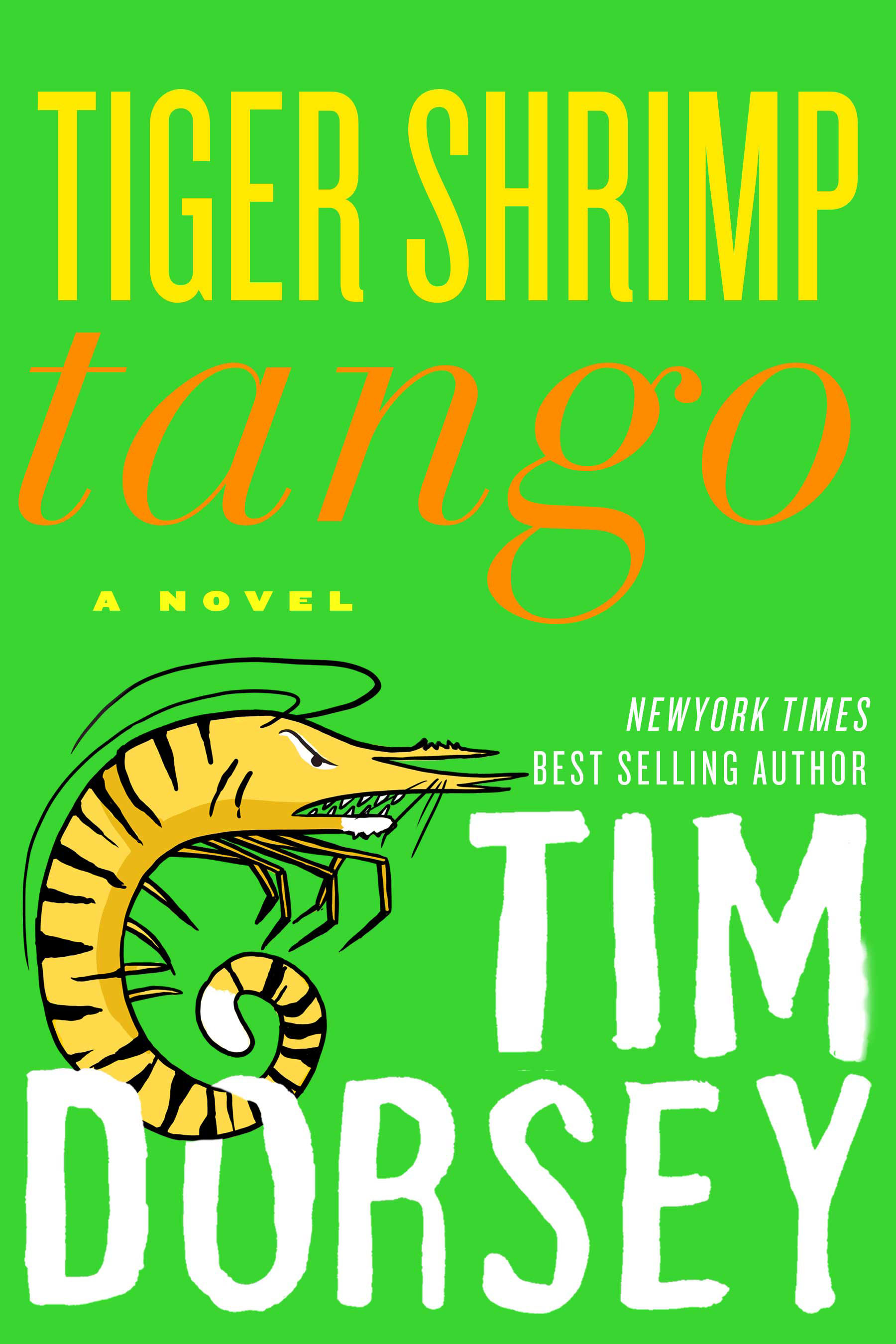
Tim Dorsey has a new book hitting the stands today, the latest misadventure of his homocidal protagonist Serge Storms: "Tiger Shrimp Tango." (Read an excerpt here.)

I first met Tim 12 years ago at BooksAlive, where his reading and storytelling amused me and made my son laugh hysterically. We've been fans ever since.

I got to write a feature article about Tim that same month, and here it is in case you missed it (from The News Herald, February 2002):

STRANGER IN PARADISE:
Tampa author Tim Dorsey loves his wacky home state

... They entered Bay County and came to Panama City, spring break territory. Jethro eyed the motel balconies. "Life has a cruel way of taking the youngest and the brightest." The balconies were enclosed in bars and cages to prevent the brightest from falling on their heads. ... 

- Excerpt from Hammerhead Ranch Motel by Tim Dorsey 

Tim Dorsey considers himself a Florida native, which he maintains is a good thing despite the way he depicts Floridians in his "tropical noir" novels.

"My parents moved to a place close to West Palm Beach when I was 1 year old," Dorsey said. "I was at a reading once and somebody asked if I was a native; I said, 'Well, yes,' and somebody who had read my bio called me on it."

Having spent most of his 40 years in the Sunshine State - he left, briefly, to earn a degree from Auburn University in the state next door - Dorsey understands the pride factor of being a native.

"The way I feel about it, if I can't claim this then I'm a man without a state," he said. "I am very proud of being from Florida, or at least for the years I've lived here."

Born in Indiana, Dorsey grew up in Riviera Beach, a small town about an hour north of Miami. He now lives with his wife and two daughters in Tampa, where he makes his living - and is building a reputation - as a writer of wacky crime novels set in the Sunshine State.

Florida has a reputation across the country as an oddball state, though probably not on a par with California. Dorsey takes that oddity to an extreme in his novels, Florida Road Kill, Hammerhead Ranch Motel, Orange Crush and the upcoming Triggerfish Twist.

"The noir part of it is a proud reveling in it, like tattooing yourself up," Dorsey said. "When my children were born, the craziness in the newspapers started to worry me or make me angry, and we asked ourselves, 'Are we crazy to stay here? Can we raise kids here?' But every time we leave the state, we're so happy to get back - it looks so beautiful."

Popularized in the works of South Florida writers such as Elmore Leonard and Carl Hiassen, the so-called "Florida genre" now has a following worldwide. However, in-state readers generally perceive it to be non-fiction, Dorsey said.

"If you have a feel for Florida, you can't top reality," he said.

One example: When Dorsey turned in his manuscript for Orange Crush - a book about "dirtbags running for political office," he said - his publisher told him no one would be interested in Florida politics.

Then the great election debacle of 2000 erupted, and as one might suspect, Orange Crush's depiction of the backroom deals between Big Sugar, Big Tobacco and Big Government did well.

"I do it as a caricature, but the point is that it represents something much closer to reality than you might see written elsewhere," Dorsey said. "I think we as a society have lost our outrage factor. We sort of accept a lot of that stuff. When I was reporting there, either figuratively or literally my jaw was hanging open the whole time."

Dorsey with my writing group on a recent tour stop in PC.
Dorsey is a former police and court reporter, general assignments reporter, political reporter and copy desk editor for several newspapers. He covered Tallahassee for The Tampa Tribune, where he later served as night metro editor and news coordinator. He left that position in 1999 to write novels full time.

Not bad for a guy with a bachelor's degree in transportation.

"I have no idea what that degree is about," he said. "That was a classic case of me being Tim Dorsey and just screwing up my credits really badly."

Dorsey graduated from Auburn in 1983 after spending time in the engineering, business and journalism programs and working for the student newspaper, The Plainsman.

"All this time, I was working on the paper because I dreamed of writing a book, but I figured I've got to do something responsible for a living," he said. "Writing books, it's just not responsible to chase it - no, seriously."

Dorsey admired the work of novelists who had come out of journalism backgrounds, but when he examined his credits he realized it would take a couple more years to earn a journalism degree. That wouldn't do. The quickest alternative was to take a few more classes and settle for transportation - whatever that was.

"The head of the journalism department said, 'What the hell is Tim Dorsey doing in transportation?' while I was (editor of The Plainsman)," he said. "I probably had the lowest GPA of anybody who didn't go below a 'C.'"

His schizoid college experience reflects Dorsey's take on the divided nature of his home state. Some Floridians think the state has at least two distinct personalities; Dorsey thinks the number is closer to nine.

"Florida could easily be a nation unto itself, or a couple of nations," he said. "If you go to a beach bar in Jacksonville, you'll see pictures on the wall of Vince Dooley and Bear Bryant, and you know this isn't Miami Beach. But don't get me wrong - I love Miami. I love the downtown area where everybody's speaking Spanish. I like variety."

Dorsey even revels in his inadequacies as a translator. On one Miami trip, he felt pretty good about himself when he ordered a meal in Spanish with all the right accentuations in all the right places. The waitress smiled and replied with a fluency that left him flustered and admitting he couldn't understand her.

"But that was great," he said.

In preparation for writing, Dorsey travels the state like a movie location scout. He takes notes and photographs possible sites to use in a plot, then refers to the material later for detail.

His debut effort, Florida Road Kill, started out as more of a travelogue. Dorsey thought he'd revisit some of the strange roadside attractions that had filled the state in the pre-Disney era - places his family visited when he was a child.

"I love Florida cheese," he said. "Weeki Wachee, Cypress Gardens, all those mom-and-pop motels that were out there before all the chains. They were great. But somebody said, 'Make it a mystery. It'll sell better.'"

The result was a story of "dirtbags on a crime spree," Dorsey said. The lead dirtbag was Serge A. Storms, "a loveable serial killer, the character you hate to love."

Visitors to his Web site can see some of his photos of real-life places and events described in the books; read the first chapters of each of the books; view the book covers as they appeared in other countries; and see photos he took at readings and signings.

The site also features a glimpse into a wooden box in which Serge keeps his treasures. Click on the box, and your computer screen will fill with items such as swizzle sticks, buttons, matchbooks and postcards from across the state.

"Serge is, well - he loves to collect mementos of his favorite Florida places, and when he's in a motel room he'll get out his box and spread the stuff out on the mattress," Dorsey said. "It's just to show how insane he is. He's obsessive-compulsive about his passion for Florida."

It's a passion this pseudo-native shares. Dorsey recalls childhood days spent running around Riviera Beach barefoot with a fishing pole, and cracking open coconuts for the milk.

"I remember all that vividly - the palm trees, taking coconuts and thinking I could run away and live off the land," he said.

"It might be that I was imprinted at a young age, but usually you see people either return to or stay in the place they came from. For me, growing up, it was paradise. It was my Huck Finn's Mississippi."

Sunday, January 26, 2014

Inspiration and the Universe Conspire (to help me create a new story)

We were out of town this weekend, spending as much time as possible with my wife's sister, who is undergoing a bone marrow transplant and more chemo in Birmingham. She slept quite a lot, off and on, and I caught up on some Kindle reading, as well as browsing more than I usually do. I started reading a steampunk novel sample (not too good, so I'm not naming it), and decided to check out a sample of a writing guide for people interested in steampunk (also not so good, but whatever, by this time, my brain was engaged).

On the drive home today, we passed a sign pointing to the exit for two nearby towns, Jemison and Thorsby, and I said, "That's a great character name. Jemison Thorsby, a reporter for the Confederate Statesmen paper out of Atlanta in 1870, two years after the Civil War ended in an uneasy truce."

Soon, we passed a sign for two more towns. "Clanton Montgomery," I said. "Former colonel in the Alabama militia. Hero of the Battle of Birmingham. Now a soldier of fortune operating out of the Republic of Texas."

We passed a sign for two more towns. "Coosada Wetumpka," I thought (as by this time my wife was trying to nap). "A Creek Indian. Father was a Red Stick warrior. He works for Montgomery, and is on the train from the free port of New Orleans to Port Arthur when he meets Thorsby."

I began to think about Thorsby more. He's a reporter, dispatched to get the story on Montgomery, who has been making expeditions into the Plains Nations, where the tribes are armed with electrostatic weapons, dirigibles, and steam-powered cannon-carriages to keep the interlopers off their lands. They have a mysterious benefactor that is designing these breakthroughs, and the U.S. government is secretly bankrolling Montgomery's excursions.

On the train, Thorsby sees a beautiful black woman in the company of two white men. She is clearly rich, clearly a free woman, but one of the men is threatening her. The woman glances at Thorsby on several occasions. Later, in the dining car, Thorsby sees the man slap the woman, and he goes to their table to warn the man not to strike a lady. She speaks to him in a lyrical French accent, "I do not require your assistance, little man." I could hear her voice in my imagination.

Only then does he recognize her. But what is her name?

A moment later, I passed a sign for a place called Legrande. That's certainly French-ish. So her name is LeGrande, but that's only a stage name. What's her first name? What's her real name? I pass a sign for a place called Cleo. Her stage name is Cleopatra LeGrande, she's a famous chanteuse, the toast of Paris, but he knew her when they were children. She was a house servant at the same estate where his father was a stable hand. Her name was...

I passed a sign for a place called Ada. He knew her by that name in their childhood, and he would often offer to help Ada with her chores, but she would always say, "I don't need your help, Little Man."

So what happens when they reach Port Arthur? And then onward to Beaumont, and all across to Amarillo? What happens when they cross the border into "Injun Country," as Wetumpka sneeringly calls it, and they face the dirigible fleet of the United Tribes under the command of Touch the Clouds (a character who I had in mind, but not by name until I happened to do a search for "native American leaders" and found this list)?

What otherworldly monstrosity waits in Roswell? What is "the Breach" and why must it be "Repaired"?

(I wondered that when I passed a sign on a country church that declared they were "Repairers of the Breach." (Don't look that up, because it will depress you.))

The sunset was fiery red as we passed through a string of small Alabama towns. Signs and portents in the sky. The iPod began playing a song about a woman traveling back in time, and I knew I had my answers...

...And that is how a story begins to take shape in my head.

Peace.